1. Home
  2. Space
  3. News

Mystery gas shooting out of the center of Milky Way ‘like bullets’

Add as a preferred source on Google

Astronomers have stumbled across a mystery at the heart of the Milky Way: A dense, cold gas shooting out of the region “like bullets.”

Researchers aren’t sure what the source of the gas is or how it’s being propelled so fast. They have previously observed flows of hot gas, but not cold gas which is harder to move due to it being heavier. The flow of cold gas could possibly be due to the supermassive black hole in the area or perhaps due to cosmic winds related to star formation.

Recommended Videos

“This is the first time something like this has been observed in our galaxy,” lead author Dr. Enrico Di Teodoro from Johns Hopkins University said in a statement. “We see these kind of processes happening in other galaxies. But, with external galaxies you get much more massive black holes, star formation activity is higher, it makes it easier for the galaxy to expel material. And these other galaxies are obviously a long way away, we can’t see them in a lot of detail.

“Our own galaxy is almost like a laboratory that we can actually get into and try to understand how things work by looking at them up close.”
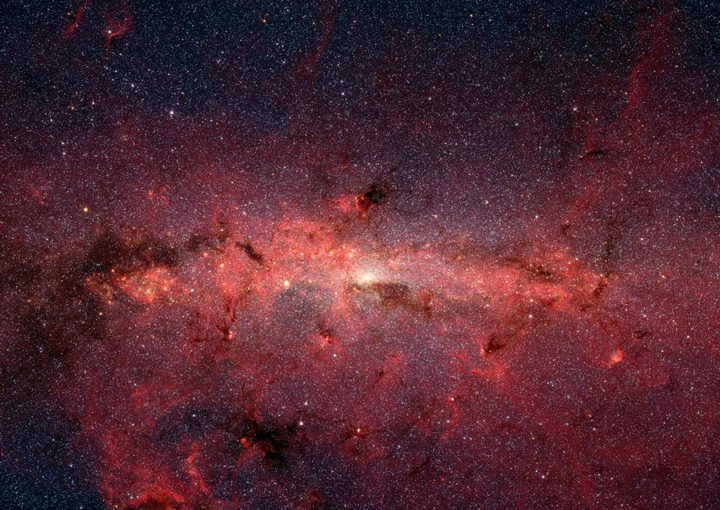
The center of our Milky Way galaxy captured by the Spitzer Space Telescope's infrared cameras.
The center of our Milky Way galaxy captured by the Spitzer Space Telescope’s infrared cameras. NASA, JPL-Caltech, Susan Stolovy (SSC/Caltech) et al.

The center of the Milky Way, shown here in an infrared image captured by NASA’s now-retired Spitzer Space Telescope, is a strange place with features like an enormous and hungry supermassive black hole and unusual stretchy G objects which behave in unexpected ways. The area is known to be where most of the Milky Way’s stars formed when the galaxy was young, between 8 and 13.5 billion years ago.

But since then star formation in this region has dropped off, and the flow of this cold gas could be contributing to that. “Galaxies can be really good at shooting themselves in the foot,” one of the authors, Professor Naomi McClure-Griffiths of the Australian National University, explained in the statement. “When you drive out a lot of mass, you’re losing some of the material that could be used to form stars, and if you lose enough of it, the galaxy can’t form stars at all anymore.

“So, to be able to see hints of the Milky Way losing this star-forming gas is kind of exciting — it makes you wonder what’s going to happen next!”

The findings are published in the journal Nature.

Georgina Torbet
Georgina has been the space writer at Digital Trends space writer for six years, covering human space exploration, planetary…
China’s answer to SpaceX’s reusable rockets literally catches boosters in a net
SpaceX catches boosters on legs. China just used a net.
Ammunition, Missile, Weapon

SpaceX's playbook for recovering a rocket booster generally involves legs, a precisely controlled vertical landing, and either a concrete pad or a drone ship. 

China just managed to pull off something similar, but in a slightly different way, and on July 10, it tested the method as well.

Read more
Dimming the sun sounds unhinged, but this new study on El Niño makes a surprisingly good case for it
A natural test case, Australia's worst-ever wildfire season, suggests the idea deserves serious consideration.
Nature, Outdoors, Sky

When I first saw "scientists propose dimming the sun," I rolled my eyes. It sounds like a science fiction movie cooked up after watching many climate documentaries. But a new study, published on July 8, 2026, in the journal Science Advances, seems to have a genuinely compelling argument.

A Super El Niño is currently forming in the Pacific, feared to be the most intense in decades. It could escalate floods, wildfires, and extreme heat events worldwide. However, Researchers at UC San Diego's Scripps Institution of Oceanography, led by climate scientists Kate Ricke and Jessica Wan, are now proposing one of the most interesting solutions I’ve come across.

Read more
You can now walk through space and gaze into a black hole at this VR exhibit
Smithsonian Starstruck lets you drift past dying stars and see the origin point of the universe for as little as $18 a person.
Smithsonian Starstruck featured

Most planetarium shows ask you to sit still and look up. The Smithsonian's new VR exhibit takes a different approach, letting visitors walk through the vast expanse of the universe, drifting past stars, planets, and a black hole to get a physical sense of its true scale.

A $29 ticket to the edge of the galaxy

Read more