1. Home
  2. Space
  3. News

Teenage ‘lava world’ is the youngest exoplanet of its type discovered so far

Add as a preferred source on Google
TESS Finds Related Stars Have Young Exoplanets

Exoplanets come in many different types and sizes, and to understand how planets form and develop, it’s helpful to see them at a variety of different points throughout their life cycle. NASA’s exoplanet-hunting satellite TESS has recently discovered four “teenage” exoplanets, including one dramatic lava world that orbits ultra-close to its star.

Recommended Videos

TESS investigated two young stars that are close to each other and thought to be related, TOI 2076 and TOI 1807. It found four exoplanets in orbit around them that are in a rarely-spotted middle phase between recent birth and maturity.

“The planets in both systems are in a transitional, or teenage, phase of their life cycle,” said Christina Hedges, an astronomer at the Bay Area Environmental Research Institute in Moffett Field and NASA’s Ames Research Center in Silicon Valley. “They’re not newborns, but they’re also not settled down. Learning more about planets in this teen stage will ultimately help us understand older planets in other systems.”

Three of the exoplanets orbit TOI 2076, each of which is called a mini-Neptune, as they are between Earth and Neptune in size.

But the really dramatic planet is the one seen orbiting TOI 1807. The planet, TOI 1807 b, is so close to its star that a year there lasts just 13 hours. This planet is the youngest version of such a planet, called an ultra-short period planet, yet discovered. If the planet is mostly rock and doesn’t have a thick atmosphere, researchers predict that it could be covered in lakes or even oceans of lava.
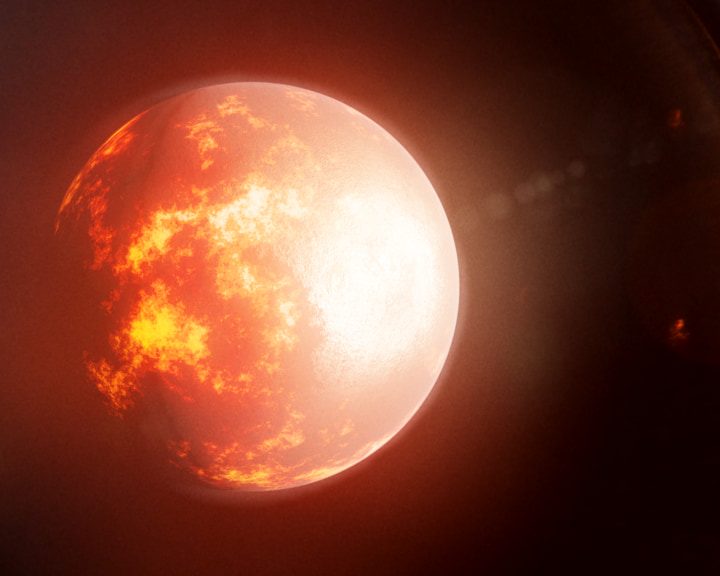
Potential lava world TOI 1807 b.
Short-period planets, or those with orbits shorter than one day, are rare. Potential lava world TOI 1807 b, illustrated here, is the youngest example yet discovered. NASA’s Goddard Space Flight Center/Chris Smith (KBRwyle)

This planet is also bombarded with UV radiation because its star is so young and active. It is estimated that the planet is hit with 22,000 times the amount of UV radiation from its star than Earth gets from the sun. And the other star is similarly active as well.

“The stars produce perhaps 10 times more UV light than they will when they reach the sun’s age,” said co-author George Zhou, an astrophysicist at the University of Southern Queensland in Australia. “Since the sun may have been equally as active at one time, these two systems could provide us with a window into the early conditions of the solar system.”

Georgina Torbet
Georgina has been the space writer at Digital Trends space writer for six years, covering human space exploration, planetary…
China’s answer to SpaceX’s reusable rockets literally catches boosters in a net
SpaceX catches boosters on legs. China just used a net.
Ammunition, Missile, Weapon

SpaceX's playbook for recovering a rocket booster generally involves legs, a precisely controlled vertical landing, and either a concrete pad or a drone ship. 

China just managed to pull off something similar, but in a slightly different way, and on July 10, it tested the method as well.

Read more
Dimming the sun sounds unhinged, but this new study on El Niño makes a surprisingly good case for it
A natural test case, Australia's worst-ever wildfire season, suggests the idea deserves serious consideration.
Nature, Outdoors, Sky

When I first saw "scientists propose dimming the sun," I rolled my eyes. It sounds like a science fiction movie cooked up after watching many climate documentaries. But a new study, published on July 8, 2026, in the journal Science Advances, seems to have a genuinely compelling argument.

A Super El Niño is currently forming in the Pacific, feared to be the most intense in decades. It could escalate floods, wildfires, and extreme heat events worldwide. However, Researchers at UC San Diego's Scripps Institution of Oceanography, led by climate scientists Kate Ricke and Jessica Wan, are now proposing one of the most interesting solutions I’ve come across.

Read more
You can now walk through space and gaze into a black hole at this VR exhibit
Smithsonian Starstruck lets you drift past dying stars and see the origin point of the universe for as little as $18 a person.
Smithsonian Starstruck featured

Most planetarium shows ask you to sit still and look up. The Smithsonian's new VR exhibit takes a different approach, letting visitors walk through the vast expanse of the universe, drifting past stars, planets, and a black hole to get a physical sense of its true scale.

A $29 ticket to the edge of the galaxy

Read more