1. Home
  2. Space
  3. News

Watch Santa drop by the International Space Station

Add as a preferred source on Google

Santa has made an unprecedented stop at the International Space Station at the start of his global gift-giving adventure.

Presumably docking via the space station’s recently delivered Bishop Airlock (it’s quite large and therefore able to accommodate Santa’s paunch), Santa popped into the orbiting outpost to drop off some presents for the current seven-member crew.

Recommended Videos

A video (below) posted on NASA’s official Twitter account on Christmas Eve shows Santa and his reindeer approaching the station 250 miles above Earth.

“NORAD [North American Aerospace Defense Command] satellites have spotted Santa on a true path straight to the ISS and the astronauts who are living and working on board,” the video’s narrator says.

Are you waiting up for a visit from Santa’s sleigh? Our @NASA_Astronauts are doing the same! This year @NORADSanta is making a special stop to the International @Space_Station to deliver presents.

Track where else he's going: https://t.co/TAfztY2fO7 pic.twitter.com/H0RHyTb7fC

— NASA (@NASA) December 24, 2020

After visiting the station, Santa set off to embark on the main task of squeezing down chimneys and eating lots of cookies (oh, and delivering presents, too). You can follow his progress throughout the evening by using a Santa tracker provided by Google or NORAD.

Santa’s visit to the ISS came shortly after Expedition 64 crew members Mike Hopkins, Victor Glover, Shannon Walker, Kate Rubins, and Soichi Noguchi offered a few words on what it’s like to spend the holiday season in space.

Thoughts, Gifts, and a Challenge: An International Space Station Holiday

NASA and its international partners have recently been celebrating 20 years of continuous human habitation aboard the station. Up to now, more than 240 individuals from 18 countries have visited the space-based laboratory, and NASA celebrated its 300th spacewalk involving American astronauts in July. These videos, made by different astronauts over the years, offer fascinating insight into how crew members work, rest, and play aboard the station.

The 357-foot-long space-based laboratory orbits Earth every 90 minutes, traveling along at a speedy 5 miles per second. When it passes overhead, the sun’s reflection on the station’s solar panels makes it highly visible from Earth. Interested in seeing it? Digital Trends has an article telling you how to spot the International Space Station from your backyard, no telescope required!

Trevor Mogg
Contributing Editor
Not so many moons ago, Trevor moved from one tea-loving island nation that drives on the left (Britain) to another (Japan)…
Amazon’s Starlink rival is set to launch satellite internet later this year
After launching nearly 400 satellites, Amazon says its Leo broadband service will go live later this year.
Atlas V launches 29 Amazon Leo satellites from Cape Canaveral, Florida

Amazon's long-awaited answer to SpaceX's Starlink is finally nearing liftoff. According to an exclusive report from Reuters, the company plans to begin offering its Leo satellite internet service later this year, after its latest rocket launch pushed the constellation to 394 satellites in orbit.

The pieces are finally falling into place for Project Kuiper

Read more
NASA is investing $590 million in private contractors to build humanity’s first Moon outpost
NASA is counting on private companies to land its Moon Base dream.
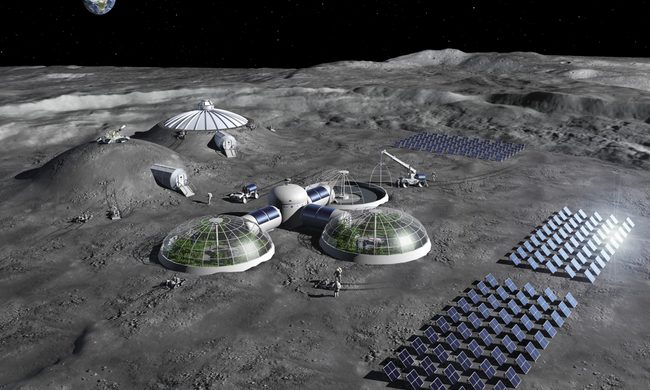
Artist impression of a Moon Base concept, with solar arrays for energy generation, greenhouses for food production, and habitats shielded with regolith.

Building a permanent base on the Moon sounds like science fiction, but NASA is making it feel a lot more real. The agency just handed $590 million in contracts to three private companies for four uncrewed lunar lander missions launching in late 2028.

These missions are part of Phase 1 of NASA's broader $30 billion Moon Base program, which needs to deliver landers, rovers, and scientific cargo up there before astronauts eventually move in. These efforts are closely tied NASA's Artemis program, which sent humans on a lunar flyby in April for the first time since the Apollo era.

Read more
Getting to Mars may require a pit stop in orbit, and NASA just tested the nozzle to make that happen
A gas pump nozzle for spacecraft sounds simple. It is not, and that's what makes this test worth paying attention to.
Architecture, Building, Factory

Getting a spacecraft to Mars or beyond requires an enormous amount of fuel, most of which has to be hauled from Earth, adding to the overall cost and weight of the spacecraft. NASA has been working on a different approach, one that could be more efficient and effective.

It wants to refuel a spacecraft in orbit before heading out for the mission. What’s even more interesting is that the space agency just finished testing a component that could make that possible: a cryocoupler.

Read more