
“Cisco has boosted both the price and size of an already middling camcorder with this bloated attempt at a pocket cinema.”
- Large 3-inch screen for viewing
- Captures sharp 720p video
- Generous 16GB internal memory
- HDMI and headphone outputs
- Intuitive FlipShare software
- Bulkier and heavier than comparable cams
- Touch controls complicate shooting
- Sloppy, unintuitive playback controls
- Too expensive for pocket camcorder
- No included HDMI cable
- No still mode, SD card slot, or electronic image stabilization
- Suffers from motion blur
“Why you can trust Digital Trends – We have a 20-year history of testing, reviewing, and rating products, services and apps to help you make a sound buying decision. Find out more about how we test and score products.“
Introduction
We found plenty of things not to like about the second-generation Flip MinoHD, but its sleek, compact design was not one of them. With the new SlideHD, Flip throws out this most likeable asset, preserves the ho-hum feature set, and backpedals on features like usability. The SlideHD, advertised as a kind of pocket camcorder and TV in one, adopts a slide-out three-inch screen for sharing videos, along with 16GB of internal memory for up to four hours of recording. While clever in theory, the touch screen mucks up formerly idiot-proof controls, fattens the whole device, and at $280, drives price right to the edge of “real camcorder” territory.
Design and Features
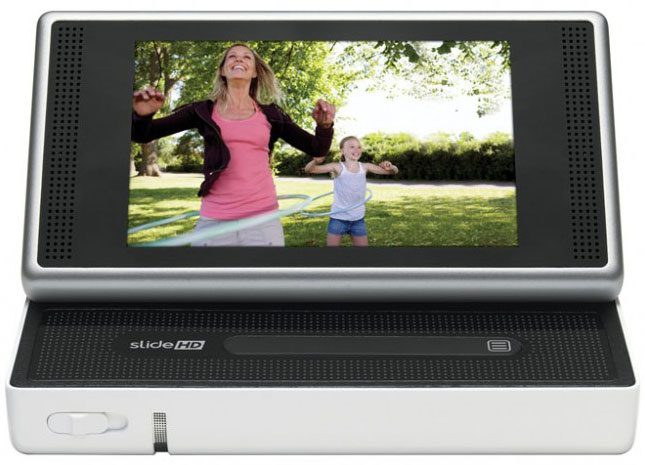
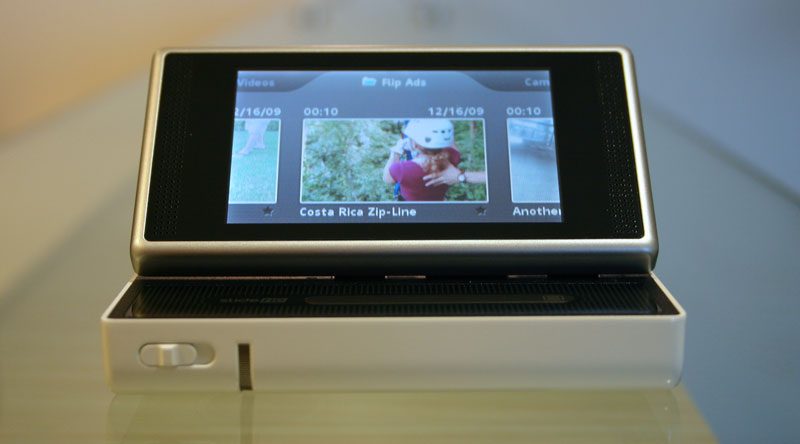
From the front, you might mistake the Flip SlideHD for a version of the chunky, AA-battery-powered Flip UltraHD. With the same 1/4.5-inch, 1.6-megapixel CMOS sensor and fixed-focus optics, the guts have remained stagnant, explaining the nearly identical business end. But flip it around and things have changed. Rather than a 2-inch screen, the SlideHD boasts a large 3-inch model covering the majority of the backside. A sideward shove glides the whole rear panel over an inch, where it pops up to 45 degrees for tabletop viewing and reveals a touch-sensitive control strip below. Voila: A pocket-sized device that’s as much a camcorder as a mini theater.
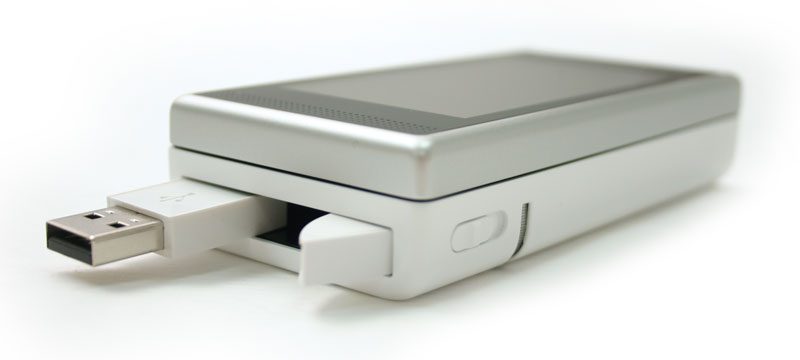
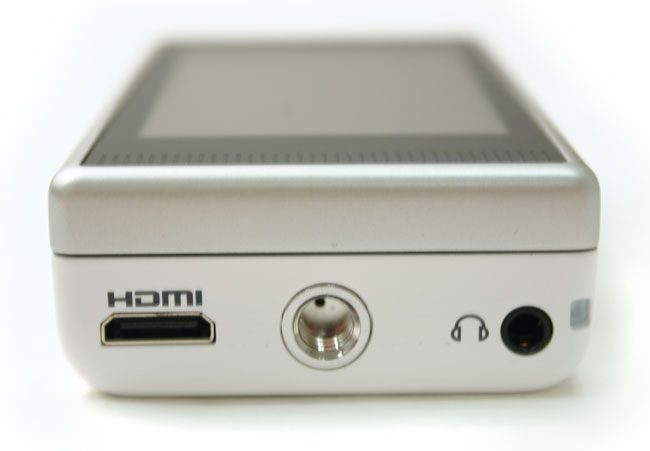 An HDMI port for plugging this guy into a real home theater can be found on the bottom, along with a headphone jack and 1/4-inch tripod mount. The power button is on the right, and the flip-out USB port gets moved to the top, with a release on the left. Unfortunately, this model reverts to the cheaper-feeling plastic arm, rather than the tough metal one found on the MinoHD. However, there’s plenty of metal to go around the rest of the chassis and even the sliding mechanism, leaving the SlideHD to feel quite sturdy in the hand. The front on our model came dressed in a shiny white coating, but like all Flip cams, you can deck it out with number of different designs and even your own uploaded photos when you order it from Flip.
Though not quite as fat as the 1.17-inch thick UltraHD, the SlideHD’s depth of 0.98 inches doesn’t exactly flatter it, especially when the cheaper MinoHD measured a full third thinner. It still qualifies as a pocket camcorder, but you’ll definitely feel the extra bulk smashed into your Levis.
Accessories
Buried in Flip’s undeniably slick packaging, you’ll find a soft microfiber pouch and a wrist strap. That’s really all you really need, considering you can both charge and transfer data through the built-in USB plug, but an HDMI cable for watching videos on the big screen should have been an obvious addition for a camera that makes sharing its primary goal. Other manufacturers, like Kodak and Creative, have made this inexpensive add on a staple.
Testing and Usage
In shooting mode, the Flip SlideHD resembles just about every other pocket cam, with one notable exception: all the controls are displayed on the touch screen. It feels incredibly familiar thanks to what pretty much amounts to a photo of the old controls pasted onto the screen, but we definitely missed having a hard button for the record function. The natural inclination with any camcorder is to plant a thumb on it when you’re ready to shoot, then press harder to actually click it in. With the touch screen, you’ll need to hover over it, then tap when you want to record. Not convenient or natural. The jostle of pressing it can also add a shaky beginning to your videos. The extra screen feels like a bit of a waste when the live view occupies just a tiny sliver of it at the end. You won’t get any better idea what you’re shooting than you would with a MinoHD or UltraHD. In terms of pixels, you’re actually getting less.
 Because Cisco uses the same optical underpinnings as previous Flips, there’s nothing much new to report on the video quality front. Video quality is actually very near the top of its class for 720p, but cams like Kodak’s Zi8 offer both higher quality 1080p footage and smoother 720p footage at 60 frames per second. The Kodak also far outperformed the SlideHD in adjusting exposure on the fly, zapping from bright outdoor scenes to dim indoor scenes in a split second where the SlideHD seemed to be in a daze, stalling for much longer. Like previous Flips, it also has no dedicated button for taking still photos: You’ll need to shoot video then fish out screencaps later with the software.
Finish shooting, open it sideways, and things get interesting. The SlideHD displays all the clips in the camera within folders, but only one really fits on the screen at a time, so you have to navigate through them linearly. With the potential for four hours of video nestled in its 16GB of memory, this navigation gets very old, very fast. The image of leafing through hundreds of vinyl records at a yard sale – one at a time – comes to mind. The physical scroll bar can help you whip through a few at once, but it can also be tricky to land on the one you want, since it seems sluggish to respond after you slow down your gestures or reverse direction. Other commonly used controls, like adjusting volume, couldn’t get less intuitive. You’ll need to start playing a video, hold down on the screen, select the volume icon, then tap it up and down with plus and minus signs.
 With 400 x 240 pixels on tap, there’s plenty of screen here once you get to use the full thing. Videos look solid. But three inches won’t blow anybody’s mind who has seen a modern smartphone, and the glossy screen coating has a tendency to catch reflections when you turn it off axis. If you can avoid this syndrome, color distortion from the sides actually remains quite low, and the 45-degree slant makes it easy to plop on a table or desk and watch comfortably.
Cisco’s FlipShare software still leads the pack in usability, making it a cinch to import, upload and edit videos.
Conclusion
At $280, it’s tough to justify the SlideHD over the much sleeker MinoHD for $230, the more capable Kodak Zi8 for $180 (about $215 after adding 16GB memory), and almost impossible to justify it over any number of HD-capable point-and-shoot cams. The larger screen does make it easier to share videos than with either of those cams, but the clunkier controls and fatter design you get in trade just don’t make sense for most users. Only Flip fans who absolutely need the 16GB storage (and aren’t willing to jump ship to an SD-based cam) along with chronic hey-look-what-I-did video sharers will really find the SlideHD a worthy purchase.
Highs:
- Large 3-inch screen for viewing
- Captures sharp 720p video
- Generous 16GB internal memory
- HDMI and headphone outputs
- Intuitive FlipShare software
Lows:
- Bulkier and heavier than comparable cams
- Touch controls complicate shooting
- Sloppy, unintuitive playback controls
- Too expensive for pocket camcorder
- No included HDMI cable
- No still mode, SD card slot, or electronic image stabilization
- Suffers from motion blur


