Before we get too far ahead of ourselves, the research shows eye-tracking isn’t ready for mainstream use just yet, due to the tests being performed using head-mounted eye-trackers, rather than cameras mounted in the watch itself. That doesn’t make the examples any less exciting though.
The team used the a custom control system called Orbits to navigate through a missed call menu, notifications, and a music app. The name comes from targets that ‘orbit’ a circular watch face, on which you concentrate your gaze to activate a function. By following objects moving smoothly around the display, accuracy is improved, and the eye-tracking calibration process simplified. Unlike systems that require us to stare at a target to interact with it, watching a moving target reduces errors.
Targets made for the Orbits system can vary in size, speed, and direction, providing a range of different control options. They’re speed-sensitive though, as certain speeds produce a higher degree of accuracy. Using size presents an interesting opportunity for addressing notification importance. The team introduced larger spinning icons for apps that needed more attention, giving more information to the wearer simply by glancing at the watch, without even opening an app.
Learning curve
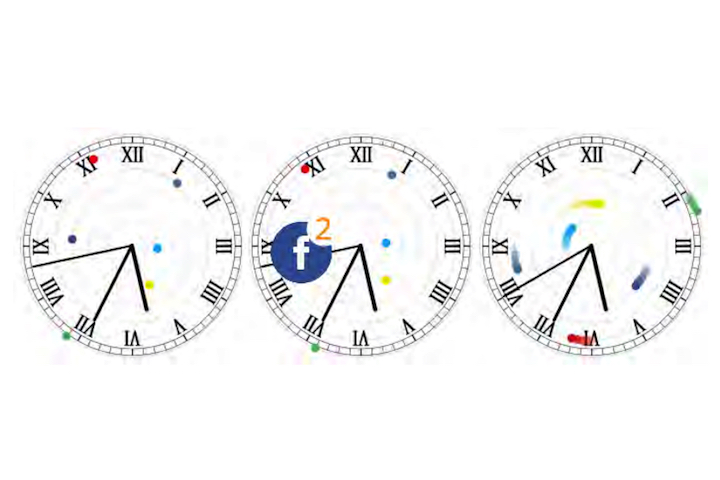
In the paper describing the research, those who tested it were initially overwhelmed by spinning objects on the display, and didn’t fully understand how to use it. After some instruction, things were clearer. The smartwatch is still a very new piece of technology, and adding an entirely new and unfamiliar interface to it inevitably caused confusion. To help recreate use in the real world, the music player app — which featured five different orbiting controls to master for play/pause, volume, and track skipping — was tested while using a stationary bike. The team reports the tests had an average accuracy rating of 83-percent, and a false positive return of 2.1-percent.
Eye-tracking on a smartwatch makes sense for hands-free use, and for accessibility cases where it’s not possible to fingers or hands to control the device; but it may not be fast enough in everyday situations to be the sole method of interaction. We can see how it could speed things along as a secondary system.
Sadly though, we’ll have to wait to try it all out for ourselves. The university’s tests were all performed using remote or head-mounted eye-trackers and for Orbits, or a similar system, to be a success an eye-tracking camera will need to be built into a smartwatch. The good thing is, research like this may mean that happens sooner than expected.
Editors' Recommendations
- How one company is giving your Wear OS smartwatch superpowers
- The Apple Watch Ultra and Galaxy Watch 5 Pro may change our smartwatch future
- How to track your coronavirus stimulus check using the IRS web app
- Oppo sees a smartwatch, a chip, and an under-screen camera as part of its future
- Smartglasses use eye-tracking to make sure whatever you look at is in focus