  1. Home
  2. Computing
  3. News

Acer Swift 7 dazzles with near-borderless touch display, weighs under two pounds

Add as a preferred source on Google
Acer Swift 7
Image used with permission by copyright holder

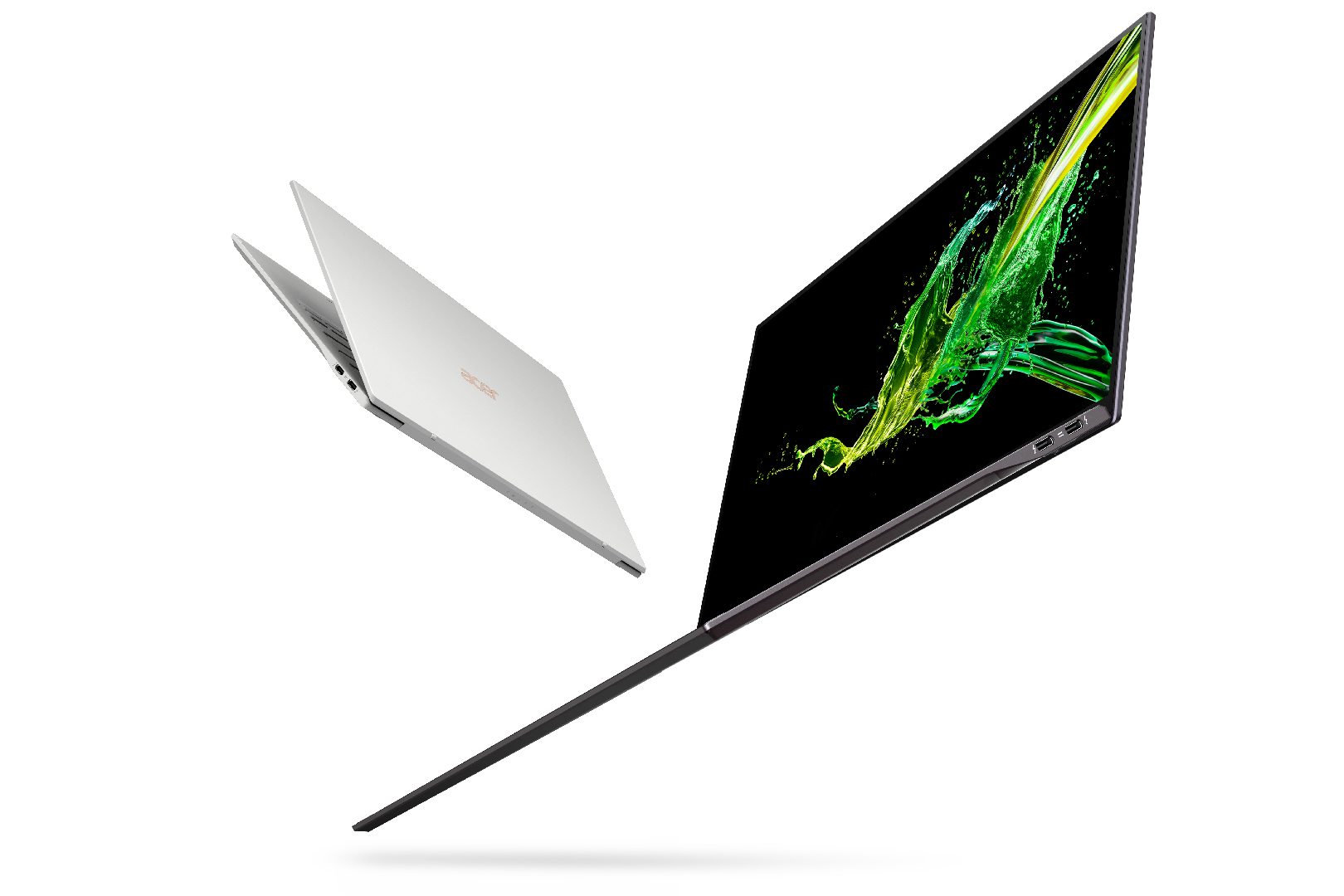
If screen bezels are your enemy, the Acer Swift 7 is your new best friend, featuring a high-resolution touchscreen with an impressive 92-percent screen-to-body ratio. Improving upon the previous generation Acer Swift 7, the latest iteration continues to offer Intel Core i7 processors and a 14-inch display in an incredibly thin and portable package. This year, Acer has doubled-down on the machine’s styling, while also paying attention to issues we had with the first generation.

The Acer Swift 7’s display is the main attraction — a vibrant 1920 x 1080 touchscreen with IPS technology and Corning Gorilla Glass 6. The screen itself features a 100% sRGB/72% NTSC color gamut and a brightness of 300 nits. The screen border has been reduced dramatically, producing a machine with an impressive 92-percent screen-to-body ratio — that’s an astoundingly small 8 percent bezel. The Swift 7 is a beautiful machine overall, but the display sealed the deal for becoming a CES 2019 Innovation Award honoree.

The previous generation came in at an incredibly thin 8.98mm, and while the new generation clocks in a bit thicker at 9.95mm, it remains one of the thinnest notebooks on the market. Thinness isn’t everything though, as Acer reduced the width and depth of the machine to an impressive 12.51 x 7.53 inches. You won’t need to worry about this machine being too thin for a decent trackpad, as on the previous unit, as Acer has addressed its previous non-clickable trackpad with a new Gorilla Glass trackpad that features an integrated click button with a responsive physical click.

Recommended Videos

A thin notebook wouldn’t mean much if it was dense and heavy to carry, which is why the Swift 7 features a frame composed of both magnesium-lithium and magnesium-alloys. Acer notes that the materials are “two to four times stronger than standard aluminum alloys at the same thickness, yet are up to 20 to 35 percent lighter.” The result is a laptop that weighs in at under two pounds.

Under the hood of the Acer 7 are Intel’s Core i7-8500Y series processors, up to 512GB of PCIe SSD storage, and up to 16GB of LPDDR3 RAM. Users who need to stay connected can utilize the machine’s two USB Type-C ports with Thunderbolt 3, Bluetooth 5.0, or the integrated Intel Wireless-AC card, featuring Wi-Fi 5 capable speeds.

The Acer Swift 7 will be available in North America in May, starting at $1,699 for the base model. Internationally, the Swift 7 will touchdown in EMEA and China in April. Users particular about their machine’s color scheme can pick up a Swift 7 in either starfield black or moonstone white.

Michael Archambault
Former Digital Trends Contributor
Michael Archambault is a technology writer and digital marketer located in Long Island, New York. For the past decade…
What happens when AI detectors fail? Researchers say we must be trained to spot fake AI faces
Researchers say spotting AI faces may soon depend more on people than software
Zuckerberg Deepfake

Artificial intelligence has become remarkably good at creating fake human faces. So good, in fact, that the old tricks people relied on - counting fingers, spotting warped earrings, or looking for distorted backgrounds - are quickly becoming obsolete. According to a new study highlighted by the BBC, the next line of defence may not be a better AI detector at all. It might simply be a better-trained human.

Researchers from the University of Aberdeen, working alongside Australia's National University, found that people can dramatically improve their ability to distinguish AI-generated faces from real ones after a relatively short period of structured training. Instead of hunting for obvious visual glitches, participants were taught to recognise subtle patterns that modern image generators still struggle to replicate consistently.

Read more
Google’s new Magic Pointer Play Store listing reveals a Gemini shortcut built for Googlebooks
The unannounced app turns the cursor into a contextual AI tool for search, image creation, and shopping
Plant, Text, Business Card

Google has quietly published a new Play Store listing for Magic Pointer, an unannounced app built for Googlebooks. Updated on July 10, the app turns the cursor into a Gemini shortcut that can act on whatever a user selects on screen.

Magic Pointer can send an image to Lens, generate a related image, or surface a shopping action without forcing users to open a separate chatbot. Regular Android devices currently show as incompatible, so the listing offers an early preview rather than a broad release.

Read more
You can stop using AI, but this new report says you probably can’t escape it
A UK survey found that most people feel AI exposure is unavoidable, raising harder questions about consent, privacy, and whether opting out is still realistic
AI Chatbots

More people are trying to use less AI, but avoiding it altogether may already be impossible.

A survey of 2,055 UK adults found that 42% deliberately limit how much AI they use. Another 70% said avoiding AI exposure would be difficult or impossible, even when they actively wanted less of it.

Read more