  1. Home
  2. Computing
  3. Legacy Archives

Google Chrome browser nears 10 percent share

Google is making some ground in the browser market. In Nov. 2010, the browser hit a 9.27 percent market share, up almost a full percentage point from October, according to a report from Net Applications. The gain came at the cost of Microsoft’s Internet Explorer, which dropped by nearly a full point to 58.41 percent. Mozilla Firefox suffered a drop, but it was insignificant drop of .02 percent to land at 22.81 percent and Apple’s Safari browser rose a fifth of a point to 5.57 percent.
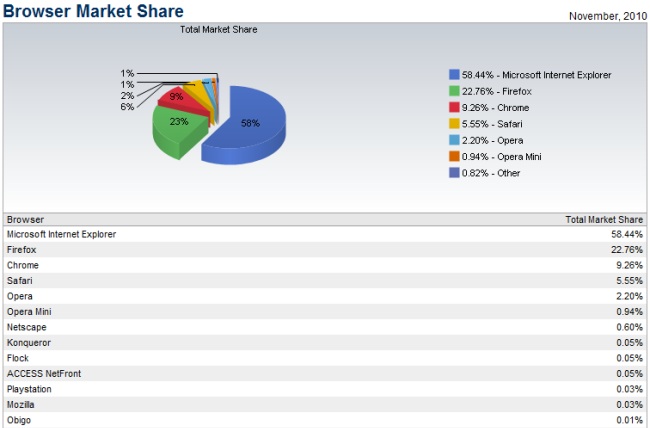
browser-market-share-november-2010
Image used with permission by copyright holder

Chrome’s impressive month appears to have been caused by strong adoption of Chrome 7.0, the newest version of the browser. In a single month, 7.0 alone gained a 5.64 percent market share, the second largest monthly gain of any browser share since Net Applications began tracking. At this pace, 7.0 should almost completely replace 6.0 in two months time. Google’s new browser versions appear to have a quick adoption rate. Chrome 6.0 showed a similar two month replacement of 5.0.

Recommended Videos

Another reason for the gain could be attributed to the launch of Google TV, which uses a version of the Chrome browser. However, the actual numbers don’t reflect that. Google TV runs Chrome 5.0, the share of which actually fell from .26 percent to .20 percent in November, which was the first full month Google TV devices were on the market. This data doesn’t bode well for sales of the Logitech Revue and Google-powered Sony TVs.

Eweek points out that in November Google began running print ads in publications like the LA Times, which may have increased awareness of the browser.

Are you a Chrome user? It appears to be the browser of choice for the tech savvy and the only one that’s showing much growth.

Jeffrey Van Camp
As DT's Deputy Editor, Jeff helps oversee editorial operations at Digital Trends. Previously, he ran the site's…
AMD to play safe at CES 2026, but it may still deserve your attention
AMD’s CES 2026 keynote is shaping up to be far more about AI strategy than shiny new consumer chips.
AMD CEO Dr. Lisa Su holding up a chip at Computex 2024.

For years, the Consumer Electronics Show (CES) has evolved from a consumer-electronics showcase to a global premier launchpad for chipmakers, turning the event into a key battleground for leadership in computing and AI hardware. The upcoming 2026 edition is expected to be no less. 

AMD has confirmed that President and CEO, Dr. Lisa Su will deliver the opening keynote on January 5, outlining the company’s AI vision across cloud, enterprise, edge, and consumer devices. While we aren’t expecting any major announcements like a new GPU generation or a surprise Zen 6 tease (though we can still dream), expect some important launches. 

Read more
ChatGPT gets major update (GPT-5.2) as OpenAI battles Google in AI arms race
OpenAI's GPT-5.2 upgrade boosts real-world productivity just as Google escalates the competition with its latest Deep Research model.
featured image OpenAI GPT-5.2

OpenAI has officially launched GPT-5.2, the latest iteration of its flagship AI model series and its answer to Google's Gemini 3. The new model is meant to be faster, smarter, and more helpful for the complex, real-world queries with improvements in reasoning and long-document processing.

It is rolling out to ChatGPT's paid subscribers as part of the Plus, Pro, Team, and Enterprise tiers, and developers via API. OpenAI provides GPT-5.2 in three models: GPT-5.2 Instant, GPT-5.2 Thinking, and GPT-5.2 Pro (is it just me, or does the naming sound similar to that of the Gemini models?).

Read more
Gemini Nano Banana now turns your selfie into a full-body avatar for online try-ons
Google's upgraded AI try-on tool uses a single selfie to generate a realistic full-body avatar, making virtual clothes shopping faster, more personal, and far more accurate.
Google Shopping gets a Gemini Nano upgrade.

Google is updating its AI-powered visual try-on tool, and the best part is that you no longer need a full-body photo to use it. Thanks to the company's Nano Banana model (part of the Gemini 2.5 Flash Image suite), the tool can now turn a single selfie into a full-body digital avatar for trying on clothes, and it works across Google Search and Shopping.

All you need to do is upload a selfie and pick your usual size; Nano Banana will generate a handful of avatars. Using your face, the AI model generates the rest of your body while maintaining consistent proportions. Choose the one you think suits you best, and use the avatar to try on shirts, jackets, dresses, and more.

Read more