
One of the undeniable themes at this year’s CES was 3D technology. It was everywhere. Despite the relatively lukewarm reception that 3D is receiving from the public, the big guys in the electronics field simply refuse to let it go. Coming this year, consumers will see 3D laptops, 3D cameras, 3D video games, 3D camcorders, and of course a massive selection of 3D televisions. Like it or not, 3D visual technology is the wave of the future. But despite how hard the manufacturers keep pushing, in their hearts, they have to know that 3D tech will only ever be fully embraced once the glasses required to see 3D images are made obsolete. And most consumers know that it is coming sooner or later.
While the new wave of 3D TVs coming out this year are impressive to behold, they are a temporary step on the road to the 3D that we all really want. After all, who wants to have entertainment that comes with restrictions, requires expensive accessories that limit the number of people able to see the entertainment, and even makes the picture darker? Not to mention the potential problems with things like crosstalk, flickering and ghost images.
We all know a solution is on the way, and the real question is who will get there first. The answer might be found out of a small Hungarian startup company known as iPont.
While the big names like Toshiba, Sony and Samsung all cranked up their displays at CES with giant and fantastic booths designed to impress and amaze, down in the bowels of the convention center, hidden among rows of crowded displays that resembled a bazaar more than a tech expo, the easiest way to find the iPont booth was to listen for the gasps as people experienced 3D the way it should be—in high definition without glasses.
“Autostereoscopic” is a word that may only ring bells in the heads of tech geeks, but in the next few years it will eventually become a selling point for 3D TVs everywhere. Current 3D TVs use stereoscopic displays, which are pictures that essentially come out of the TV looking like a double image. When you wear the 3D glasses, the double images are then combined into a 3D display. Using an active set of glasses, also known as shutter glasses, the images are processed by the lenses flickering in and out in rapid succession. Besides the obvious limitations of this style—including the weight and cost of the glasses, the number of batteries the power hungry glasses will force you to buy, plus the comfort factor and potential headaches caused by the flickering effect—the angles you can view the 3D display in are limited. With active glasses, you cannot turn your head 90 degrees to the side, or the image goes dark. That makes it impossible to lay on your side to watch 3D TV. An odd limitation for home entertainment.
The up and coming batch of 3D displays use polarized lenses known as passive 3D glasses, which weigh no more than average glasses, and some even come as clip on lenses that go on users’ current frames. The glasses use specially polarized lenses that filter the light coming in to each eye, and create the 3D image. The 90 degree turn is not an issue with passive, but there is still a limited field of vision for this type of 3D, and regardless, there are issues associated with wearing any accessories to watch 3D, including the small things like the added darkness of watching an image through tinted lenses.
Autostereospic displays a 3D image through the use of a special type of screen. The effect is similar to 3D cards, or 3D displays on magazines, that seem to come out as you move them. The actual technology behind it is much more complex, and the display is far clearer, but both are autostereoscopic.
One of the biggest problems with autostereoscopic displays has been the quality, which many have judged to be unsuitable for the high definition 3D movies coming out recently. Part of the reason the current generation requires glasses is to process the higher resolution images being displayed. Even on most of the autostereoscopic prototypes displayed by the major brands at CES, there was always a loss of quality. The image typically looked fine (although not great), but the 3D itself was much weaker than with glasses, and the depth just wasn’t as impressive. And then there was the cost associated with making a specially created display for each set rather than just a set capable of displaying a particular type of image. In short, autostereoscopic 3D TVs may indeed be the inevitable trend for 3D in the home, but it is expensive, and the technology seemed to be several years away from matching the quality available tody. That may have just changed thanks to iPont.
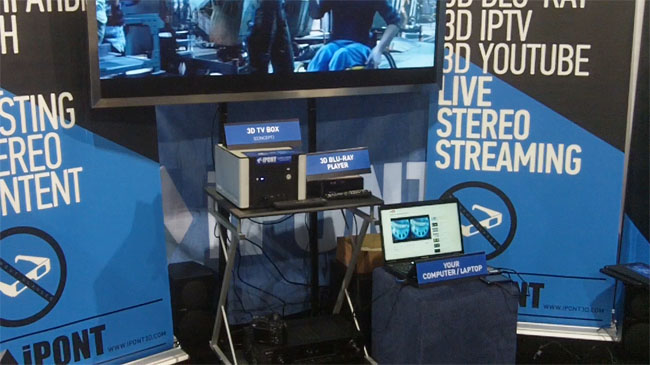
Using a Tridelity 65-inch LCD autostereoscopic set (a prototype), iPont showed off their newest technology, simply called the iPont 3D TV Box. When a standard 3D image was sent through the box to then be displayed, it then was projected with the same depth that you see by using 3D glasses on most 3D sets. There were limits in viewing angles, but they were no worse than the current batch of 3D sets, and actually better than many others. The picture also managed to keep the same HD quality it was broadcast in, and the lack of glasses made the 3D image shine brightly.
As part of the display, both standard blu-ray 3D movies and YouTube 3D clips were displayed, and both looked amazing. Both displayed the HD quality we have come to expect, and the 3D depth that has thus far only been seen through 3D glasses.
The 3D TV Box is still a prototype, but iPont is currently seeking partners. Much of the technical side of the device is still being kept under wraps by iPont, and the device itself is proprietary, but iPont has claimed that the technology uses standard equipment and it is nothing that cannot be easily reproduced. The technology might still be years from production, and the costs will need to drop over the coming years, but the iPont 3D Box shows that glassless 3D TV in the home not only can be done, but it can be done well.


