“Why you can trust Digital Trends – We have a 20-year history of testing, reviewing, and rating products, services and apps to help you make a sound buying decision. Find out more about how we test and score products.“
As virtual reality comes of age in 2016, it promises the most immersive media experiences that have ever been possible. While the core experience of strapping on a headset remains largely consistent between platforms, the question of how one interacts with these virtual worlds remains up in the air.
Both the HTC Vive and Oculus Rift will have dual motion controls that look like more sophisticated evolutions of the Wiimote, allowing for a more direct analog between physical and virtual. The Holy Grail for VR input, however — where imagination goes first — is a pair of gloves that lets users interact with VR as they would real life, greatly increasing immersion.
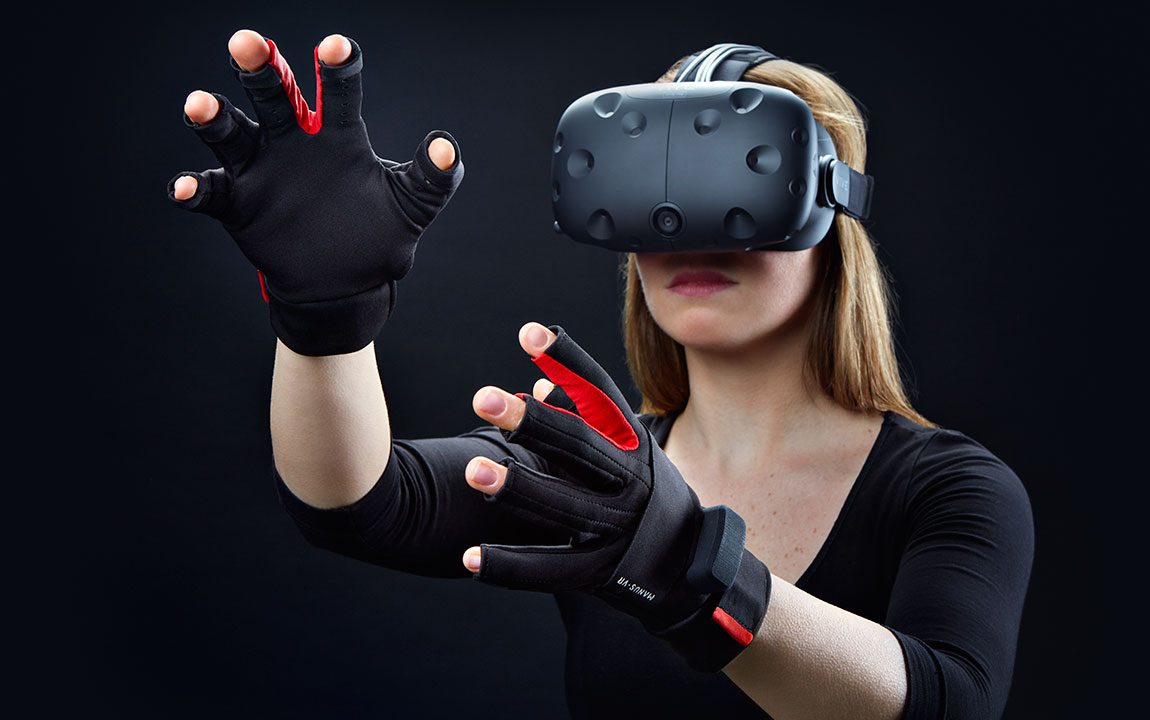
The Manus VR gloves is one of several attempts (the others being Gloveone and the Virutix Hands Omni) to bring tactile feedback to virtual worlds. The company was at GDC this past week, and we had the chance to try out the latest dev kit alongside an HTC Vive.
Touch the future
The current system exists in two parts, but future iterations will combine them into a single unit. The gloves themselves have a cable running inside, along the tops of the fingers, to detect bending. They are made of a light, breathable material to ensure comfort during long sessions, and are washable. On top of that, HTC Vive controllers are strapped to the user’s forearms to track hand position and orientation. The gloves and controllers work in concert to create a real-time, virtual approximation of your hands.
Reach out, turn up your palms, point, wiggle your fingers–the initial moments using Manus fulfill basic expectations.
Reach out, turn up your palms, point, wiggle your fingers–the initial moments using Manus fulfill your basic expectations of what VR gloves should feel like. The developers were showing them off with an in-house-created demo called Pillow’s Willow in which you aid a little girl’s journey past various dangers by manually manipulating her environment.
In the beginning, you light her path by catching fireflies in one hand, and use your other to open up street lanterns in which you place them. Get close to the fireflies and you feel a slight buzz in your hand. At the moment this haptic feedback is all that’s possible, but the developers promise more nuanced ways to integrate touch in the future. Moving forward, you must lower a bridge, grab and assemble pieces of a stairwell for her to ascend, press down obstacles in her way, and then imitate a simple melody on a piano to open a portal.
The game was brief, but charming. Facilitating the journey of a helpless character through a dangerous world from a godlike perspective is somewhat reminiscent of the classic Lemmings games (which, as a side note, seem overdue for some sort of revival).
Just out of reach
After the initial interest of being able to wiggle your virtual digits, though, does Manus bring anything new and essential to the VR experience? The jury is still out. Current VR titles such as Job Simulator and I Expect You to Die use the existing motion controllers as hands, with triggers to grip things. With the exception of piano, which required a single finger to hit the keys, this would have worked equally well for every interaction in Pillow’s Willow.
The gloves won’t be game-changing until the technology reaches a greater degree of accuracy.
The resolution of translating your actions onto the virtual hands was a bit off at times, breaking immersion. Until the technology reaches a sufficient degree of accuracy to feel seamless, it’s not clear that gloves will add anything game-changing to supplant existing motion controllers.
Development kits, with the hardware and an open source SDK, will become available for pre-order in Q2 2016 for $250 plus shipping. Reservations can be made now on the company’s website, though they are not yet accepting payment.
VR gloves are inevitable. We are tactile creatures, as well as visual, and so true immersion in these virtual worlds will not be possible until we can reach out and touch them. But as the first iteration of the technology for public consumption, Manus VR is a little rough around the edges at this stage. The company will need to refine the concept if it hopes to attract widespread attention from VR’s early adopters.
Highs
- Breathable, washable material
- Promises tactile immersion in virtual worlds
Lows
- Better in theory than in practice
- Analog-to-virtual correspondence a little rough