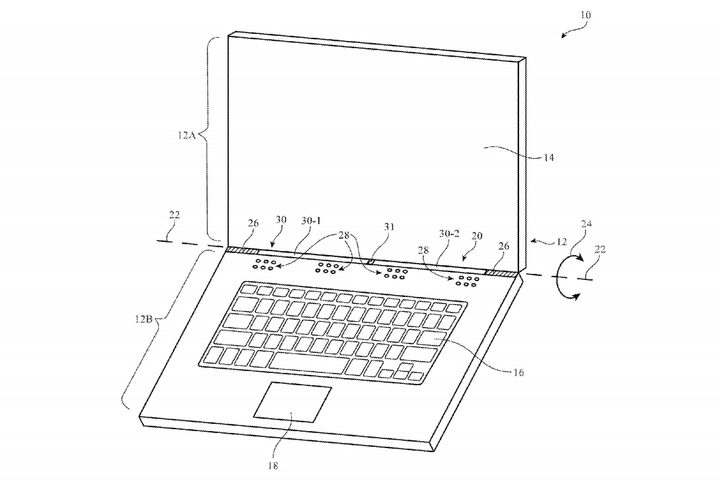
On Tuesday, Apple was granted another patent that covers adding cellular connectivity to its MacBooks. The patent was originally filed on June 8, 2015, and describes how “Isolated Cavity Antennas” are installed within the slot-shaped opening residing between the device base and its lid.
“A slot-shaped opening may separate the upper and lower housing,” states the abstract. “A flexible printed circuit with ground traces may bisect the slot-shaped opening to form first and second slots. Cavity antennas may be aligned with the slots.”
According to the patent, the first slot, second slot, and third slot run parallel to the rotational axis. The installed “cavity” antenna transmits and receives signals through the first slot when the MacBook is in the closed position. When the lid is opened, the antenna transmits and receives signals through the second and third slots.
There are actually two antennas installed in two cavities residing between the hinges, which deal with 2.4GHz and 5GHz wireless networking. A third cavity is described for long-range communications such as cellular telephone bands. The patent even covers other connectivity options like near-field communications (NFC), 60GHz communications, light-based wireless connectivity, satellite navigation, and more.
Apple began thinking to install cellular connectivity into its MacBooks in 2007. In fact, the MacBook Pro almost received 3G connectivity support, but former Apple CEO Steve Jobs said in 2008 that the company decided it would consume too much room on the device, and would lock customers to a specific carrier. Instead, owners could use a USB-based modem and use the carrier they wanted.
One possible solution Apple might use for the MacBook is Apple SIM, which is supported by AT&T, Sprint, and T-Mobile here in the United States. It already comes pre-installed in a number of Wi-Fi/Cellular iPad models, and the 9.7-inch iPad Pro. According to Apple, this wireless tech can keep customers connected “in more than 100 countries and territories around the world.”
This isn’t the first patent Apple received the green light for in regards to MacBook cellular connectivity. One granted on May 24, 2016, is called “Electronic device with dual clutch barrel cavity antennas,” and states that cavity antennas could be formed in a clutch barrel region located between the hinges. At first glance, it seems almost identical to Tuesday’s granted patent, meaning Apple is seemingly covering all of its bases regarding the design for adding 4G LTE connectivity to its MacBooks.
Unfortunately, that doesn’t mean the feature is coming soon. Large companies like Apple tend to patent everything they think they’ll use, so a competitor doesn’t beat them to it, or claim they had the idea first. LTE would be a great feature for Mac — but it’s anyone guess if it’ll actually arrive.