1. Home
  2. Emerging Tech
  3. Virtual Reality
  4. News

A clever brain hack lets you walk in VR forever, without hitting a wall

Add as a preferred source on Google

As the worlds we explore using VR get larger, one potentially limiting factor is the question of how to best simulate wide open spaces in virtual reality if the real world locations users are present in don’t provide adequate room. After all, it’s a relaxing thought to consider that we might put on our HTC Vive headset after work and take a stroll down a long stretch of deserted beach — but a bit impractical if we happen to live in a small apartment.

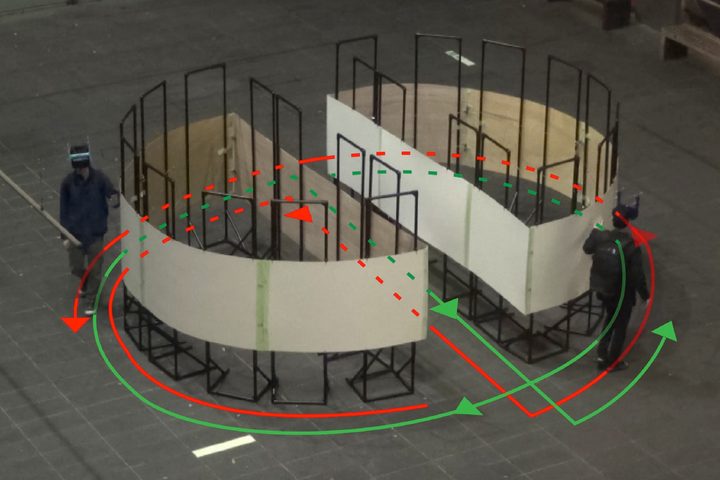
A group of researchers think they may be on to a solution, however, and they showed it off at last week’s SIGGRAPH conference. Developed by researchers at the Tokyo and Unity Technologies Japan, the project calls for a new type of “Visuo-Haptic” VR experience, which reportedly creates the illusion of an infinite virtual corridor in a “play space” measuring just 16 feet by 22 feet.

Recommended Videos

Called “redirected walking,” the technology basically tricks the subject’s brain into thinking that he or she is walking in a straight line when, in fact, the subject is walking on a slight curve. Extrapolate that slight curve into a full circle and it essentially creates a limitless play space in which someone could walk forever without hitting a wall — or realizing they’re walking in circles.

“This work uses the ‘Visuo-haptic redirected walking’ [concept], which is a novel efficient redirected working technique by utilizing haptic cues for strongly modifying our spatial perception,” Takuji Narumi, one of the researchers on the project, tells Digital Trends. “Since the combination of visual and haptic sensations strongly alters our spatial perception in agreement with visual representation, the system effectively reduces the required space for infinite walking.”
Screen Shot 2016-08-01 at 21.10.47
Image used with permission by copyright holder

Narumi says that the researchers are already speaking with several companies about the technology, and that he could see it working well in a “theme park or amusement attraction” setting. While the technology currently requires users to touch a wall to guide themselves and enhance the effect, he also hopes that long term this can be done away with.

“We can demonstrate haptic cues enhances the effect of the redirected walking technique,” he says. “[But] for actual usage, using the static wall is a limitation of our method. We would like to investigate the effect of ‘active’ haptic cues provided by some kind of haptic interfaces. By doing so, we may eliminate walls from the proposed method by presenting haptic sensations with haptic interfaces, and extend applicability of our method.”


Luke Dormehl
I'm a UK-based tech writer covering Cool Tech at Digital Trends. I've also written for Fast Company, Wired, the Guardian…
Yet another study says AI is bad for elections, and the rabbit hole gets worse
AI may be an election bomb waiting for someone to light the fuse
Voters cast their ballots on Election Day

Another election, another study has concluded that asking an AI chatbot for political guidance is a spectacularly bad idea. Research conducted during Hungary’s 2026 parliamentary election found that ChatGPT and Google Gemini offered not just inaccurate but also inconsistent and unreliable voting advice. The chatbots misclassified voter profiles, overlooked relevant parties, recommended parties absent from the ballot, and sometimes produced materially different answers when given the same information repeatedly.

AI keeps failing the voter test

Read more
Samsung’s humanoid robot ambitions are real, but factories come first
Samsung’s new robotics division has humanoids in its sights, although its immediate business is far more practical factory automation
Robot Touch Human Finger

Samsung wants a place in the humanoid race, but its new robotics push begins with machines built for factories rather than homes.

The CEO-led RX robotics division will initially focus on manufacturing robots. Samsung has separately identified humanoids as a priority, although it hasn’t announced a commercial model or explained where one fits into the division’s immediate plans.

Read more
The future of AI may depend on this one behind-the-scenes change
Running Claude on Android.

Whenever a new AI model arrives, it's easy to get caught up in the bells and whistles. We talk about how much smarter it is, how quickly it answers questions, or how realistic its images have become. But here's the thing: none of that matters much if the AI can't reliably work with the apps and services people use every day.

That's why an upcoming update to the Model Context Protocol (MCP) caught my attention. It isn't a new chatbot or a fancy AI model. In fact, most people will never even know it's happening. But it could quietly make the AI ecosystem a lot healthier. If you've never heard of MCP before, don't worry. Think of it as a shared language that lets AI assistants safely talk to apps like Gmail, Slack, calendars, databases, and countless other services. Instead of every company inventing its own way to make those connections, MCP gives everyone a common rulebook.

Read more