
Metamaterials can appear to defy the laws of nature. By bending lightwaves, they may form the fabric of invisibility cloaks. By manipulating sound waves, they may support completely sound-proof rooms. These tiny, artificial structures have a sum greater than their parts, giving them smart properties based on their shape, size, and arrangement, rather than the materials they’re made from.
A team of researchers from the Hasso Plattner Institute in Potsdam, Germany has taken the concept of metamaterials in another direction, developing what they call “metamaterial mechanisms,” objects with seemingly simple internal microstructures that enable some rather complex functions given that they consist of a single piece of 3D-printed material.
“The goal of this work was to explore how we can create materials that are machines at the same time.”
To develop their mechanisms, the designers and engineers began by examining an everyday object: rotary door knobs. They used firm cells to act as the handle and anchor blocks, and used “shear” cells to enable movement of the parts. They quickly realized that, if they could implement rotation, they could connect the handle to a hinge and have a fully-functional door latch.
“The goal of this work was to explore how we can create materials that are machines at the same time,” lead researcher and PhD student, Alexandra Ion, told Digital Trends. “Usually, materials are designed for some deformation behavior, but not to transform forces to implement mechanical functions. Our approach allows us to achieve a deeper integration between the structural and the mechanical functions of materials.”
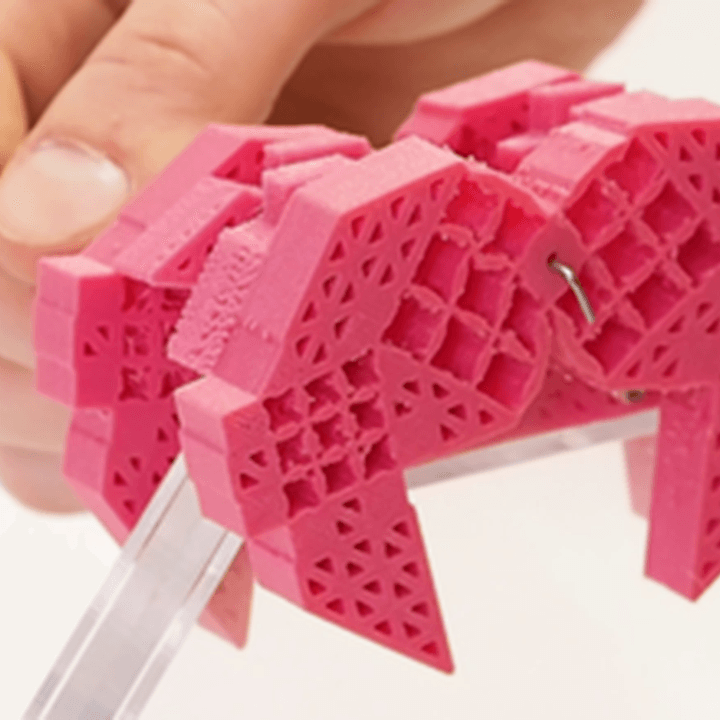
After developing their working door latch, Ion and her team began creating other mechanical machines, such as a Jensen walker, pantograph, and pliers.
“These types of machines are very simple to fabricate, compared to the conventional manufacturing process of, for example, a door-latch mechanism, which consists of many parts and requires assembly,” Ion said. “[With this method] we envision that doors can be 3D printed with the door latch mechanism already in place, in one single fabrication step.”
In order to test their machines, the researchers created an editor that lets them experiment and verify designs before sending the objects to the printer. The team is now planning to release the source code of their 3D editor for others to experiment with. However, there might be a learning curve for amateur engineers who just want to toy around.
“While the tool we implemented so far is an expert tool, we plan to implement our learnings about the mechanics of metamaterial mechanisms from this project into software to help novice users to create and 3D print mechanisms,” Ion said.


