  1. Home
  2. Emerging Tech
  3. News

Solar-powered liquid battery hybrid prototype could be major breakthrough

Add as a preferred source on Google

Everyone loves the idea of solar energy, but the reality is that it’s not always efficient enough for our needs.

At present, solar cells have not been developed at a scale relative to our total energy requirements. Although engineers are building ever cheaper and more efficient solar panels for lapping up the sun’s rays, one major bottleneck is the inability to store this energy for times when the sun’s not shining down on us.

Recommended Videos

A new proof-of-concept device created by researchers at the University of Wisconsin-Madison in Wisconsin, and King Abdullah University of Science and Technology in Saudi Arabia may help change that, however. They’ve combined a solar cell with a large capacity liquid battery that skips the electricity-making process in favor of transferring the harvested solar energy directly to the battery’s electrolyte.
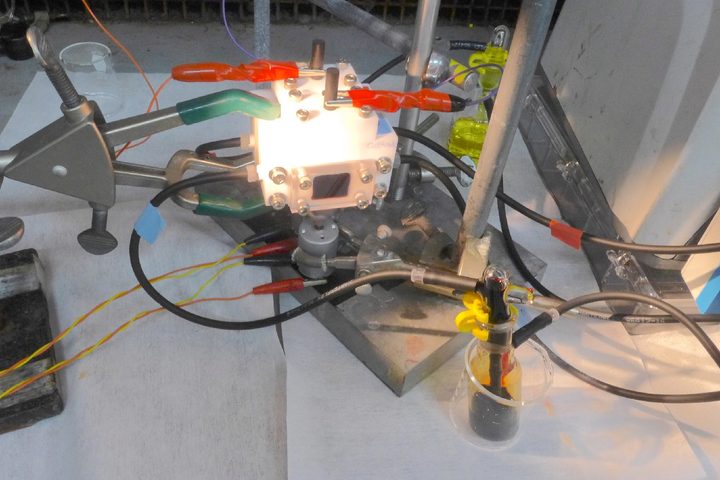
song-jin-solar-battery_0023
Image used with permission by copyright holder

“We wanted to create a technology that not only harvests the solar energy but also stores it in the form of electricity, so it can be used on demand,” Song Jin, a professor of chemistry at the University of Wisconsin-Madison, told Digital Trends. “Everyone’s familiar with a solar cell, which converts solar energy to electricity. But the problem with them is that, of course, the sun goes down every night and we don’t just want to use electricity when the sun is up.”

Discharging the battery to supply electricity at night, or on rainy days, is then a matter of connecting a load to a different set of electrodes, before passing the charged electrolyte through the device and letting the electricity flow out.

Before people get too excited, though, Jin said that the research still represents a work in progress.

“This is still an early prototype,” he said. “We’ve got a workable device, which we’ve shown can be charged without wasting too much energy in its cycles, but it only has a solar conversion efficiency level of about 1.7 percent. That’s compared to current commercial solar cells, which can be around 15-20 percent. Clearly we’re not at the level of being practically competitive yet, but as we point out in the paper we’ve got a lot of ideas for obvious directions we can take the research to improve the solar conversion efficiency, as well as the energy storage density.”

Luke Dormehl
I'm a UK-based tech writer covering Cool Tech at Digital Trends. I've also written for Fast Company, Wired, the Guardian…
Google’s new AI gives robots better balance, smarter hands, and teamwork capabilities
Google just made robots a lot less clumsy and a lot more helpful.
Gemini robotics 2.0

Google DeepMind just brought sci-fi robots closer to reality, and it is very exciting. Building on its original Gemini Robotics model, the company has introduced Gemini Robotics 2, an AI system designed to help robots think, move, and even work together. Unlike most robots today, which rely on pre-programmed routines or someone controlling them remotely, this new system lets robots figure things out on their own when situations get unpredictable.

Can robots finally handle whole-body tasks?

Read more
Remember Samsung’s Ballie home robot? It may finally be inching closer to reality
Leaked app wireframes give the strongest hint yet that Samsung's Ballie home robot, first shown at CES 2020, might still be headed toward an actual release.
Samsung Ballie robot in a room next to a dog feeder.

Samsung's rolling home robot has been the industry's longest-running "will it ever actually ship" joke, and I'll admit I'd mostly given up on it. Now, there's finally a glimmer of hope.

Samsung first unveiled Ballie as a concept at CES 2020. Then, it showed it as a significantly upgraded version four years later. However, the company never confirmed a release date or committed to releasing it at all. 

Read more
Polar is yet another AI browser, but it goes beyond just automating the mundane web chores
Polar wants to turn your browser into an AI-powered productivity tool
Polar AI browser

The AI browser race is entering a new phase. After spending much of 2025 trying to reinvent web search with built-in chatbots, startups are increasingly shifting their attention toward browser agents that can automate repetitive work instead of simply answering questions. The latest company to embrace that transition is Polar, a startup founded by former Perplexity engineer Kevin Zhang, which has raised $5.7 million in seed funding led by Madrona.

Unlike the first generation of AI browsers that targeted everyday consumers, Polar is designed specifically for knowledge workers. Its premise is straightforward: instead of replacing Google Search, the browser aims to eliminate repetitive tasks that professionals perform across dozens of browser tabs every day.

Read more