You only need to pop open a website detailing the latest happenings in artificial intelligence (may we recommend Digital Trends?) to be aware that some exciting stuff is going on right now.
But while it’s all well and good to know that these breakthroughs are taking place in labs, and will one day trickle down to consumer products, what if you want to take advantage of some of them in your own DIY Arduino robot project — and without having to first earn a PhD in computer science?
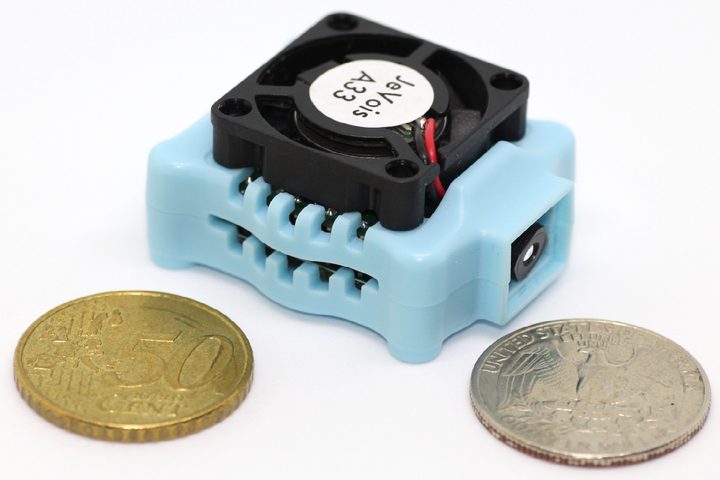
Fortunately, a new Kickstarter project offers one possible answer. Created by Dr. Laurent Itti, professor of computer science, psychology and neuroscience at the University of Southern California, JeVois in a diminutive, open-source, quad-core smart machine vision camera designed for users to incorporate into their “maker” projects.
Coming preprogrammed with a bank of cutting-edge algorithms, the camera will not only record images, but will also let your robot project make sense of them. Results are streamed over USB to a host computer, or over a serial port to a micro-controller.
“A lot of progress has been made in machine learning and machine vision,” Dr. Itti told Digital Trends. “However, this is often still confined to the lab. What we want to do is to help people use some of these algorithms in their own projects by providing them with a platform which lets them experience them, without having to program them on their own. This is like having a smartphone but no programming experience. Instead, you just go to the App Store and download the apps that you need. You can still enjoy them, even if you don’t know how they work.”
JeVois opens up an exciting range of possibilities and potential use-cases.
“Recognizing QR codes is one that everyone will understand,” he continued. “But there are other, more advanced things you can do as well. For example, you could get it to detect roads if you’re trying to build an autonomous car. We also have algorithms that can detect objects, algorithms that can help your robot work out which room it is in, and more.”
Some of the other applications not mentioned by Itti include human face detection, eye-tracking, object recognition in cluttered scenes, and a wealth of others. Many of the algorithms operate at 30, 60 or 120 frames per second, and if you have the necessary coding know-how, you can also program new algorithms yourself.
At present, JeVois is raising funds on Kickstarter, where you can pre-order a unit starting at $49 for the Barebones Kit. Shipping is set to start in February, with the majority of orders arriving in March.