
Albert Einstein stands within the pantheon of larger-than-life figures who need no introduction. The German physicist and Nobel Prize winner, credited with developing the general theory of relativity and the mass-energy equivalence formula, has become synonymous with the label “genius.”
But unlike many of his intellectual caliber, Einstein had a noted social side, too. He was a prolific humorist, a prankster, and a humanist who devoted much of his life to the advancement of humanitarian causes. “Most people say that it is the intellect which makes a great scientist,” he once said. “They are wrong: it is character.”
The cross-cultural fascination with Einstein shows no sign of waning. Einstein toys are a category onto themselves — the market’s positively dominated by plushies, dolls, DVDs, and other interactive toys. But that didn’t stop David Hanson, a former Walt Disney Imagineer and veritable pioneer in the field of lifelike robots, from taking a stab.
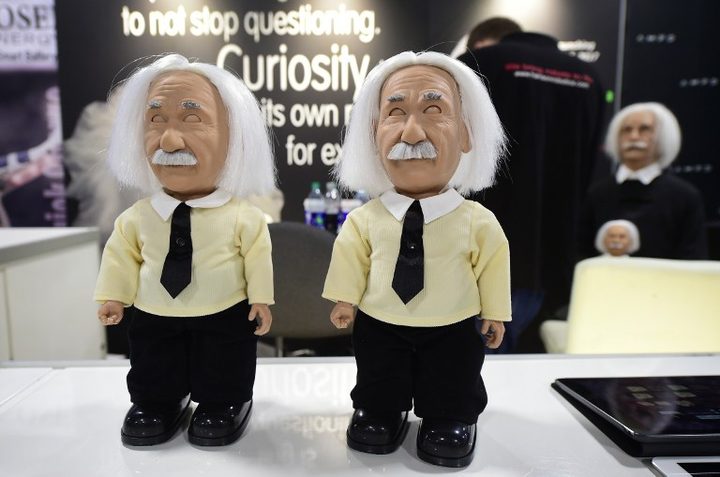
Hanson’s namesake company, Hanson Robotics, teamed up with Andy Rifkin, former senior VP of Mattel Toys, to create a fully automated, 14.5-inch Einstein caricature who teaches scientific basics to kids, teens, and curious adults. “Our end goal is to make AI very smart and to relate with people, so by giving it a humanlike form it means that we can teach it more what it means to be human,” Hanson said. “It can physically explore the world the way that a baby would, and it can socially explore; learn from people.”
That’s all to say Professor Einstein is just as personable as its real-life inspiration. Hanson worked with the Hebrew University of Jerusalem, which owns Einstein’s image and intellectual property, to ensure that the robot channeled the real-life Einstein’s “warm and caring” side. “He’s bright, funny, and engaging, and comical,” said Rifkin. “The key is you want to go back and play with him again and again. We didn’t cut corners. We purposefully made him silly and funny — we didn’t want him to make anybody uncomfortable.”
Rifkin stopped by the offices of Digital Trends last week to demo a prototype of Professor Einstein, which launches on Kickstarter today. The robot, dressed in black pants, a corduroy sweater, and black tie, certainly looked the part. And it sounded the part, too, thanks to a voice synthesis platform that taps AI systems like IBM Watson and Microsoft’s Xiobing chatbot to strike up casual conversations.
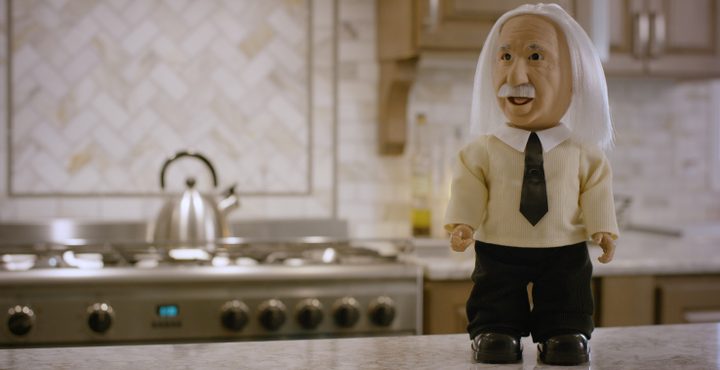
It tells jokes, too. “I had the worst dream,” Professor Einstein said. “My vast intellect had been downloaded into a prosthetic body. I was then made to present the world of science to perfect strangers.”
There’s a lot of technology beneath Professor Einstein’s plastic surface. It sports a chest-level camera that performs “blob detection” — a computer vision technique that identifies facial features — in order to turn and address people with whom it’s carrying on a conversation. (Privacy concerns precluded facial recognition, Rifkin said). Nine motors power everything from Professor Einstein’s facial tics to its basic movement. And rechargeable batteries housed in his feet provide about three to four hours of playtime.
The team worked to make Professor Einstein as lifelike as possible within the project’s budget constraints, Rifkin said. Its face, replete with moving pupils that can move up to 30 degrees in any direction and an articulated tongue, is surprisingly expressive — it’s capable of more than 50 individual gestures, including smiles, frowns, and expressions of surprise. And the attention to detail is impressive: Professor Einstein sticks out a lone finger to emphasize points and shuffles forward and backward with motorized feet.
Two far-field microphones help Professor Einstein process basic questions. Thanks to internet-based sources, it can answer questions about the weather (“How’s the weather in Hong Kong?”), food, and people (“Who’s Brad Pit?”), with more to come in the future.
It doesn’t always do so quickly, unfortunately — it is slower than voice-activated assistants like Alexa and Cortana at answering basic questions. But Rifkin thinks of those features as “bonuses” rather than selling points.
Professor Einstein truly shines in the area of “edutainment,” Rifkin said. A companion software, a sleekly designed mobile app called Stein-o-Matic, comes preloaded with 14 animated lessons on subjects from human biology to basic mechanics. (One teaches how the human digestive system and brain is organized, while another explains the concepts of friction and electromagnetism.) They serve as visual aids for the toy’s vocalized lectures, which makes for an experience that’s a bit like sitting in for a classroom lesson — albeit with a miniaturized robotic Einstein and iPad in place of a teacher and whiteboard.
After-lesson games include timed question-and-answer cards, matching games, slideshows, daily mental “kick starts,” thought experiments, and time-pressured brain games designed to test and boost mental quickness. A chemical reaction lab provides substances you can mix and match into compounds, and a gravity game lets you launch a rocket and use planetary gravity wells to extend their journey.
Other experiences are a little more hands-off. A “space travel” mode provides a guided journey through the solar system, while “time travel” has professor Einstein narrate the early history of the world.
Rifkin sees Professor Einstein as a platform that will improve over time. The app will gain new videos and activities via over-the-air updates (Rifkin is tossing around the idea of a lesson on the basics of smartphone technology) and aftermarket accessories like clothing. And thanks to a yearly subscription service, Professor Einstein will be able to answer an increasing number of queries.
Eventually, the team plans to expose Professor Einstein’s programming to third-party developers. And it’s planning a software development kit that will let enterprising engineers program Professor Einstein to their liking. “We wanted to embrace a personality. It’s functional artificial intelligence that solves a problem,” said Rifkin. “It’s adaptive learning in humanlike form.”
Professor Einstein starts at $250 for Kickstarter pre-order backers, and ships in April. It’s targeted at those 13 and older.


