1. Home
  2. Emerging Tech
  3. News

New 6-axis 3D printer can print complex objects with gravity-defying overhangs

Add as a preferred source on Google

3D printers can make objects of practically any shape you can dream up, but despite the fact that they’re so capable, there’s one thing that they often struggle with: overhangs.

Filament-based 3D printers create objects one layer at a time, from the ground up. So if the object you’re printing has any overhangs that protrude at angles over 45 degrees, the printer is (usually) incapable of making the object without support structures, and therefore must print little plastic scaffolds to hold up the object while it prints. The downside, of course, is that this uses extra plastic, and often leaves burrs and imperfections on the object when the supports are removed.

Recommended Videos

Luckily, two students from the Zurich University of Applied Sciences (ZHAW) have created a solution to this problem.

What Oliver Tolar and Denis Herrmann have developed is a 3D printer prototype that uses a tilting printer bed to print objects with a critical overhang. Better yet, it’s able to print these overhangs in such a way that they don’t require added support material.

The printer itself can be pivoted with a total of six axis: three which control the print head, and another three which control the printer bed. The result is a massive range of movements that would be impossible using a conventional 3D printer. Picture the way you might use one hand to move a model as you paint it with the other, and you won’t be far off!
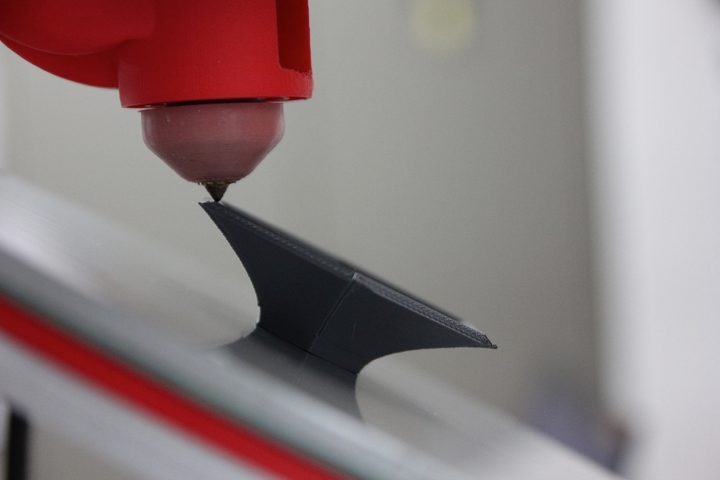
Image used with permission by copyright holder

“The advantage lies in the time saving at printing time,” Professor Dr. Wilfried Elspass of the ZHAW School of Engineering, who oversaw the project, told Digital Trends. “At the same time, there is no need to remove the support material after printing. Another potential application will be that an already existing component such as an actuator or sensor can be directly printed. It is thus possible, for example, to integrate electronic components directly into a printed part.”

It’s definitely a neat idea, and one that could save valuable minutes and hours spent sanding and cutting away extraneous aspects of our prints. Unfortunately, if you do like the idea it could still be a while before its creators are even able to think about bringing it to market — if they ever do.

That’s because, with the limited time Tolar and Hermmann had to work on the project, they didn’t have long enough to properly develop the necessary software for it to work.

“Next the software for generating the control data must be further developed,” Elspass continued. “A commercial implementation of the new printer is not yet planned. However, further research and development activities will follow.”

Color us intrigued!

Luke Dormehl
I'm a UK-based tech writer covering Cool Tech at Digital Trends. I've also written for Fast Company, Wired, the Guardian…
Yet another study says AI is bad for elections, and the rabbit hole gets worse
AI may be an election bomb waiting for someone to light the fuse
Voters cast their ballots on Election Day

Another election, another study has concluded that asking an AI chatbot for political guidance is a spectacularly bad idea. Research conducted during Hungary’s 2026 parliamentary election found that ChatGPT and Google Gemini offered not just inaccurate but also inconsistent and unreliable voting advice. The chatbots misclassified voter profiles, overlooked relevant parties, recommended parties absent from the ballot, and sometimes produced materially different answers when given the same information repeatedly.

AI keeps failing the voter test

Read more
Samsung’s humanoid robot ambitions are real, but factories come first
Samsung’s new robotics division has humanoids in its sights, although its immediate business is far more practical factory automation
Robot Touch Human Finger

Samsung wants a place in the humanoid race, but its new robotics push begins with machines built for factories rather than homes.

The CEO-led RX robotics division will initially focus on manufacturing robots. Samsung has separately identified humanoids as a priority, although it hasn’t announced a commercial model or explained where one fits into the division’s immediate plans.

Read more
The future of AI may depend on this one behind-the-scenes change
Running Claude on Android.

Whenever a new AI model arrives, it's easy to get caught up in the bells and whistles. We talk about how much smarter it is, how quickly it answers questions, or how realistic its images have become. But here's the thing: none of that matters much if the AI can't reliably work with the apps and services people use every day.

That's why an upcoming update to the Model Context Protocol (MCP) caught my attention. It isn't a new chatbot or a fancy AI model. In fact, most people will never even know it's happening. But it could quietly make the AI ecosystem a lot healthier. If you've never heard of MCP before, don't worry. Think of it as a shared language that lets AI assistants safely talk to apps like Gmail, Slack, calendars, databases, and countless other services. Instead of every company inventing its own way to make those connections, MCP gives everyone a common rulebook.

Read more