1. Home
  2. Computing
  3. Audio / Video
  4. Entertainment
  5. Web
  6. News

Your Smart TV could be hacked a lot more easily than you might think

Add as a preferred source on Google

Your smart TV may know exactly what Netflix show you want to watch at the end of a long day, but it could also be letting hackers know more than you want them to about … well, you. As first reported by Ars Technica, there’s a new hack whose proof of concept suggests that terrestrial radio signals could be used to take control of a large swath of Smart TV sets without having actual physical access to any one of them.

In the demonstration of the hack, security consultant Rafael Scheel of Oneconsult AG used a cheap transmitter to embed malicious commands into a rogue TV signal, Ars reports. When that signal is broadcast to devices in the vicinity, it’s able to gain access to the televisions. The key to the attack is the exploitation of two documented security flaws in the Web browsers that run in the background of the TV models used in the test, both manufactured by Samsung. But that doesn’t mean that other sets are immune — if the attack were engineered to target other browser bugs, it would likely be just as effective.

Recommended Videos

“Once a hacker has control over the TV of an end user, he can harm the user in a variety of ways,” Scheel told Ars. “Among many others, the TV could be used to attack further devices in the home network or to spy on the user with the TV’s camera and microphone.” Indeed, in Scheel’s demonstration, he was able to remotely control the TV, and even rebooting and resetting the device didn’t lock him out of the smart appliance.

Perhaps the most terrifying aspect of Scheel’s proof of concept is that a hacker wouldn’t need any physical access to any of the devices. That means one could control a much larger number of smart TVs, too. And as an increasing number of concerns are raised about smart home devices overall, this demonstration certainly serves to underscore our vulnerability.

“This research is significant because TVs are used by a fundamentally different demographic than computers,” Yossef Oren, a security researcher told Ars. “People who use TVs don’t know/care about security, they aren’t used to getting security prompts from their TVs, they don’t have the discipline of installing security updates, and so on.”

Lulu Chang
Fascinated by the effects of technology on human interaction, Lulu believes that if her parents can use your new app…
ChatGPT Live could make talking to AI feel straight out of the movies
We might finally get the AI sidekick sci-fi movies promised
Elderly women using ChatGPT live on a smartphone

AI voice assistants have been chasing the sci-fi dream for years, but they still have a hard time holding a conversation with humans. Most voice systems still need clear turns, clean pauses, and a few seconds before they respond. OpenAI is now rolling out GPT-Live, a new voice model for ChatGPT Voice that is designed to make those exchanges feel faster and less scripted.

The main upgrade is what OpenAI calls a full-duplex architecture. In simpler terms, GPT-Live can listen and speak at the same time. It continuously processes what the user is saying while also generating its own response, allowing it to decide when to talk, when to pause, when to keep listening, and when to use a tool.

Read more
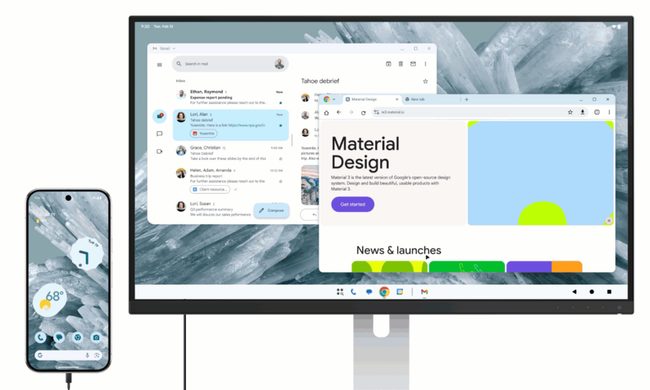
A broken Galaxy Fold 5 just became the Pixel desktop future I want Google to steal
A broken Galaxy Fold 5 became a tiny PC because Samsung already built the desktop mode Google keeps treating like a side quest.
Desktop mode within Android 16.

A broken Galaxy Fold 5 should be a sad little monument to modern gadget math. One busted outer display, one repair bill nobody wants to inspect too closely, and suddenly a powerful foldable starts heading toward a drawer. Instead, a Redditor turned one into a glowing acrylic DeX box with spare parts, fans, a USB hub, and the kind of LED lighting that makes every homebrew computer look mildly illegal.

https://www.reddit.com/r/SamsungDex/comments/1upica7/fold_5_dexbox/

Read more
You’ll finally be able to try OpenAI’s GPT-5.6 Sol, Terra, and Luna models this week
The GPT-5.6 family will become publicly available on July 9, ending the restricted preview that lasted nearly two weeks.
OpenAI Sol Terra Luna featured

OpenAI is ready to expand access to its latest GPT-5.6 model family. In a recent post on X, the company confirmed that GPT-5.6 Sol, Terra, and Luna will become publicly available on Thursday, July 9. If you've been itching to try the new models since the limited preview began in late June, you won't have to wait much longer.

Why the rollout took longer than expected

Read more