Anyone who is a fan of Star Trek is probably familiar with the Vulcan mind meld, a telepathic link between two individuals which allows both participants to temporarily share their brainwaves. Well, as with other Trek fantasies-turned-reality such as teleportation, universal translators, and the holodeck, it seems the idea wasn’t quite as far-fetched as viewers might have thought at the time.
At Spain’s Basque Center on Cognition, Brain, and Language (BCBL), researchers have used electroencephalogram (EEG) brain caps to demonstrate that people’s brain waves really do sync up when they have a conversation. Even if there is not (yet) any telepathy involved.
“Recent evidence has highlighted that the brain’s oscillatory activity, which can be understood like the rhythmic pattern of brain activity at different levels, is modulated by the properties of what the person is hearing — so that the oscillatory pattern gets entrained by the input to favor speech comprehension,” researcher Jon Andoni Duñabeitia told Digital Trends. “In this study, we decided to move a step forward and explore whether brain entrainment also occurs at the person-to-person level, and not just at the person-to-audio level. To this end, we had pairs of people speak to each other in a normal conversation setting and collected EEG data from their brains. Results surprisingly demonstrated that the brains of the two individuals got synchronized in such a way that they showed brain-to-brain entrainment of the oscillatory activity.”
To put this another way, the EEG brain data demonstrated that a person’s brainwaves are synchronized not just to the message they are hearing (which previous studies have shown), but also to the oscillatory pattern of the person they are speaking to. The effect was so obvious that simply looking at brainwave data could reveal whether two people were communicating.
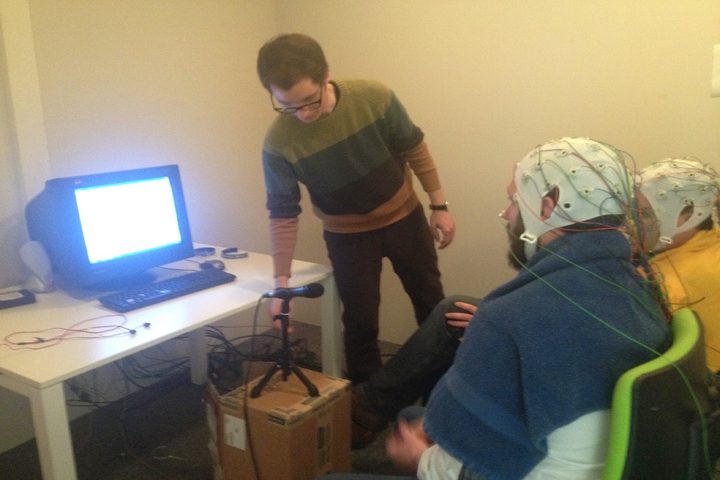
The researchers note that the work is still in its infancy, with plenty more research to be done. For this study, the participants were reading from a set script, but later investigations could open up these parameters.
“There a few [potential applications],” Alejandro Pérez, a postdoctoral researcher on the project, told us. “I envision a future in which we can intervene externally over this ‘brain-to-brain entrainment,’ provoking behavioral changes. In other words, it will be possible by externally stimulating the oscillatory neural activity of two or more individuals to enhance their inter-brain synchronization — boosting the possible outcome of the communicative situation in terms of remembering, agreement, empathy, comprehension and so on.”
Pérez said that specific uses could involve scenarios like improving human robot interfaces by generating robot activity based on a person’s brain state or potentially measuring a person’s willingness to negotiate.
In all, it is fascinating stuff. Even if we are putting in writing right now that we are not going to agree to wear an EEG brain cap next time we negotiate a pay raise — no matter how much our boss assures us it is for research purposes only!
A paper on the work was published in the journal Scientific Reports.