Bookworms, this is your year. In case Amazon’s Kindle, Sony’s Readers and Barnes & Noble’s Nook didn’t quite catch your fancy this past holiday season, CES 2010 brought an onslaught of new e-book products to fill, well, a small library. From ultra-thin, large-screen readers meant to replace magazines and newspapers, to those tagged with full color LCDs for browsing blogs when Jane Austen gets a little dull (that’s five pages into Emma, by the way), the category marches forward with more content, features and flexibility than ever before. Here are five of the hottest e-readers that will define the portable reading space in 2010.
 Plastic Logic Que, $649 and $799

Clearly targeting the well-heeled business reader who might normally have a copy of Robb Report tucked under arm, Plastic Logic’s Que reader comes in high on price, but appropriately stacked with features. It’s one of only two new readers (the Skiff being the other) that use intuitive touch screens, rather than side buttons mounted on a bezel. Plastic Logic has also partnered with over 300 magazines to have them specially formatted for the Que, along with securing full access to the same Barnes & Noble e-book library used by the Nook. Even better, it will aggregate digital sources using RSS feeds, and even grab document files like .DOC and .XLS files off of Bluetooth-tethered cell phones, which can be configured to automatically deliver e-mail to the Que for big-screen reading.
Skiff Reader, $TBA
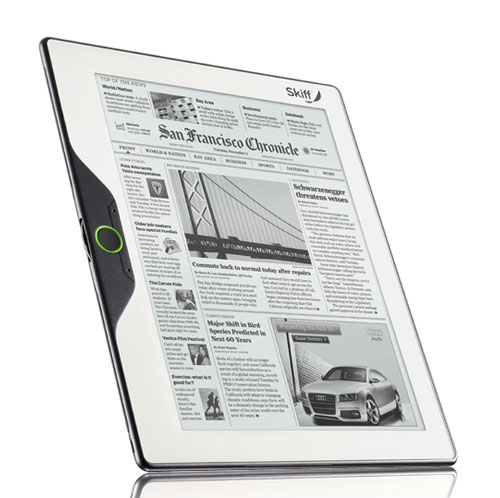
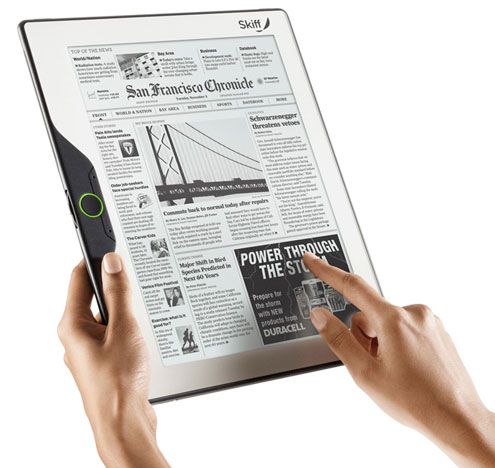
Although initially quite similar to the Que, thanks to its large-format, touch-screen display, Skiff’s Reader also sets itself apart with some quite notable differences. For starters, it has a larger screen – a full 11.5-inches diagonally, compared to the 10.7-inch Que. Skiff uses a foil-backed e-ink screen, while the Que’s is bonded to flexible plastic, but both reach for a common purpose: They won’t shatter like glass e-ink screens. Rather than the single “home” button on the Que, the Skiff sports a wheel-like scrolling tab on the side, as well as up and down toggle buttons. Since its development has been backed by Hearst, you can also be sure that Popular Mechanics, Cosmo and Good Housekeeping will all make an appearance, though we don’t know much else. It all adds up to a reader that might, on (digital) paper, look better than the Que, but Plastic Logic will beat the Skiff to market with a release date in mid-April., while the Skiff has only been promised later this year.
Spring Design Alex, $359
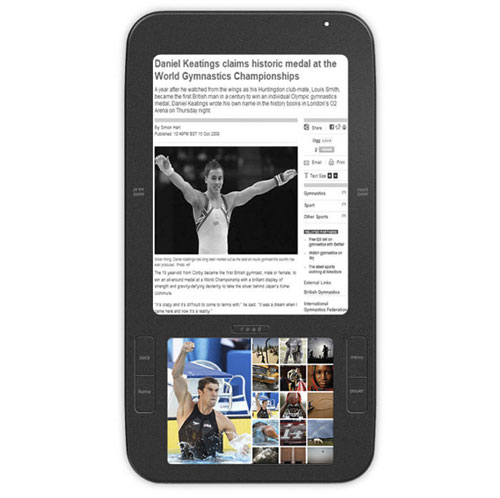
Similar in appearance to Barnes & Noble’s Nook, the Alex couples a 6-inch e-Ink upper display with a 3.5-inch, full-color LCD below. Quite unlike the Nook, that bottom screen offers full access to Google Android, allowing readers to look up items they’re reading about on Wikipedia, browse blogs, send e-mail, and a host of other tasks typically associated with a smartphone. Like many other companies, Spring Design has partnered with Google to gain access to the company’s one million shared public domain books, as well as with Borders for access to that company’s e-book store. Although the Alex will include a built-in modem, Spring Design hasn’t yet announced which carrier it will partner with to provide mobile library access for the reader when it launches on February 22.
Samsung E6 and E101, $399 and $599

We’ve always felt a little bit guilty defacing books with our own ballpoint pen scribbles and notes, but something tells us even the most diehard booklovers won’t have a problem marking them up in e-Ink. Samsung’s new line of e-book readers are the very first to the market to offer the ability to draw directly on the screen as if it were paper. The included stylus makes it possible to naturally record your thoughts on a book as you go, which could make it a boon to students. However, at the moment Samsung has only partnered with Google for free, public domain books, which leaves a gaping hole on the commercial side, and it will only offer Wi-Fi – no built-incellular modem.
Qualcomm Mirasol Technology
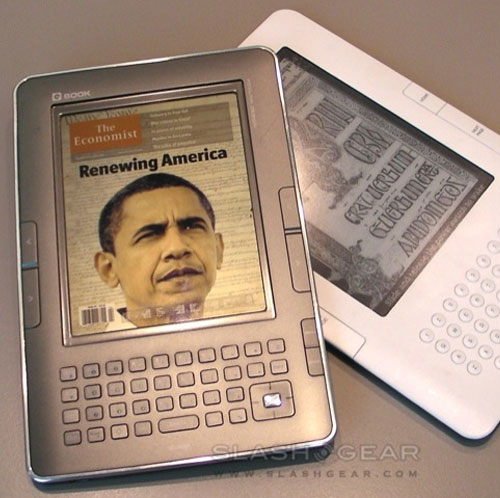
Not an actual e-reader so much as a technology that will power them, we’re still including Qualcomm’s Mirasol displays because they have the potential to significantly shake up the industry in 2010. As the name alludes to, Mirasol displays reflect light like a mirror, eliminating the need for a backlight, just like e-Ink. However, Mirasol displays can already handle full color and refresh at 15 times per second for fluid motion and even video. In other words, future e-readers using Mirasol displays may blend the flexibility of an LCD with the low energy consumption of e-ink, producing full color displays that might go well beyond displaying simple novels. Qualcomm claims the technology will begin appearing in commercial e-readers later this year, and some already speculate that Amazon may have lined the company up for its next-gen Kindles.