A few years back, Harry Potter author J.K. Rowling penned a detective novel titled The Cuckoo’s Calling under the pen name Robert Galbraith, choosing to conceal her own identity. When people started to notice a couple of stylistic similarities between the “two” authors, experts were called in to investigate — in the form of some smart AI software. Its conclusion? That Rowling was indeed Galbraith, and the author of the book in question. She subsequently revealed her ploy online.
Jump forward to 2017, and a publicly available AI application called Emma Identity promises to do the same thing for whoever needs it. It’s the world’s first web application capable of determining the authorship of a particular text based on a person’s writing style.
“To run the check, one needs to upload a text of at least 5,000 words by one author,” CEO Aleksandr Marchenko told Digital Trends. “Then Emma analyzes and learns the author’s writing style, and can determine whether all the subsequent texts you upload belong to the same author. The technology will render its verdict in the form of a percentage.”
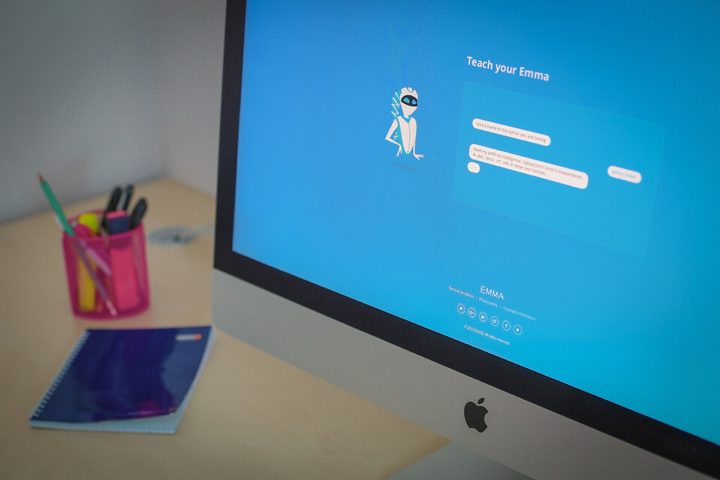
Marchenko explained that the technology combines natural language processing (NLP) and machine learning with the techniques of stylometry, a study of linguistic style rooted in the 15th century. He claims that the result is an AI that’s capable of exhibiting 85 percent accuracy in correctly determining an author.
“More than 50 mathematical parameters stand behind every author’s writing identity,” he continued. “So the issue is of a striking complexity: it’s extremely difficult to define and assess style features of a vexing number of authors, and to implement the extracted knowledge into an NLP technology. Our team of researchers, scientists and engineers have set out to create an algorithm that could surmount that challenge and develop such a technology that could operate on minimal sets of texts and reach an accuracy level worthy of a successful commercial product.”
While you may simply want to upload some sample texts for fun, Marchenko thinks that the real benefit of Emma Identity will be as an anti-plagiarism tool for use in schools, colleges, and universities. It could also be useful in fields like publishing and as a tool for law enforcement. Historians and literature researchers could also benefit from it.
Well, we guess “plagiarist” is yet another job to suffer in the face of the AI takeover! Is nothing sacred?