  1. Home
  2. Emerging Tech
  3. News

Self-driving forklift takes the human factor out of warehouse work

Add as a preferred source on Google

Robots and autonomous vehicles are taking over a growing number of domains, and jobs in warehouses are no exception to that rule. That is where self-driving industrial vehicle company Seegrid’s new GP8 Series 6 forklift enters the picture. The GP8 Series 6 is capable of autonomously maneuvering around warehouses, picking up heavy loads, taking them where they need to go, and then unloading them — and all without any human sweat needing to be expended.

“Our autonomous vehicles specialize in helping human workers haul extremely heavy loads of materials around the facility floor, making the whole system more efficient,” Jeff Christensen, vice president of product at Seegrid, told Digital Trends. “The new GP8 Series 6 adds one more layer of automation because it’s capable of executing hands-free load exchange from pickup to drop-off. That means the robot can approach a pallet, lift it up quickly and carefully, and drive off to the next point. This end-to-end automation solution optimizes warehouse operations by removing the need for human assistance to complete certain tasks.”
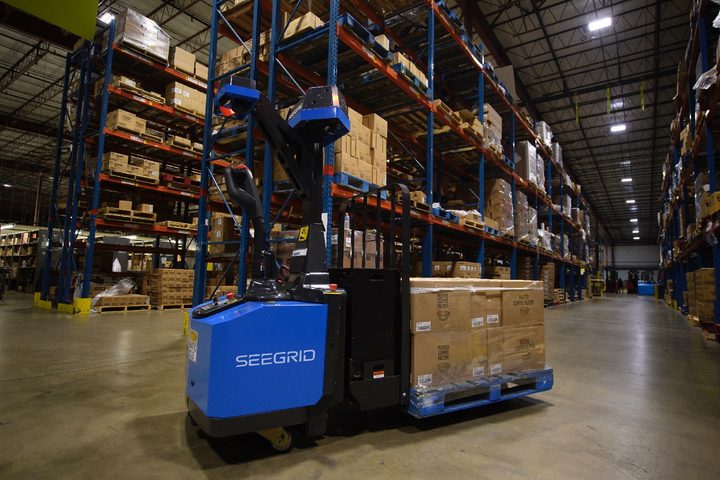
Image used with permission by copyright holder

Compared to the automated guided vehicles (AGVs) that have been used in similar facilities for years, Seegrid’s self-driving forklifts don’t require any changes to a facility’s infrastructure in order to be used. Each vehicle operates using 10 cameras and image-recognition algorithms, instead of the wires, lasers, magnets, or tape commonly used by AGVs. This is also different from autonomous cars, which employ sensors like radar or lidar in order to move around. Christensen notes that the stereoscopic cameras the forklift uses have higher data density and offer a 360-degree view, compared to these rival sensor technologies. Another reason they do not require radar or lidar is because the lighting levels in a warehouse are more easily controllable than the natural light in the outside world.

Recommended Videos

Although the GP8 Series 6 is still in the pre-order phase, Seegrid autonomous vehicles are already being widely used in the industry. They have cumulatively driven more than 725,000 production miles for customers including General Motors, Amazon, Whirlpool, Jaguar Land Rover and many other manufacturing and distribution companies — all without a single accident.

The hope is that the company’s new autonomous forklift will not do anything to sully that sterling safety reputation. Until Skynet’s ready to make its move, at least!

Luke Dormehl
I'm a UK-based tech writer covering Cool Tech at Digital Trends. I've also written for Fast Company, Wired, the Guardian…
Anti-surveillance clothing is getting cheaper, but don’t expect an invisibility cloak
Affordable shirts now claim to confuse facial recognition, although their protection depends heavily on the camera and software watching you
Chart, Plot, Adult

Anti-surveillance clothing is starting to look less like an art-school experiment and more like something you could actually wear outside. Shirts designed to confuse facial recognition systems now cost about as much as ordinary streetwear, although buying one won’t make you disappear.

The Guardian reports that designers are using face-like prints, unusual cuts and infrared lights to interfere with computer vision. These techniques target specific weaknesses, so their success depends on what happens to be watching you.

Read more
This spinning drone hides in plain sight using a visual illusion
This drone doesn't turn invisible. It tricks your brain into thinking it has.
Phantom Twist

For decades, engineers have chased the dream of an invisible drone. The usual approaches have involved transparent materials, camouflage coatings, or complex optical systems that bend light around an object. Researchers at Northwestern University decided to take a completely different route. Instead of hiding the drone itself, they chose to fool the human eye.

The result is Phantom Twist, an experimental drone that spins so rapidly it almost disappears into the background. It's not technically invisible, but to anyone watching, it looks more like a faint blur than a flying machine.

Read more
This smart knitted fabric can flip switches, count your steps, and even change shape
Grandma's knitting just entered its Iron Man era
Representative Image

For most of us, knitting brings to mind sweaters, scarves, and perhaps an ambitious grandmother determined to make winter more fashionable. Researchers at Harvard University, however, have a far more futuristic vision. They've transformed ordinary knitted fabric into a programmable material capable of changing shape, acting as an electrical switch, sensing movement, and potentially forming the foundation of tomorrow's wearable technology.

The research, published in Advanced Functional Materials by scientists at the Harvard John A. Paulson School of Engineering and Applied Sciences (SEAS), demonstrates how machine-knitted textiles can "snap" between multiple stable shapes without relying on motors or rigid mechanical parts.

Read more