“Why you can trust Digital Trends – We have a 20-year history of testing, reviewing, and rating products, services and apps to help you make a sound buying decision. Find out more about how we test and score products.“
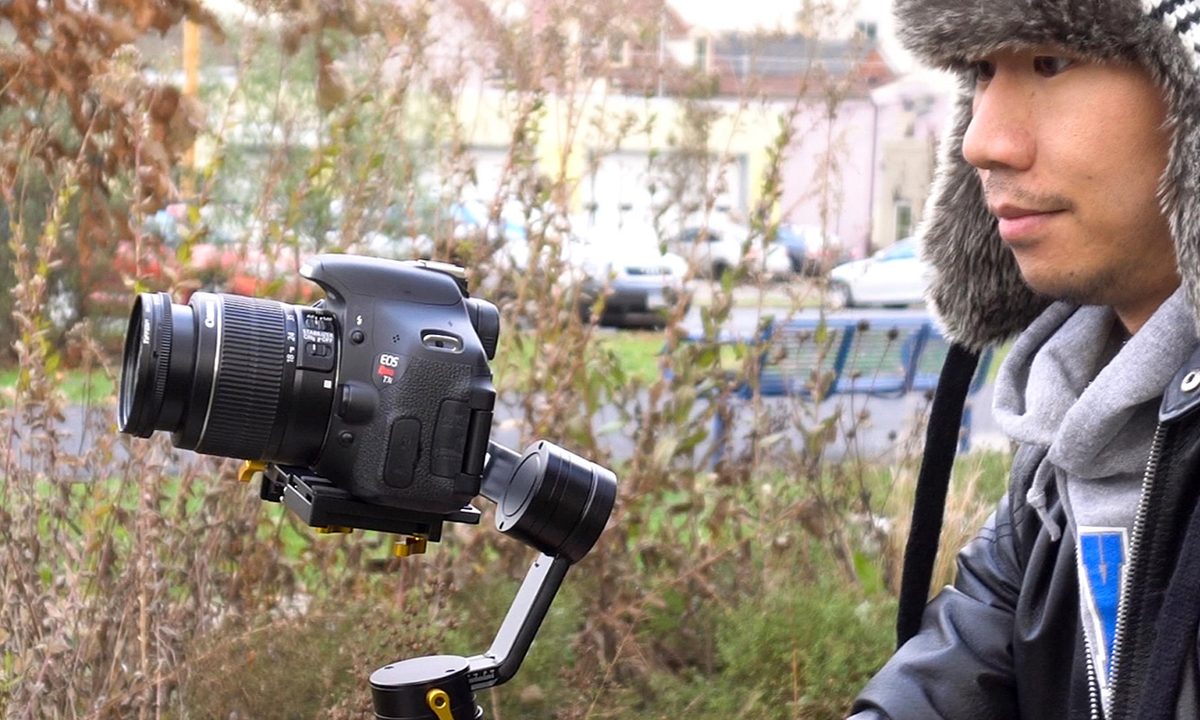
Ikan’s Beholder series 3-axis gimbals have been fairly successful at competing with other handheld stabilizers like Zhiyun’s Crane and are lighter weight, less expensive alternatives to the DJI Ronin 2 for creating professional looking shake-free video. However, one of the most common complaints from handheld gimbal users is that the rear motor can partially or completely block the LCD on mirrorless and DSLR cameras. We checked out Ikan’s latest gimbal in our DS2-A Beholder review and found how they solved this problem with one simple change.
Look and feel
The rear motor — also known as the roll-axis motor — on most 3-axis gimbals is typically located in the same horizontal plane as the tilt-axis motor, which unfortunately places it directly in front of the LCD screen of mirrorless and DSLR cameras. On the DS2-A, this motor is placed lower, at an angle, giving you a clear view of the LCD for framing your shots. Ikan appears to be testing whether or not users will prefer this ‘angled’ version since they also simultaneously released the DS2, an otherwise identical gimbal without the angled arm.
We weren’t sold on the handle design and placement of the controls.
While we loved the angled arm idea, we weren’t sold on the handle design and placement of the controls, which are standard across all the Beholder gimbal models. The wide finger grooves on the handle don’t make it any easier to hold one-handed, and the position of the joystick controller in the front was hard to manipulate.
Like Ikan’s other gimbals, the DS2-A is made entirely of machined aluminum alloy right down to the buttons, joystick, and thumbscrews. Although it looks compact, the girthy handle, triplet of 18650 batteries, and large mounting platform weigh it down at two and a half pounds. Fortunately, its maximum payload is four pounds, so it can handle beefy cameras like the Canon EOS 6D Mark II, but doesn’t have a lens support bracket for longer and heavy lenses. That said, six and a half pounds is a lot to carry one-handed, and more often than not, we ended up using two hands to help alleviate fatigue (and be able to reach the joystick comfortably).
Balancing and setup
Mounting a camera to the quick release (QR) plate requires using the included mini screwdriver to tighten the 1/4-inch screw to the camera. This seems like a design flaw considering the rest of the gimbal is built to require no tools at all. The screw also had a habit of coming loose during use unless it was screwed down extra tight. The QR plate, however, is conveniently compatible with universal mounting systems like Manfrotto 577 series tripods, letting you quickly swap from gimbal to tripod without switching plates. There’s also a safety latch on the mounting platform; a feature that saved our camera from sliding off and crashing to the ground more than once.
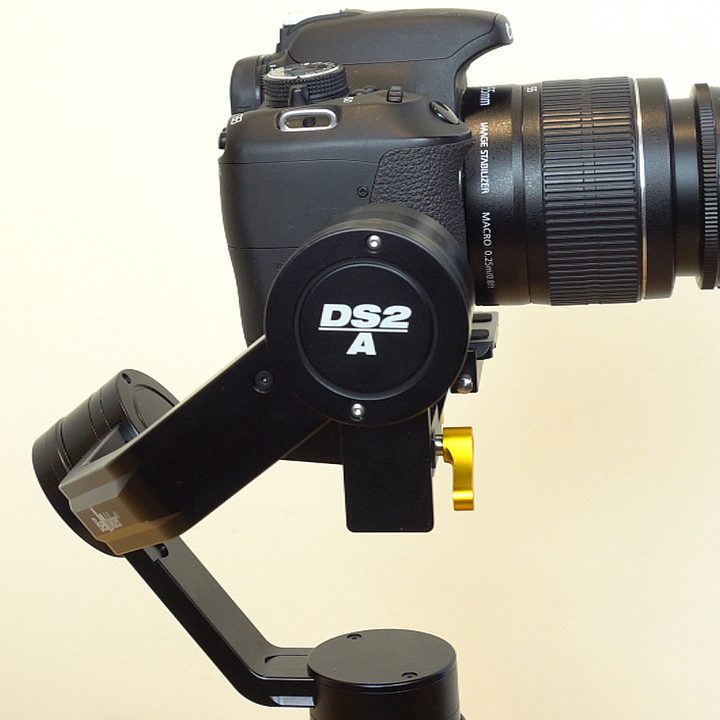
Balancing the gimbal is only slightly modified for the new motor position. The roll-axis balance, usually performed by adjusting the side-to-side position of the roll-axis arm, is instead achieved by moving the camera’s mounting plate side-to-side. Otherwise, setup is identical to normal gimbal balancing procedures and only takes a few minutes for practiced users.
New features
The new OLED status screen is a welcome addition. It shows both remaining battery life and the current mode. We saw a similar feature when we reviewed Zhiyun’s Crane 2 gimbal, although the DS2-A’s screen isn’t quite as large nor as versatile. Since the OLED can display text, we weren’t sure why it didn’t show more descriptive information rather than ‘Profile 1’ and ‘Profile 2.’ For example, the first four profiles perform typical stabilization modes: locked, pan-follow, pan-tilt-follow, and 3-axis follow.
The new OLED status screen is a welcome addition.
The fifth profile introduces a new sixty-second auto-sweep feature that lets you to choose start and end orientations for automated slow panning over the course of one minute. This feature works great for precisely framing up shots and filming them without having to manipulate the controls.
Ikan’s gimbals that use encoders, like the DS2 and DS2-A, also allow them to perform ‘point and lock.’ This lets the operator quickly re-position the camera by manually pointing and holding it in any direction to change tilt, roll, and yaw all at once.
Performance and outlook
As for stabilization, this gimbal performed admirably for creating smooth, gliding shots. Keep in mind, the gimbal doesn’t compensate for side-to-side, up and down, and forward and back motion, so simply walking with the gimbal in hand can still produce slightly bobbing footage. In some cases, this may be what you’re after, but you’ll need to walk very smoothly if you want to try to achieve a perfectly stable shot.
As with anything, practice makes perfect, especially while running and moving quickly with the gimbal. It handled lightweight mirrorless cameras like the Sony a6300 pretty well, where we’ve seen other gimbals struggle with motor vibrations. A fully charged set of batteries gave us around the advertised 10 hours of use, and we were able to film for an 8-hour day uninterrupted.
A companion smartphone app has been announced for early 2018 that connects to the gimbal via Bluetooth for changing settings like motor speed. It’s also supposed to include a mimic feature that will let you use your phone as a gravity controller, with the gimbal tracking your every move. The app currently only has a planned iOS release, so Android users will have to wait a bit longer.
The angled motor arm may be the only unique feature of this gimbal, but it makes a lot of sense — and we know of at least one other gimbal, the FeiyuTech a1000, that agrees. If you’ve never tried using a gimbal where the roll-axis motor gets in the way of framing up your shots, the Ikan DS2-A Beholder may be for you. It is available now from Amazon for $649.