1. Home
  2. Emerging Tech
  3. Smart Home
  4. News

Seaside or pine forest? This alarm clock wakes you to the scent of your choice

Add as a preferred source on Google
Sensorwake Trio: Start Mornings Better. Get #Sensorwake at http://trio.sensorwake.com

Like a lot of people, we’re usually woken up in the morning by the insistent beeping of our smartphone alarm. That is a method that is certainly effective at rousing us from slumber, although it’s not exactly enjoyable. Could there be a better way? That is the question that the folks behind a new Kickstarter campaign clearly asked themselves. To answer it, the Google-accelerated French startup Bescent has created an alarm clock capable of combining sight, smell, and sound for an altogether more pleasant wake-up experience.

Recommended Videos

The so-called Sensorwake olfactory alarm clock offers a mix of blue halo light, five preloaded melodies and — most excitingly — scent capsules. There are 16 different scents in total, ranging from the smell of ground coffee or orange juice to the evocative aroma of the seaside, a pine forest, or a freshly cut grass meadow. These scents have been created in collaboration with Swiss fragrance manufacturer Givaudan and use dry diffusion without any “liquids, heating elements, mist, or mess.” A single capsule promises to last up to 30 wake-ups, after which you simply slot in a new one to repeat the process.

“Like many teenagers and young adults, I hated waking up early,” Bescent CEO and founder Guillaume Rolland told Digital Trends. “I needed an alarm, but I thought there had to be a more soothing way to be woken up than the loud cell phone alarm I was used to. Seeking a more motivating way to wake up, I turned to the sense of smell. In 2015, when I was 18, I began building prototypes in my garage. That same year I represented France at the Google Science Fair and my innovation was recognized as ‘one of the top 15 that could change the world.’”
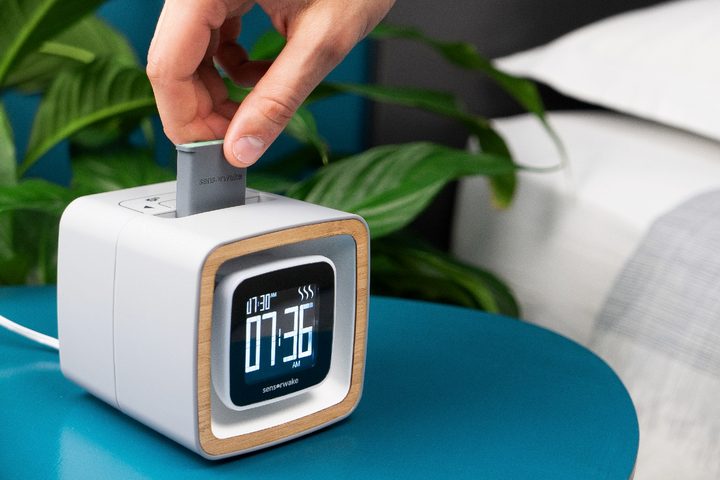
Image used with permission by copyright holder

Rolland said that Sensorwake will appeal to anyone who wants to wake up in a better mood. (And, let’s face it, pretty much everyone falls into that category.) He continued that he sees the product having a particular appeal to both people who frequently travel for work and students who want to wake up better rested for class.

As ever, we offer our usual warnings about the risks inherent in crowdfunding campaigns. However, if you wish to go ahead and get involved you can do so by visiting the project’s Kickstarter page. Having only been up and running for a couple of days, the Sensorwake olfactory alarm clock has already smashed through its crowdfunding target, suggesting that Rolland was quite right in thinking that there is an audience for this.

An alarm clock with two scent capsules will set you back $59, while other higher-priced options come with more capsules. These capsules are also available to buy separately. Shipping is set to take place in November.

Luke Dormehl
I'm a UK-based tech writer covering Cool Tech at Digital Trends. I've also written for Fast Company, Wired, the Guardian…
Claude can now join your Slack channels and work alongside your team
Laptop running Claude Fable

For years, AI assistants have been siloed. You open ChatGPT, Claude, Gemini, or Copilot, type a prompt, get an answer, and move on. Anthropic's new Claude Tag feature takes a different approach. Instead of making employees jump into a separate AI chat every time they need help, it brings Claude directly to where many teams already spend their day: Slack.

Add Claude to a channel, grant it access to needed tools, and tag @Claude for help — whether analyzing data, writing reports, reviewing code, or investigating incidents. But Claude Tag isn't just another chatbot integration. Its key differentiator is that Anthropic positions it as a digital coworker for your team, enabling seamless collaboration where multiple users can jointly interact with the same AI within their work environment.

Read more
Getty Images accused AI of wholesale theft. It’s now an official ChatGPT image partner.
Advertisement, Shop, Clothing

The AI industry's most fascinating stories often come from unlikely alliances, and this is certainly one of them. Getty Images, a company that has spent years raising concerns about how AI models are trained and how creative work is used, is now officially partnering with OpenAI.

The new agreement will allow Getty Images' licensed content to appear across ChatGPT's search and discovery experiences. That means users may begin seeing Getty's professionally licensed photos and visual assets integrated into ChatGPT responses, adding more visual context to searches and AI-generated answers. Getty says the goal is to make AI-powered search more useful and trustworthy by relying on high-quality, licensed content rather than the murky sourcing practices that have sparked countless debates across the AI industry.

Read more
Timekettle’s new X1 Meeting Hub does real-time translation for 50 people and fits in your pocket
Fifty participants, five languages, one 199-gram hub, and no booth required.
Electronics, Screen, Computer Hardware

Professional conference interpretation setups are notoriously painful. Dedicated booths, trained interpreters, bulky hardware, and a bill at the end of every month that makes you rethink whether the meeting was even required in the first place. 

Timekettle wants to collapse all of that into a single hub that weighs 199 grams (less than modern flagship smartphones). The company just launched the X1 Meeting Interpreter Hub. 

Read more