  1. Home
  2. Emerging Tech
  3. Smart Home
  4. News

Color-changing LED stools let you know if you’re sitting with bad posture

Add as a preferred source on Google
Image used with permission by copyright holder

Sitting down for hours on end is bad for you. But what is the best way to prompt folks to get up and stretch their legs every so often? Looking for a solution to that very issue has previously led designers, technologists and engineers to create everything from standing desks to the Apple Watch’s periodic reminders that you should get up and move around. A new effort from German research organization Fraunhofer may be our favorite approach yet, however.

They have developed a special LED stool which is designed to encourage healthy sitting, and prompt “active, conscious movements” while a person is sitting down. The health benefits of promoting healthy back movements could not just help reduce back pain (an obvious side effect of sitting with poor posture), but also cardiovascular problems, excess weight, and high blood pressure, which can result from an inactive lifestyle.

Recommended Videos

The stool is fitted with a variety of sensors and LEDs which offer color-coded feedback regarding the way that you are sitting, as well as providing more detailed information through a connected app. The pressure sensors in the stool identify incorrect posture through measuring a user’s weight distribution on the seat. The seat can even lead you through defined movement exercises.

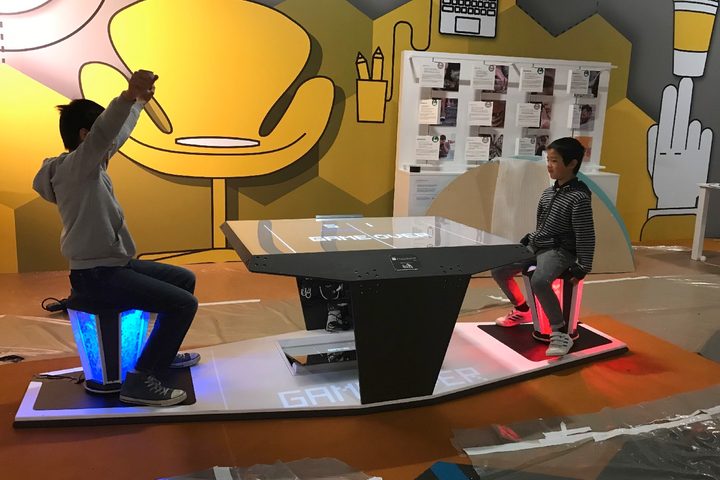
Oh, and did we mention the games? That’s right: since this is a proof of concept, the researchers went one step further and constructed a gaming table which lets people play seat-related games. Okay, so a game that you control by sitting nicely doesn’t sound amazing, but in this case the results are pretty neat. The researchers reworked classic titles like Pong, in which you control the on-screen paddles by making certain pelvic movements.

“We know from scientific research that the balancing movements have a positive impact on mental performance in terms of concentration and productivity,” Nguyen-Truong Le, one of the researchers on the project, told Digital Trends. “By playing games in such ways at work, social interaction with co-workers can be improved.”

There are no immediate plans for commercialization. Instead, the researchers point to this as a demonstration of its soft pressure sensors. These can be built into a wide range of environments, including not only stools, but also mats, steering wheels, and far more. They could therefore be used for a wide variety of applications. Don’t give up hope if you’re dreaming of getting your hands on these smart stools, though. “There will be an open-source distribution of the instructions, including the CAD files and the software to rebuild this product idea,” Le continued. “Everyone can benefit from this project.”

Luke Dormehl
I'm a UK-based tech writer covering Cool Tech at Digital Trends. I've also written for Fast Company, Wired, the Guardian…
Home robots can already walk. The hard part is stopping them from crushing your glassware
1X’s NEO uses tactile sensing and force control to handle fragile objects, aiming at the kind of household work humanoids still struggle to do.
Baby, Person, Electronics

A robot can look convincing while walking across a stage and still be useless in a kitchen. Picking up a wet glass demands precision, quick corrections, and enough restraint to avoid squeezing too hard. 1X is tackling that problem with new tendon-driven hands for NEO, its humanoid home robot.

1X says each hand has 25 degrees of freedom, with 22 across the fingers and palm and another three in the wrist. Its joints can yield when pushed instead of staying rigid, giving NEO a better chance of handling household objects without treating every collision like a wrestling match.

Read more
This tiny gadget called Moodi could save your thumb during long reading sessions
This tiny remote thinks your finger deserves a vacation
DuRoBo Moodi

Digital reading has become more comfortable thanks to larger displays and e-paper screens, but one small annoyance remains: constantly reaching over to tap or swipe every page. DuRoBo believes it has a solution. The company has unveiled Moodi, its first Bluetooth page-turning remote, designed to make reading, browsing, and media control more comfortable across e-readers, tablets, and smartphones.

Unlike conventional page-turners that focus solely on e-books, Moodi doubles as a compact Bluetooth remote for scrolling through articles, controlling multimedia playback, and navigating long-form content. The device looks towards ergonomic accessories that aim to reduce repetitive hand movements during extended screen time.

Read more
Camera sensor breakthrough promises sharper images without hulking up your phone’s thickness
Camera sensors just got thinner. Your excuses for blurry photos didn't.
Representative Image

Researchers at Nagoya University have developed a new type of transparent optical sensor that could significantly reduce the size of camera sensors while improving image quality. Published in the journal ACS Nano, the study demonstrates how gallium-doped zinc oxide (GZO) nanosheets can detect red, green, and blue (RGB) light within a single pixel, potentially replacing the decades-old Bayer filter design used in nearly every digital camera today.

If commercialized, the technology could enable thinner smartphone cameras, higher-resolution medical imaging devices, and more compact sensors for automotive and aerospace applications, all while simplifying manufacturing.

Read more