Online privacy could be on the rise in 2018. After the Cambridge Analytica scandal prompted Facebook to tweak how users can control their ad experience on the social media website, it looks like Google is also stepping up to give you a little more control. The company has announced a revamp of the slightly old and outdated Ad Settings, which Google says “makes it easier to understand and control how ads are tailored to you.”
By the looks of it, the new Ad Settings website will make it a whole lot easier to see the kinds of data that Google is using to advertise to you. The interface is organized based on topics — so you’ll be able to see a list of topics that Google thinks you’re interested in.
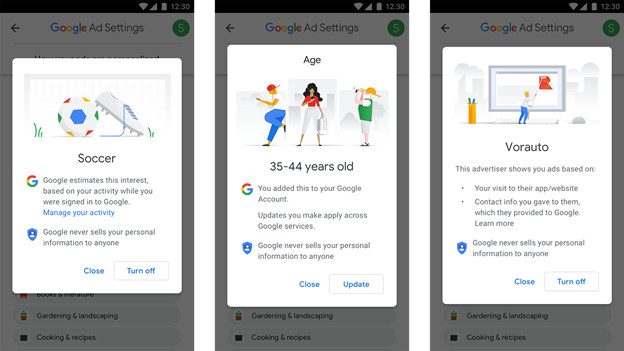
According to Google, data used for advertising is collected in three different ways. For starters, it estimates users’ interests based on their web activity when they’re logged in. Second, it uses data that you’ve directly given the company through your Google account, like your age and location. Last but not least, data is collected from advertisers that partner with Google when you visit their website.
So how does that relate to the new Ad Settings? Well, Google is basically allowing users to turn off whether or not they want ads tailored to them based on one of those metrics. That’s a pretty huge move for Google, whose entire business model is based on advertising — it means that, theoretically, you could tell Google that you don’t want any ads based on data collected by partner websites.
It’s important to note that Ad Settings itself doesn’t give you control over the actual data collected, but rather whether or not Google uses that data to advertise to you. Still, it does link out to places where you can control what kinds of data Google collects.
Revamping Ad Settings isn’t the only thing Google is doing to bolster advertising transparency. The company is also expanding the “Why this ad?” link to all Google ads, including those on YouTube and “almost all” websites that partner with Google to show ads. When you click on “Why this ad?” you’ll basically be shown what data Google is using to suggest the ad to you. For example, you might click on it on YouTube and be told that the ad is being served based on the video you’re watching and data that has been collected while you were signed in to Google.