It’s been a decade and a half since NASA’s Opportunity rover left the Earth. For the last 15 years, this trusty robot has roamed the Red Planet, but now we may have lost her — at least temporarily. A massive dust storm about the size of the North American continent has shrouded Mars and covered Opportunity, and it’s showing no signs of letting up.
In the latest images of Mars, captured by the Mars Reconnaissance Orbiter, it’s clear that the entirety of the Red Planet has now turned…brown. A dust storm that began in late May is raging on, and storms of its ilk apparently engulf the planet every six to eight years.
“It’s exciting because it’s the strongest dust storm we’ve ever seen on Mars,” Tanya Harrison, director of Arizona State University’s NewSpace Initiative, told Gizmodo via Twitter direct message. “It’s worrisome for Opportunity because she’s not getting enough sunlight to keep her batteries charged, but thermal models tell us temperature is on our side.”
Not only is much of the planet in the dark, but so too is Earth about Opportunity’s whereabouts and status. Because the robot’s solar panels have been unable to receive light, its battery status has dropped to the point where Opportunity has gone to sleep, which means it’s no longer transmitting information to Earth. But luckily, the Curiosity rover is doing enough transmitting for the both of them — in fact, Curiosity managed to snap a selfie in the middle of the storm, and looks pretty great.
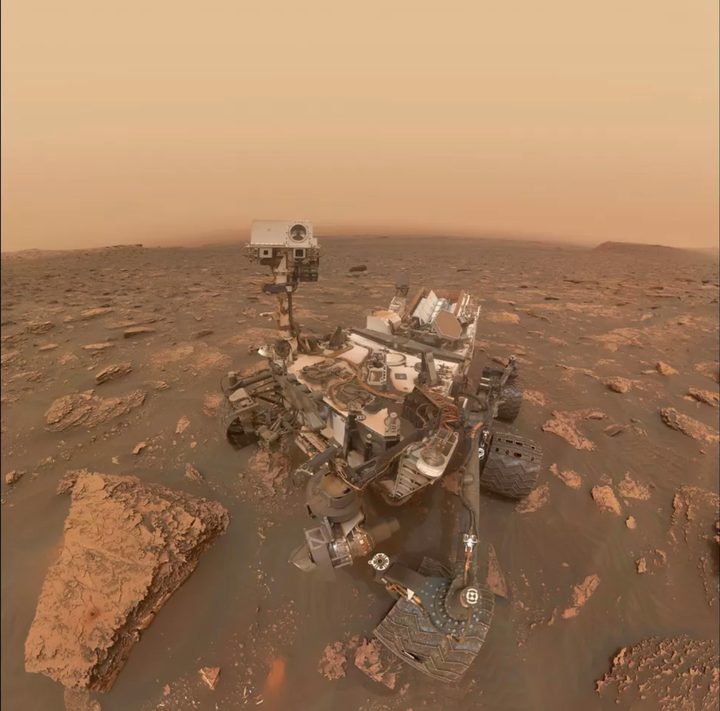
But while Curiosity is out and about, looking fabulous, poor Opportunity isn’t faring so well. “It’s gotten so bad she’s not talking to us,” Bill Nelson, chief of the Opportunity mission’s engineering team at NASA’s Jet Propulsion Laboratory, told Mashable. “It’s a bit scary — we like to hear from our rover.”
On June 8, NASA announced that Opportunity had been covered by the veil of “perpetual night” due to the massive dust storm. And although Opportunity has weathered many a storm since it first touched down on the Red Planet’s surface in 2004, this one is particularly bad. NASA is waiting with bated breath to see whether the rover will be able to repower once the storm finally calms.
“If they go completely dead, you’re usually in trouble,” Nelson noted.
But Opportunity has beaten the odds before. After all, the 400-pound rover was only meant to be operational for 90 days. It’s exceeded that expectation thus far by a factor of more than 56, and it’s possible that it will keep defying expectations.
As Nelson said, “I’m fairly optimistic at this point. I’m hopeful that we may be able to recover.”
That said, the dust storm Opportunity faces is exactly what scientists initially thought would kill the rover. With Martian dust and grime accumulation, it seemed only a matter of time before the solar panels were obscured enough to make it impossible for Opportunity to keep on keepin’ on. “We’ve been lucky that winds or dust devils have come and blown off the arrays,” Nelson explained. “The wind blows off the bulk of the dust. We’ve been fairly fortunate in missing the regional and global dust storms.”
The same could not be said for Opportunity’s sister, Spirit, who met her end in 2010. That poor rover ended up getting stuck in a part of Mars that didn’t receive as much sunlight, and before engineers could move Spirit to a more advantageous location, time ran out.
Apparently, Spirit froze to death.
Opportunity will remain asleep until the dust storm is over, but don’t hold your breath for that. Scientists believe it could be September before everything has settled and the rover is nudged awake. In the meantime, NASA noted in a release, “the Mars Reconnaissance Orbiter, Mars Odyssey, and Mars Atmosphere and Volatile EvolutioN (MAVEN) orbiters are all tailoring their observations of the Red Planet to study this global storm and learn more about Mars’ weather patterns…the Curiosity rover is studying the dust storm from the Martian surface.”
Updated on July 21: The dust storm on Mars is far from over, but NASA and its equipment are coping.