  1. Home
  2. Emerging Tech
  3. News

Reprogrammable Braille could capture the Harry Potter series in a few pages

Add as a preferred source on Google

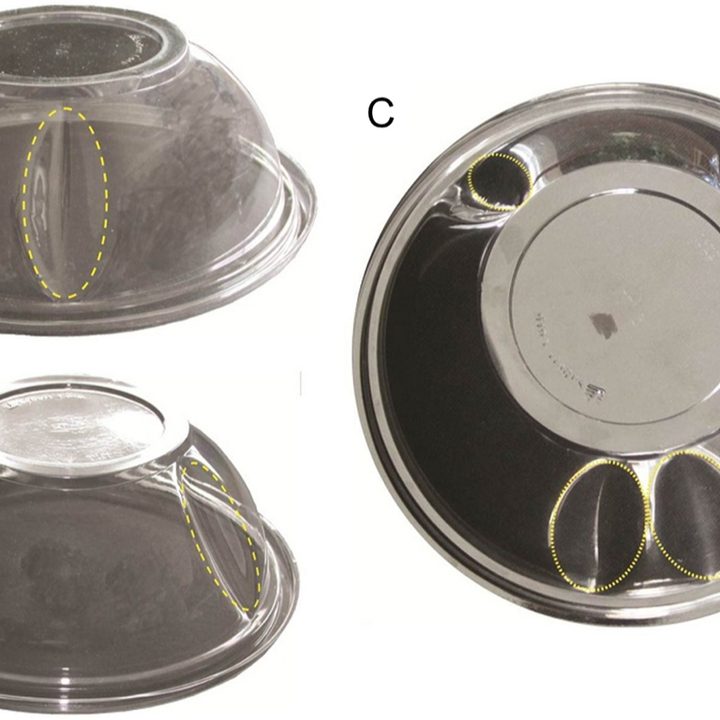
Dimples are formed on an inverted plastic fruit bowl by poking the dimple location with a simple stylus, in much the same way that the pages of a traditional Braille book are printed. Image used with permission by copyright holder

Why carry around a tome when you can carry around just a few pages? That seems to have been the question that launched the latest innovation in Braille, which should help to reduce the size and weight of books for the visually impaired. Researchers at the Harvard John A. Paulson School of Engineering and Applied Sciences (SEAS) have created a so-called reprogrammable Braille — it’s described as “a framework to encode memory, in the form of Braille-like dimples and bumps, onto a blank, lattice-free material.” In essence, this material is as dynamic as the words it can contain, changing as needed to reflect new text.

Recommended Videos

The design is surprisingly simple. First, there’s a thin elastic shell that is compressed on each end. Next, a stylus is used  to create simple indentations, much in the same way that a traditional Braille book might be printed. The shell keeps these indentations where they were even when the force is no longer applied. But once the shell is stretched back out to its original position, those indentations disappear.

“We show how an otherwise featureless curved elastic shell, when loaded appropriately, can store elastic bits (e-bits) that can be written and erased at will anywhere along the shell,” said L. Mahadevan, the Lola England de Valpine professor of applied mathematics at SEAS and senior author of the study. “This system could serve as the basis for small-scale mechanical memories.”

This new material marks the first time that scientists have proven that mechanical memory is possible in a system without any inherent lattice. Moreover, researchers say that their method can be used on any scale — whether it’s one-atom-thick graphene or paper, you should be able to use this  technique to create reprogrammable Braille. If implemented correctly, this could turn Leo Tolstoy’s War and Peace from a massive 21 Braille volumes into just a few pages.

“Simple experiments with cylindrical and spherical shells show that we can control the number, location, and the temporal order of these dimples which can be written and erased at will,” Mahadevan added. “This paper is a first step in showing that we can store memories. The next step is to ask if we can actually compute with them.”


Lulu Chang
Fascinated by the effects of technology on human interaction, Lulu believes that if her parents can use your new app…
Yet another study says AI is bad for elections, and the rabbit hole gets worse
AI may be an election bomb waiting for someone to light the fuse
Voters cast their ballots on Election Day

Another election, another study has concluded that asking an AI chatbot for political guidance is a spectacularly bad idea. Research conducted during Hungary’s 2026 parliamentary election found that ChatGPT and Google Gemini offered not just inaccurate but also inconsistent and unreliable voting advice. The chatbots misclassified voter profiles, overlooked relevant parties, recommended parties absent from the ballot, and sometimes produced materially different answers when given the same information repeatedly.

AI keeps failing the voter test

Read more
Samsung’s humanoid robot ambitions are real, but factories come first
Samsung’s new robotics division has humanoids in its sights, although its immediate business is far more practical factory automation
Robot Touch Human Finger

Samsung wants a place in the humanoid race, but its new robotics push begins with machines built for factories rather than homes.

The CEO-led RX robotics division will initially focus on manufacturing robots. Samsung has separately identified humanoids as a priority, although it hasn’t announced a commercial model or explained where one fits into the division’s immediate plans.

Read more
The future of AI may depend on this one behind-the-scenes change
Running Claude on Android.

Whenever a new AI model arrives, it's easy to get caught up in the bells and whistles. We talk about how much smarter it is, how quickly it answers questions, or how realistic its images have become. But here's the thing: none of that matters much if the AI can't reliably work with the apps and services people use every day.

That's why an upcoming update to the Model Context Protocol (MCP) caught my attention. It isn't a new chatbot or a fancy AI model. In fact, most people will never even know it's happening. But it could quietly make the AI ecosystem a lot healthier. If you've never heard of MCP before, don't worry. Think of it as a shared language that lets AI assistants safely talk to apps like Gmail, Slack, calendars, databases, and countless other services. Instead of every company inventing its own way to make those connections, MCP gives everyone a common rulebook.

Read more