
Dr. Nimesha Ranasinghe doesn’t seem content with the way we consume food and drink here in 2018. The brains behind a previous project that lets you send lemonade over the internet, and a programmable cocktail glass able to trick your senses into thinking you’re drinking just about anything you can imagine, Ranasinghe displays the kind of disregard for culinary convention that would make even the most avant-garde chef balk.
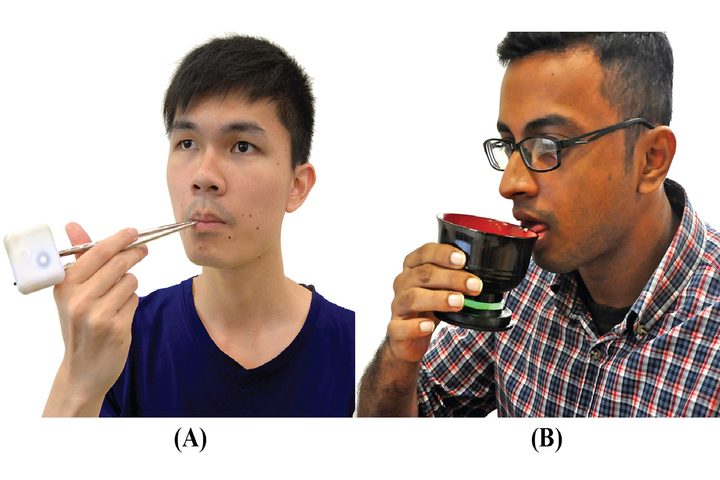
Now he’s back with a new project — and this one’s a real doozy. Created at the National University of Singapore, Ranasinghe developed a pair of chopsticks and Miso soup bowl able to add seasoning to your food through the use of tongue-zapping electrodes. OK, so sticking a combination of eating or drinking utensil and low-powered cattle prod in your mouth might not be to everyone’s taste (pun intended), but it could actually make you lead a healthier diet. And not just because you’d be too scared to eat!
“Our technology demonstrates a digital flavor augmenting solution by applying controlled electrical pulses on the user’s tip of the tongue,” Ranasinghe, who recently took a job as director of the Multisensory Interactive Media Lab at the University of Maine, told Digital Trends. “A pair of chopsticks and a soup bowl is developed to stimulate the user’s tongue while eating and drinking. To achieve electric taste augmentation, the utensils utilize electrical stimulation via a microampere current and two silver electrodes applied to the tip of the tongue during eating interactions.”
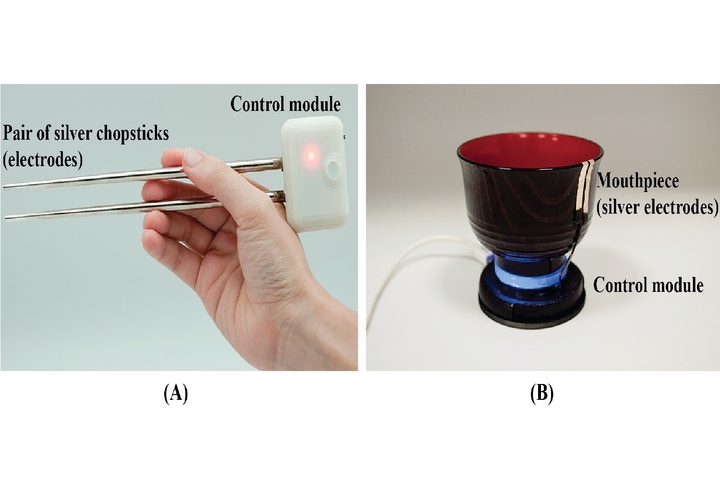
Using the chopsticks, it’s possible to simulate the taste of saltiness, sourness, and bitterness in food — just so long as the chopsticks come into direct contact with the tongue during eating. In theory, this could mean lowering people’s salt intake, since the chopsticks can simulate the taste without requiring any actual salt to be consumed.
“We have developed several form factors of this technology to explore how people intuitively touch different areas of utensils while consuming food and beverages,” Ranasinghe continued. “Our latest study focused on modulating flavor experiences while eating mashed potato, unsalted and salted, and miso soup, [both] diluted and salted. Our findings show that significant increases in perceived saltiness and sourness can be achieved when consuming unsalted mashed potato, and significantly higher ratings of sourness can be achieved when consuming diluted miso soup.”
Now that Ranasinghe is no longer at the National University of Singapore, this particular project has seemingly come to an end. However, Ranasinghe is continuing to investigate cutting-edge technologies for augmenting flavors in his new role. We can’t wait to see what he’s got up his sleeve (or in his kitchen-lab) next!
A paper describing the work was recently published in the journal Food Research International.


