1. Home
  2. Emerging Tech
  3. Gaming
  4. Virtual Reality
  5. News

This cockpit-style simulator will make your VR experiences more immersive

Add as a preferred source on Google
Feel Three Kickstarter Promo

Are you a virtual reality fan, who wishes the whole experience could be made even more immersive than it already is? Do you have the cash to throw down for a gaming chair that looks like something a Star Trek captain or James Bond villain would sit in? If so, you may be interested in the new “3 Degree of Freedom Motion Simulator” that’s just launched on Kickstarter.

Recommended Videos

Created by U.K. entrepreneur Mark Towner, the cockpit-style motion simulator takes the form of a hemispherical platform, seated on an array of omni-wheels. It’s similar in concept to the kind of motion simulator rigs usually reserved for large VR arcades, but intended for home use. The three degrees referenced in its name describe the device’s ability to yaw, pitch, and roll; essentially giving users the ability to quickly (but silently) rotate in any direction. For extra verisimilitude, built-in tactile transducers add immersive surround vibration. This makes it the perfect accompaniment to VR experiences like racing or flight simulators.

“VR is all about the thrill of adventure, of exploring, of flirting with danger in another world — but when you’re flying a Spitfire in VR you’re only getting half the experience,” Towner told Digital Trends. “It might look and sound amazing, but your sofa doesn’t feel like a plane’s cockpit. Most motion simulators are ugly steel frames, noisy as hell, and insanely expensive. We put the user at the center of gravity in a large half-sphere and rotate them instead of pushing them up and down.”
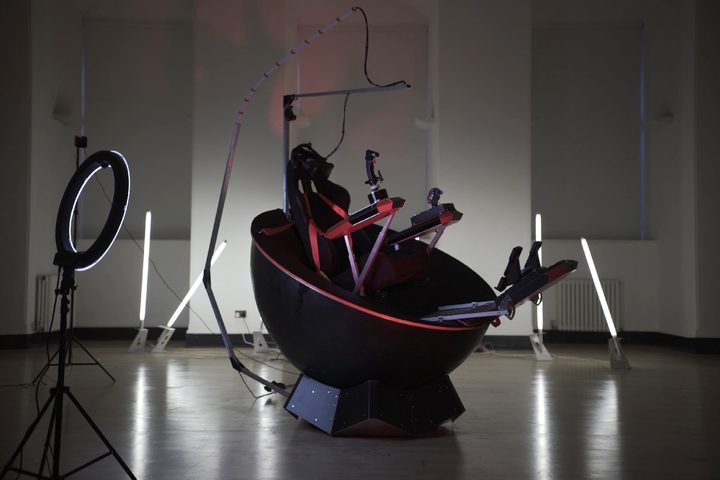
Image used with permission by copyright holder

A particularly neat touch is the contraption’s modular design, which allows users to swap out the regular seat for specialized add-ons to fit the particular VR scenario they want to enjoy.

“There is a huge community of people who love racing, space, and flying games, but without the budget to buy a decent simulator,” Towner continued. “This really gives people an amazing new design to enjoy their hobby, and even learn new skills — such as piloting aircraft, learning to drive, or practicing flying a helicopter. This gives people the chance to experience some thrills on the race track with friends, without the cost or danger.”

As ever, we offer our warnings about the potential risks inherent in crowdfunding campaigns. However, if you’re aware of this and still want to get involved, head over to the project’s Kickstarter page. Prices vary, but the early bird option is still available for $2,590 at time of writing. Shipping is set to take place in May 2019.


Luke Dormehl
I'm a UK-based tech writer covering Cool Tech at Digital Trends. I've also written for Fast Company, Wired, the Guardian…
Yet another study says AI is bad for elections, and the rabbit hole gets worse
AI may be an election bomb waiting for someone to light the fuse
Voters cast their ballots on Election Day

Another election, another study has concluded that asking an AI chatbot for political guidance is a spectacularly bad idea. Research conducted during Hungary’s 2026 parliamentary election found that ChatGPT and Google Gemini offered not just inaccurate but also inconsistent and unreliable voting advice. The chatbots misclassified voter profiles, overlooked relevant parties, recommended parties absent from the ballot, and sometimes produced materially different answers when given the same information repeatedly.

AI keeps failing the voter test

Read more
Samsung’s humanoid robot ambitions are real, but factories come first
Samsung’s new robotics division has humanoids in its sights, although its immediate business is far more practical factory automation
Robot Touch Human Finger

Samsung wants a place in the humanoid race, but its new robotics push begins with machines built for factories rather than homes.

The CEO-led RX robotics division will initially focus on manufacturing robots. Samsung has separately identified humanoids as a priority, although it hasn’t announced a commercial model or explained where one fits into the division’s immediate plans.

Read more
The future of AI may depend on this one behind-the-scenes change
Running Claude on Android.

Whenever a new AI model arrives, it's easy to get caught up in the bells and whistles. We talk about how much smarter it is, how quickly it answers questions, or how realistic its images have become. But here's the thing: none of that matters much if the AI can't reliably work with the apps and services people use every day.

That's why an upcoming update to the Model Context Protocol (MCP) caught my attention. It isn't a new chatbot or a fancy AI model. In fact, most people will never even know it's happening. But it could quietly make the AI ecosystem a lot healthier. If you've never heard of MCP before, don't worry. Think of it as a shared language that lets AI assistants safely talk to apps like Gmail, Slack, calendars, databases, and countless other services. Instead of every company inventing its own way to make those connections, MCP gives everyone a common rulebook.

Read more