1. Home
  2. Emerging Tech
  3. Cars
  4. News

With this robotic garage, retrieving your car is like using a vending machine

Add as a preferred source on Google
ONE PARK w Sub

Technology has given us all kinds of handy tools for helping us find our car in a busy parking lot. But what if our cars came to find us, rather than the other way around? No, we’re not talking about self-driving cars, but rather a new automated car parking and retrieval service that essentially functions as a robot valet.

Recommended Videos

Created by New Jersey-based startup U-Tron, the automated garage system is designed for everything from high-end housing developments to commercial buildings. It allows drivers to pull in off the street, get out of their cars, and then let robots sort out the rest of the parking rigamarole. To retrieve their car, users then load up an app on their smartphone and select the vehicle they want to retrieve. (So long as it belongs to them, that is!) Do this around the time you shut your front door and, with any luck, your car should be ready and waiting by the time you get to the garage.

“[Our] automated parking system is a computer-controlled array of robots that [transfers] the vehicle from the bay room entry point to a parking position and vice versa, without any human intervention,” Executive Vice President of Sales and Marketing Yair Goldberg told Digital Trends. “The system is controlled by an automated parking management software that ‘conducts’ the orchestra of robots. It is a valet system without the valet. The management software allows for the highest level of user interface and connectivity to dedicated apps and building systems, resulting in an experience that transforms parking to an amenity.”
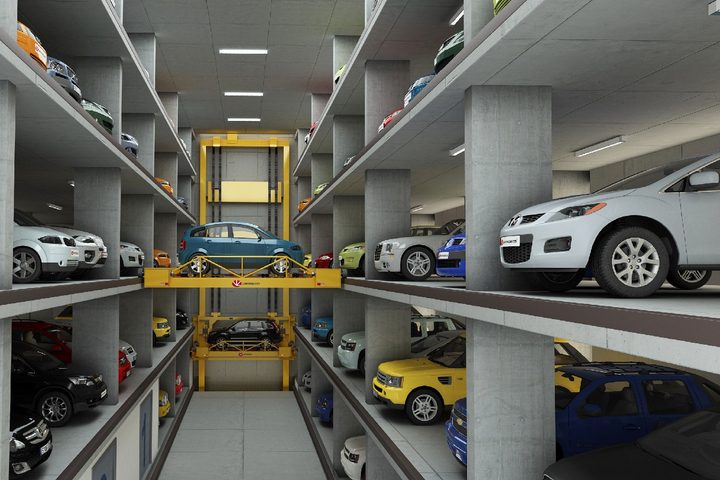
Image used with permission by copyright holder

As attention-grabbing as the idea of a robot valet is, however, in some ways the whole “have your car transported by a robot” concept is really a side attraction. The big problem this system aims to solve is the space issue endemic in most city-based parking lots. A technology like this aims to dramatically reduce the space required for vehicular access to parking space since it eliminates requirements for ramps, turning radiuses, clearances for opening doors, and other previous necessities. Where required, it can even use smart stacking technology to rack up cars like some kind of ultra luxurious vending machine; ready to be recalled at a moment’s notice.

“In all case,s it is a tool in the hands of the architect for a better, greener building design, which results in a superior user experience,” Goldberg said.

The applications for such automated parking systems vary from residential, commercial, retail, and office environments, with different solutions available for different uses. So start petitioning the boss at your office — unless you happen to be wealthy enough to require a personal multi-car garage, that is!

Luke Dormehl
I'm a UK-based tech writer covering Cool Tech at Digital Trends. I've also written for Fast Company, Wired, the Guardian…
Yet another study says AI is bad for elections, and the rabbit hole gets worse
AI may be an election bomb waiting for someone to light the fuse
Voters cast their ballots on Election Day

Another election, another study has concluded that asking an AI chatbot for political guidance is a spectacularly bad idea. Research conducted during Hungary’s 2026 parliamentary election found that ChatGPT and Google Gemini offered not just inaccurate but also inconsistent and unreliable voting advice. The chatbots misclassified voter profiles, overlooked relevant parties, recommended parties absent from the ballot, and sometimes produced materially different answers when given the same information repeatedly.

AI keeps failing the voter test

Read more
Samsung’s humanoid robot ambitions are real, but factories come first
Samsung’s new robotics division has humanoids in its sights, although its immediate business is far more practical factory automation
Robot Touch Human Finger

Samsung wants a place in the humanoid race, but its new robotics push begins with machines built for factories rather than homes.

The CEO-led RX robotics division will initially focus on manufacturing robots. Samsung has separately identified humanoids as a priority, although it hasn’t announced a commercial model or explained where one fits into the division’s immediate plans.

Read more
The future of AI may depend on this one behind-the-scenes change
Running Claude on Android.

Whenever a new AI model arrives, it's easy to get caught up in the bells and whistles. We talk about how much smarter it is, how quickly it answers questions, or how realistic its images have become. But here's the thing: none of that matters much if the AI can't reliably work with the apps and services people use every day.

That's why an upcoming update to the Model Context Protocol (MCP) caught my attention. It isn't a new chatbot or a fancy AI model. In fact, most people will never even know it's happening. But it could quietly make the AI ecosystem a lot healthier. If you've never heard of MCP before, don't worry. Think of it as a shared language that lets AI assistants safely talk to apps like Gmail, Slack, calendars, databases, and countless other services. Instead of every company inventing its own way to make those connections, MCP gives everyone a common rulebook.

Read more