  1. Home
  2. Mobile
  3. Wearables
  4. News

Scientists have charged a phone and a Fitbit with solar-powered clothes

Add as a preferred source on Google
ntu0748 news solar fabrics 1080social191118 mp4

Ever wish you could charge your phone while out and about, without the need for a power bank or a wall socket? The future looks bright — you might be able to do just that, with solar energy from your clothes. Scientists in Britain’s Nottingham Trent University have discovered a way to incorporate solar cells into clothing, paving the way for a future where just being outside in the sunlight can keep your devices topped up with the most literally wearable tech imaginable.

It works by incorporating tiny solar cells into a textile-like yarn. Each cell measures only 3mm in length and 1.5mm in width, making them all but invisible to the naked eye. Two hundred cells can fit into a piece of fabric only 5 square centimeters, and those 200 cells are supposedly enough to generate 2.5 to 10 volts and up to 80 milliwatts in power. According to the researchers, just 2,000 of these cells would be enough to charge a smartphone on the go. It’s not just a pipe dream either — the project has proven to provide enough energy to charge both a smartphone and a Fitbit, using only the energy gained from the solar cells.

Recommended Videos

There’s no need to worry that these “smart textiles” would behave in a different way to normal textiles either. According to the researchers, the cells are so tiny that their presence cannot be felt. As they’re encased in resin, they’re also safe to wash in a normal manner.
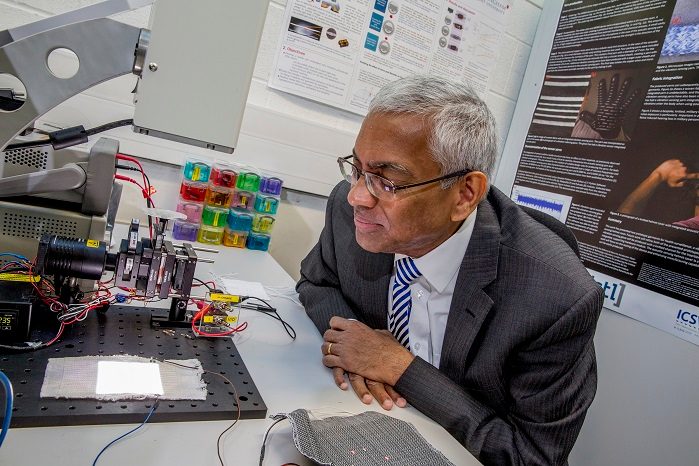
Innovation in Textiles

“By embedding miniaturized solar cells into yarn, we can create clothing and fabric that generate power in a sustainable way,” said project lead  Tilak Dias. “The clothing would look and behave like any other textile, but within the fibers would be a network of miniaturized cells, which are creating electricity.”

It cannot be understated how much of an advance this technology would be. Despite advances, modern technology is still tethered to the nearest power source, and larger batteries have increasingly become the norm, and not having to rely on such large batteries might boost the ability of manufacturers to squeeze in extra tech. The impact on the environment cannot be understated — taking a number of smart devices off the national power grid would also have a huge impact on the ability of humans to live in a more eco-friendly and sustainable manner.

Mark Jansen
Former Mobile Evergreen Editor
Mark Jansen is an avid follower of everything that beeps, bloops, or makes pretty lights. He has a degree in Ancient &…
The best phones in 2026: our 14 favorite smartphones right now
We tested phones across all price brackets so that you can make the best pick based on your needs and budget.
Google Pixel 10 Pro Fold vs Galaxy Z Fold 7 cameras

Choosing the right smartphone in 2026 is no easy task. Apple and Android manufacturers now have strong options at almost every price, while better cameras, longer battery life, improved software support, new AI features, and more refined foldable designs have made the market more competitive than ever. But picking one is not easy, especially if your budget is tight, or you are just legitimately concerned about getting the best value for your money and need a reliable daily driver for long-term usage.

We have tested and compared the leading smartphones available today, looking beyond the spec sheet to see how they actually perform in daily use. Camera quality, battery life, performance, display quality, software, design, and long-term value all play a part in our recommendations. Whether you are looking for a powerful flagship, a dependable budget phone, a compact device, or a foldable, this guide should help narrow down your choices.

Read more
Snapchat Planets Meaning: Order, Rankings, and How Friend Solar System Works
Snapchat Planets turns your best friends list into a solar system, and yes, your orbit says a lot
Snapchat Planets being shown on the Snapchat app on iPhone.

Snapchat+ includes several exclusive features, but few have generated as much curiosity as Snapchat Planets. Part of the app's Friend Solar System, it transforms your Best Friends list into a planetary ranking, assigning each of your top eight friends a planet based on how often you interact.

From Mercury, which represents your closest friend, to Neptune, which represents your eighth closest, the system offers a quick visual snapshot of your interactions. But what do the different planets actually mean, and how does Snapchat decide who gets which one?

Read more
How to use WhatsApp Web
We'll show you how to use WhatsApp on your desktop or laptop
WhatsApp Web

As one of the most popular messaging services, you’ve already heard of WhatsApp. From its humble beginnings in 2009—two years before Apple introduced iMessage—to its acquisition by Facebook (now Meta) in 2014, WhatsApp has become the dominant messaging platform around the globe.

In recent years, it's grown even more potent with new features like video messages, self-destructing voice messages, the ability to edit sent messages, and more. We even finally got an WhatsApp iPad app in May 2025.

Read more