  1. Home
  2. Emerging Tech
  3. News

Chang’e 4 rover spotted on the moon’s surface by Lunar Reconnaissance Orbiter

Add as a preferred source on Google

China’s Chang’e 4 mission has been exploring the far side of the moon, and has already sent back images and made discoveries about the cold lunar nights. Now the Chang’e 4 rover has come into view of NASA’s Lunar Reconnaissance Orbiter Camera (LROC) which has captured images of the Chinese craft perched on the floor of the Von Kármán crater.

The LROC is a system of three narrow-angle cameras that takes high-resolution black and white images, and is a part of the suite of instruments on the Lunar Reconnaissance Orbiter (LRO). The LRO craft is currently in orbit around the moon, where it has been gathering mapping data to identify safe landing zones for other craft and to identify potentially useful resources. As part of this mission, the LROC is used to capture images of the surface of the moon with a remarkable resolution down to 1 meter (3.3 feet).

Recommended Videos

At the end of January, the LRO passed over the Chang’e 4 landing site, although at a considerable distance of more than 124 miles (200 kilometers) away, capturing the Chinese craft as just a few small pixels. The next day, the LRO passed slightly closer to the landing site and captured another image, this one showing both the Chang’e 4 rover and its miniature companion, the Yutu-2 probe.
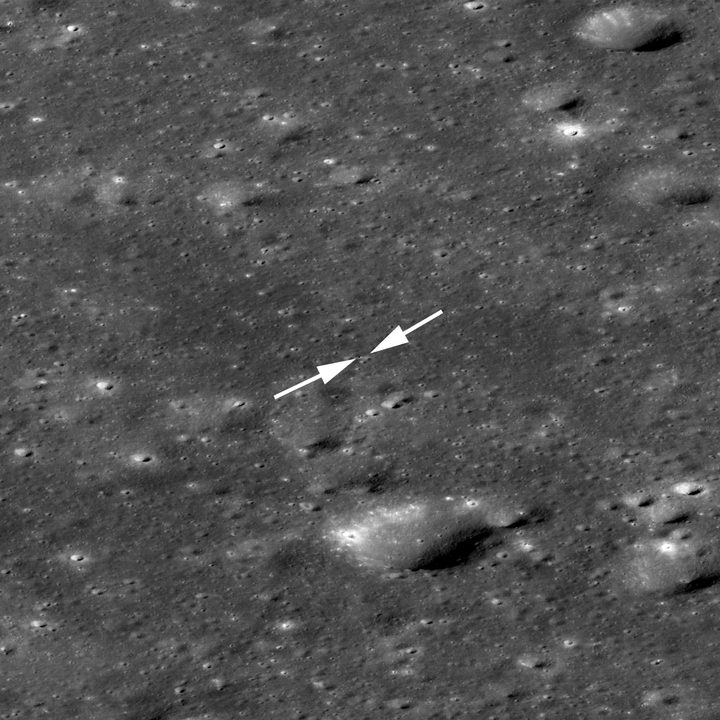
Chang’e 4 lander (near tip of left arrow) and rover (near tip of right arrow) nestled among craters on the floor of Von Kármán crater. Image is 1700 meters (5580 feet) wide across the center, LROC NAC M1303570617. NASA/Goddard/Arizona State University

As you can see from the image of the Von Kármán crater, the area has been struck by a large number of impacts over the years. The surface shows many pockmarks because it is an incredible 3 billion years old, with older craters appearing rough and highly degraded and more recent impacts appearing sharp and crisp. All of these impacts over the years have lead to the surface rock being ground down into a fine powder which looks like dust but is in fact a particular type of lunar soil known as regolith. Beneath the regolith is basaltic bedrock which is stronger than the regolith and harder to displace through impact events, meaning that moderate impacts can reveal layers of the moon’s stratigraphy.

Georgina Torbet
Georgina has been the space writer at Digital Trends space writer for six years, covering human space exploration, planetary…
This $249 LED sign wants to fix your work-life balance
My productivity isn't worth $249... or is it?
Flipper Busy Bar

Flipper Devices has built a reputation among hackers and hardware enthusiasts with the Flipper Zero, a pocket-sized gadget capable of interacting with RFID, NFC, Bluetooth, and other wireless protocols. Now, the London-based company is taking a very different approach.

Its latest product, the Busy Bar, is a desktop productivity display designed to help users stay focused, signal their availability, and automate parts of their workflow. After being teased last year, the device is finally going on sale on July 14. While the concept is genuinely clever, its starting price of up to $249 may make many buyers think twice.

Read more
FAA clears the runway for Mach flights that could cut travel times nearly in half
New regulations could dramatically reduce travel times while keeping sonic booms under control.
Supersonic Flight Time

The dream of flying faster than the speed of sound just took a major step forward. The Federal Aviation Administration (FAA) has announced a proposed rule that would create the first noise-based certification standards for a new generation of supersonic passenger aircraft, removing one of the biggest regulatory hurdles standing in the way of commercial Mach 1+ flights.

The goal is simple: fly faster without the boom

Read more
NotebookLM’s 60-second videos turned my doomscrolling curse into something useful
Electronics, Mobile Phone, Phone

Short videos have taken over just about every app we use. You scroll through them on X, lose track of time on Instagram, watch them on YouTube, and now even Netflix has its own bite-sized feed. So when I heard that Google was bringing the format to NotebookLM, it felt both surprising and completely inevitable at the same time.

Google has announced Short Video Overviews for NotebookLM, a feature that turns dense documents and complicated sources into 60-second vertical videos that explain key ideas. Instead of staring at pages of notes, you get a quick visual walkthrough of the concept you're trying to understand.

Read more