  1. Home
  2. Emerging Tech
  3. News

A river of stars one billion years old flows across the southern sky

Add as a preferred source on Google

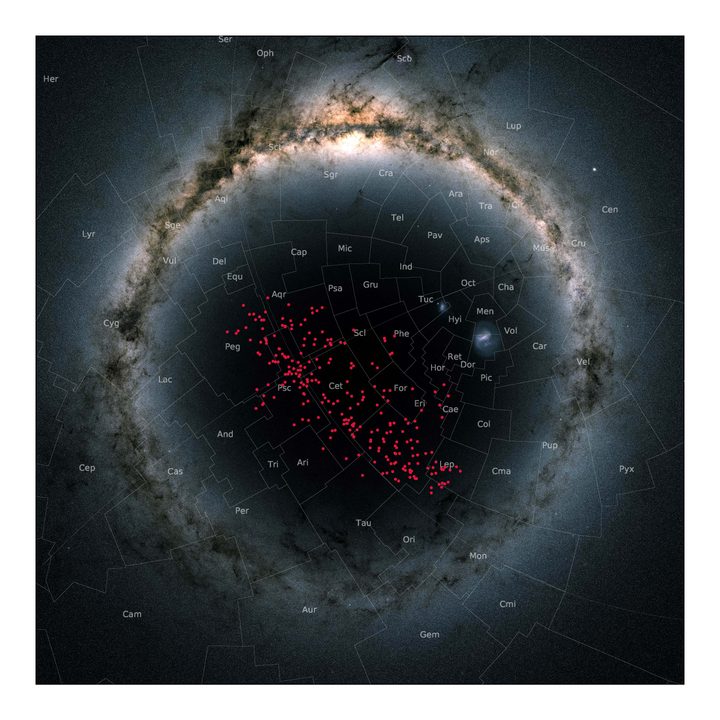
In this special projection, the Milky Way curves around the entire image in an arc. The stars in the stream are displayed in red and cover almost the entire southern Galactic hemisphere. Astronomy & Astrophysics

Astronomers from the University of Vienna have identified a river of stars flowing across our galaxy and covering most of the southern sky. The 4000 estimated stars that comprise the stream were born together and have been moving together for the last one billion years, making the river a rarity as most star clusters are quickly dispersed once they form.

Recommended Videos

Typically, when star clusters form they do not contain enough stars to create sufficient gravity to hold the cluster together, and gravitational forces quickly disperse the stars throughout the galaxy. But from observation of nearby space, astronomers have determined that there are a few clusters with enough mass to remain bound together for millions of years. The team from Vienna were able to identify such a cluster relatively nearby within the Milky Way, and map it using the European Space Agency satellite Gaia.

“Identifying nearby disk streams is like looking for the proverbial needle in a haystack,” João Alves, one of the authors of the paper, said in a statement. “Astronomers have been looking at, and through, this new stream for a long time, as it covers most of the night sky, but only now realize it is there, and it is huge, and shockingly close to the Sun. Finding things close to home is very useful, it means they are not too faint nor too blurred for further detailed exploration, as astronomers dream.”

The team found the river by measuring the 3D motion of stars through space and seeing which nearby stars moved together. Using the data from Gaia they were able to identify 200 stars in the river, but the data suggests that at least 4000 stars make up the stream. Because it is so old, this cluster has already orbited all the way around the galaxy four times, giving gravitational forces the time to pull the cluster into its stream-like structure.

As the stream is nearby, it is an excellent potential target for planet-hunting missions and could help us learn more about how stars move within galaxies.

The findings are published in the journal Astronomy & Astrophysics.

Georgina Torbet
Georgina has been the space writer at Digital Trends space writer for six years, covering human space exploration, planetary…
Chrome is getting better at understanding the breaks and punctations you never say out loud
Voice typing in Chrome is about to feel much more natural
Google Chrome on Android Featured

Google is quietly making voice dictation in Chrome feel a lot more natural. With the latest Chrome 151 Beta, the company is introducing a new capability that allows the browser's speech recognition engine to automatically infer punctuation based on the way people speak, eliminating the need to explicitly say commands like "comma" or "full stop."

The update may sound minor at first glance, but it addresses one of the biggest frustrations with voice typing: speaking naturally often produces text that lacks punctuation unless users consciously dictate every punctuation mark. By teaching Chrome to understand pauses, rhythm, and speech patterns, Google is taking another step toward making conversations with computers feel more human.

Read more
Horror films play music to warn about danger. These headphones use the same trick to save you from robots
Spherephones replaces factory alarms with music that tells you what is coming and from where.
spherephones-georgia-tech

The ear has always processed what is coming before the eye does. In horror movies, the music always tells you something bad is coming. Now researchers at Georgia Tech are using the same idea in real life to keep factory workers safe around robots.

They have built a wearable headset called Spherephones that converts nearby robot movement into spatial music, giving you a warning before a machine gets too close. It helps the user stay aware without breaking their attention.

Read more
Elon Musk refutes report claiming that an AI device is in development at SpaceX
The billionair's two-word denial on X doesn't explain what part of the Wall Street Journal's report he's disputing.
Elon Musk speaking into a microphone with a blue background

Elon Musk has denied a Wall Street Journal report claiming SpaceX showed investors a prototype AI device before its recent IPO. "Utterly false," Musk wrote on X, responding to a post about the report that has since been deleted, offering no further explanation.

A denial that leaves more questions than it answers

Read more