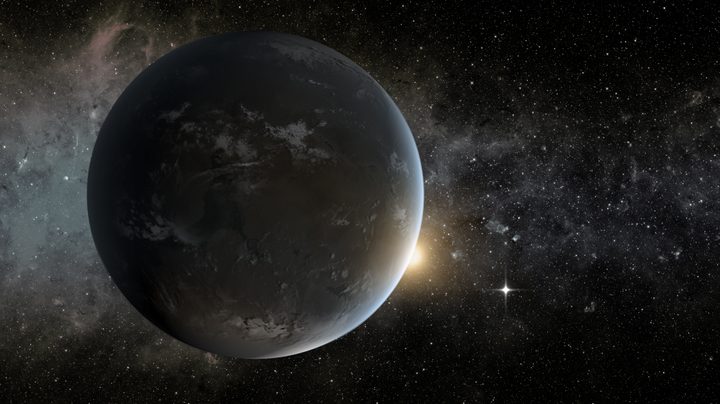
Not too hot, not too cold — this one’s just right. To identify potentially habitable worlds, astronomers search in the “Goldilocks Zone” around stars to find planets where liquid water can exist on the surface. Now a new study has identified types of star called K stars which make especially promising targets to host habitable planets.
K stars are less bright than our Sun, but brighter than the dimmest stars — called M stars or red dwarfs. This means K stars shine for a much greater length of time than our Sun, lasting between 17 billion and 70 billion years as compared to our Sun’s 10 billion years. The K stars are also more stable, experiencing less extreme activity when they are young than M stars which go through dramatic phases of stellar flares, and give off so much energy that they could boil oceans on nearby planets. All together, these factors mean that K stars have long periods when they are stable, giving plenty of time for potential life to evolve.
“I like to think that K stars are in a ‘sweet spot’ between Sun-analog stars and M stars,” Giada Arney of NASA’s Goddard Space Flight Center in Greenbelt, Maryland, said in a statement.
Traditionally, the search for habitable planets has focused primarily on M stars because they are so prevalent, making up about three quarters of all the stars in the universe. But K stars may make better targets for the search, not only because they are long-lived and stable, but also because it is easier to spot potential signs of life near them.
One way to see potential sites of life is to look for a planet with both oxygen and methane in its atmosphere. These two gases usually react and destroy each other, so if you see both present at the same time it suggests that something must be producing them both — and that something could be life. But in order to detect oxygen and methane in a planet’s atmosphere from a long way off, they both must be present in large quantities.
Arney used computer modelling to see how different types of planetary atmosphere would respond to different star hosts. She found that the biosignature of oxygen and methane would be strongest when the planet in question orbited around a K star.
“When you put the planet around a K star, the oxygen does not destroy the methane as rapidly, so more of it can build up in the atmosphere,” Arney said in the same statement. “This is because the K star’s ultraviolet light does not generate highly reactive oxygen gases that destroy methane as readily as a Sun-like star.”
Arney also indicated particular K stars which would be prime targets for investigation, including 61 Cyg A/B, Epsilon Indi, Groombridge 1618, and HD 156026.