  1. Home
  2. Emerging Tech
  3. News

NASA shares an update about its next generation launch system, SLS

Add as a preferred source on Google

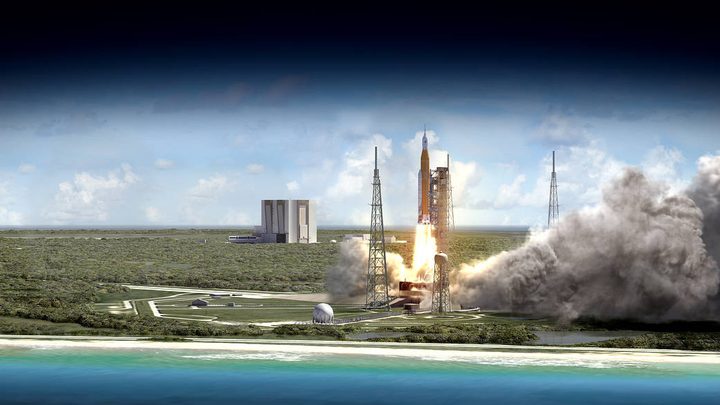
This artist rendering shows a wide-angle view of the liftoff of the 70-metric-ton (77-ton) crew vehicle configuration SLS from the launchpad. NASA/MSFC

NASA is working on a next-generation launch system called Space Launch System, or SLS, hoping to create a transport system to take astronauts of the future to the Moon and beyond. Design and manufacturing for SLS was already underway last year, and now NASA has announced their progress towards the first mission for the new system, Exploration Mission-1 (EM-1) in 2020.

Recommended Videos

The first part of the new system is a crew capsule called Orion. Engineers are currently working on stacking the crew and service modules together and checking that they operate harmoniously. Once these fitting tests are complete, the stacked modules will be taken to NASA’s Plum Brook Station in Ohio where they will be tested in a thermal vacuum and against electromagnetic interference. Then the modules will return to the Kennedy Space Center for final testing before they are integrated with SLS.
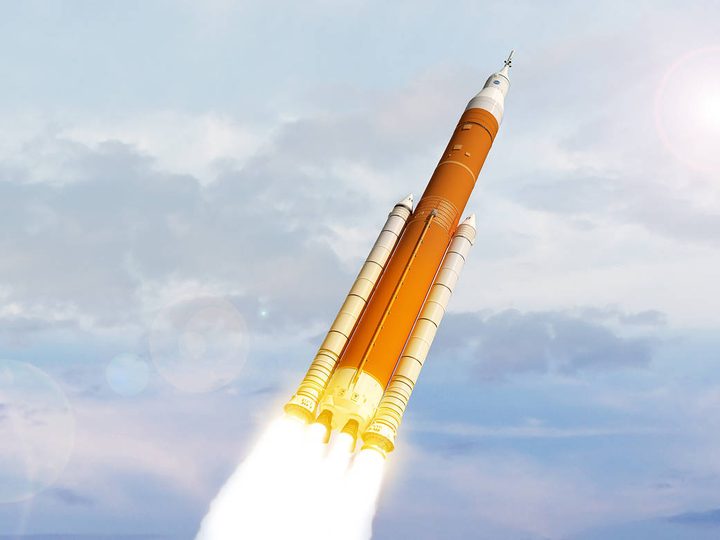
The next generation of NASA’s Space Launch System will be 364 feet tall in the crew configuration, will deliver a 105-metric-ton (115-ton) lift capacity and feature a powerful exploration upper stage. On SLS’s second flight with Orion, the newer rocket will carry up to four astronauts on a mission around the moon, in the deep-space proving ground for the technologies and capabilities needed on NASA’s Journey to Mars. NASA

The second part of the system is the SLS rocket. Production of the first flight’s core stage is nearly completed, and once finished the SLS will be the most powerful rocket in the world. The other part of the core stage being worked on is the engine section, which sits at the bottom of the core stage and feeds propellant into the four powerful RS-25 engines. Once this section is complete it will be connected to the 130-foot-long liquid hydrogen propellant tank, then also to the forward section which includes the liquid oxygen tank.
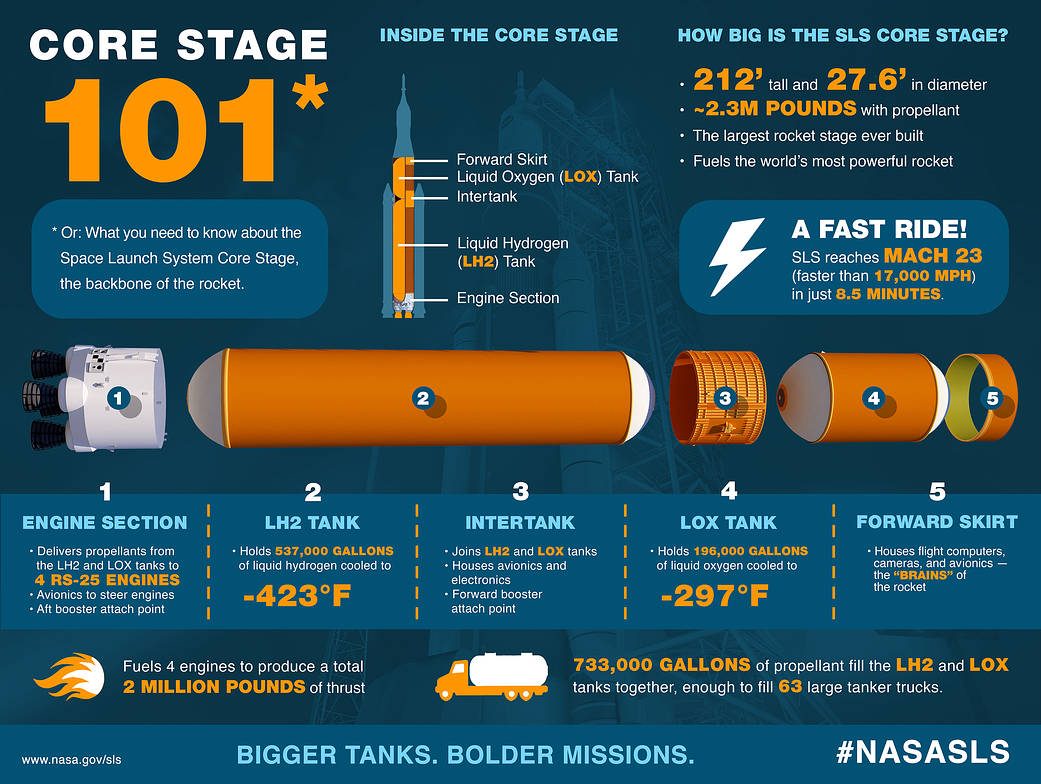
An illustration of Space Launch System Core Stage 101 NASA/MSFC

All of the preparations are building towards the EM-1 unmanned test flight in 2020, followed by a mission to send a crew around the Moon and back to Earth in a second mission called Exploration Mission-2 (EM-2) by 2023.

Georgina Torbet
Georgina has been the space writer at Digital Trends space writer for six years, covering human space exploration, planetary…
A new AI model wants self-driving cars to think before they swerve
Forget guessing games, this self-driving AI actually shows its work.
Self driving car

Self-driving cars have gotten pretty good at driving. The harder problem is teaching them to drive safely in situations nobody planned for. We have heard horror stories of self-driving cars, behaving erratically in emergency situations, often times delaying first responders from reaching the scene.

A team at Seoul National University, led by professor Jun Won Choi from the Department of Electrical and Computer Engineering, thinks they have cracked part of that puzzle with a new AI model called SafeDrive. The research was recently selected as a highlight paper at CVPR 2026, a distinction that goes only to roughly 3% of all submissions.

Read more
An AirPods-sized mini lab could help catch disease markers in minutes
Meet VPodDuo, an AirPods-sized molecular testing gadget
VPodDuo Mini Medical Device

Home testing could eventually become a lot more convenient. Researchs at the at the University of Illinois Urbana-Champaign has developed the VPodDuo, a pocket-sized fluorescence reader designed to measure sensitive molecular tests outside a conventional laboratory.

Its housing is roughly comparable in size and shape to an AirPods charging case, while Bluetooth connectivity sends results directly to a smartphone. Meaning, you might not have to wait in line anymore.

Read more
Your future AR glasses might finally stop making the real world look weird
Researchers have developed a new display technique that keeps virtual objects realistic without dimming the real world.
Samsung AR Glasses

One of the biggest promises of augmented reality is blending digital objects seamlessly into the real world. Ironically, today's AR glasses often make the real world harder to see. Researchers at the Shibaura Institute of Technology (SIT) in Japan, led by Assistant Professor Xiaodan Hu in collaboration with Dr. Yan Zhang and Professor Xubo Yang from Shanghai Jiao Tong University in China, and Professor Kiyoshi Kiyokawa from Japan's Nara Institute of Science and Technology, have developed a new AR display technique that aims to make virtual objects look realistic without reducing visibility of the real world. The study was published in IEEE Transactions on Visualization and Computer Graphics.

The biggest AR problem isn't virtual objects; it's everything around them

Read more