  1. Home
  2. Emerging Tech
  3. News

Burnin’ through the sky: Queen’s Brian May creates stereoscopic image of asteroid

Add as a preferred source on Google

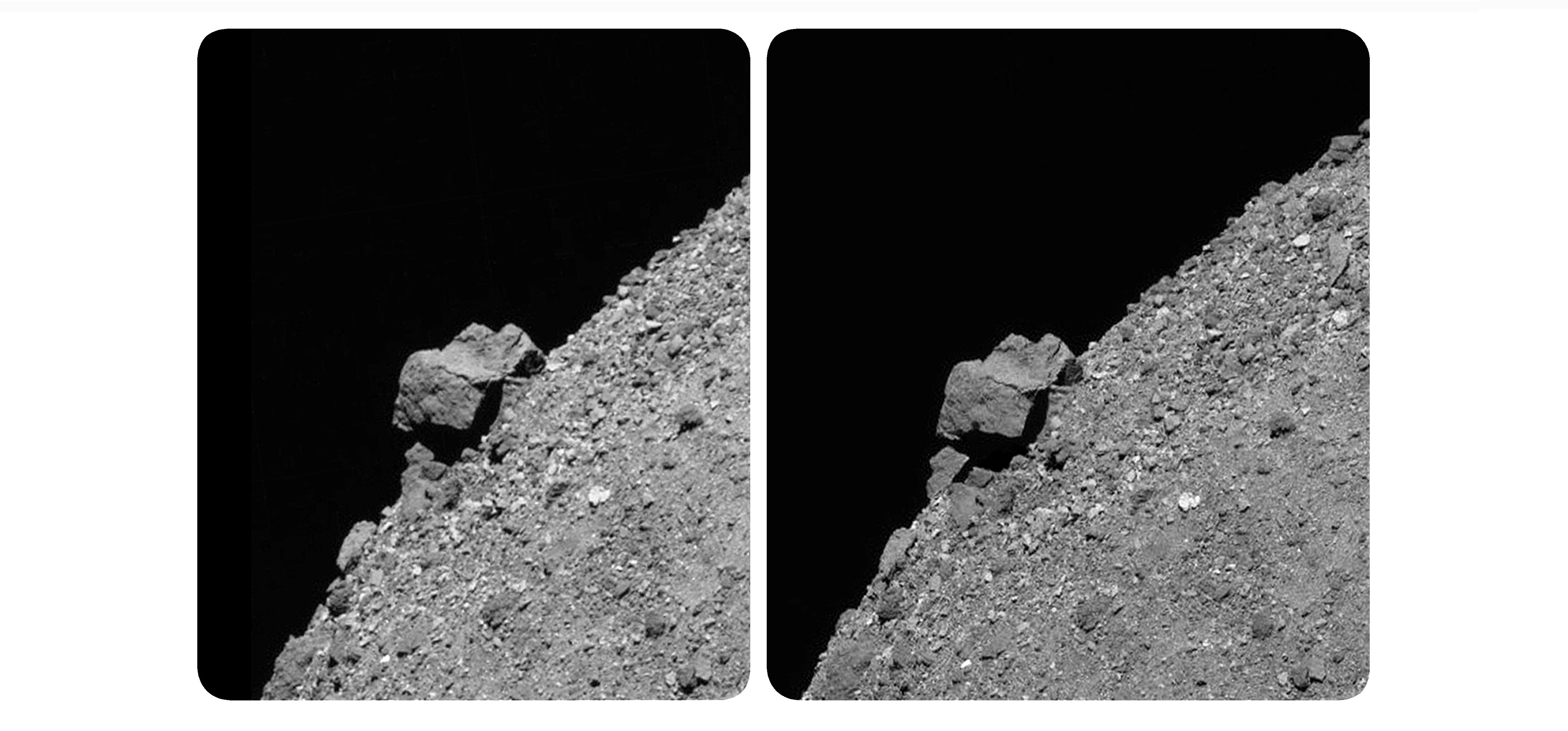
A set of stereoscopic images of a large boulder on asteroid Bennu’s southern hemisphere. NASA/Goddard/University of Arizona

Asteroid Bennu is full of surprises. Not only has it been spewing out plumes of particles, but it also turns out to be much less smooth on its surface than expected, with large boulders densely packed on the rough surface.

Recommended Videos

Now one particularly large boulder has been imaged: a massive 170-foot long (52 meter) boulder sitting on the southern hemisphere of the asteroid. NASA has released this stereoscopic image of the boulder, consisting of a pair of images taken from slightly different viewpoints. This enables viewers to see the illusion of depth in the image.

If you cross your eyes and relax your vision while looking at the image, you should be able to see the image as if it is in 3D. Tilting your head to the side can help the image come into focus. Or alternatively, if you have access to a stereoscope you can see a version of the image pair optimized for stereoscope viewing here.

And as well as its scientific importance and public interest, there’s another reason this image pair is noteworthy: It was created by Queen guitarist Brian May, along with his colleague Claudia Manzoni. May studied mathematics and physics and started a Ph.D. in astronomy at Imperial College London, but he put his physics career on hold to join the band in 1968.

Decades later, after a hugely successful career as a rock star, he returned to Imperial to complete his Ph.D. in 2007. At the time, he described it to BBC News as “the longest gap year ever” and said “[i]t was a tough decision back then to leave my studies for music.”

Since completing his Ph.D., May has been working on astronomy projects like the analysis of the Bennu data. “I’m proud to have been adopted as a collaborator on the OSIRIS-REx team, along with my colleague Claudia Manzoni,” he said on Instagram. “Our passion is producing stereoscopic (3-D) images from the astounding data that the OSIRIS-REx mission has been collecting. Special thanks to mission PI, Prof. Dante Loretta, for making this possible.

In a final charming tidbit, according to May the boulder on the surface of Bennu has been christened BenBen.

Georgina Torbet
Georgina has been the space writer at Digital Trends space writer for six years, covering human space exploration, planetary…
FAA clears the runway for Mach flights that could cut travel times nearly in half
New regulations could dramatically reduce travel times while keeping sonic booms under control.
Supersonic Flight Time

The dream of flying faster than the speed of sound just took a major step forward. The Federal Aviation Administration (FAA) has announced a proposed rule that would create the first noise-based certification standards for a new generation of supersonic passenger aircraft, removing one of the biggest regulatory hurdles standing in the way of commercial Mach 1+ flights.

The goal is simple: fly faster without the boom

Read more
NotebookLM’s 60-second videos turned my doomscrolling curse into something useful
Electronics, Mobile Phone, Phone

Short videos have taken over just about every app we use. You scroll through them on X, lose track of time on Instagram, watch them on YouTube, and now even Netflix has its own bite-sized feed. So when I heard that Google was bringing the format to NotebookLM, it felt both surprising and completely inevitable at the same time.

Google has announced Short Video Overviews for NotebookLM, a feature that turns dense documents and complicated sources into 60-second vertical videos that explain key ideas. Instead of staring at pages of notes, you get a quick visual walkthrough of the concept you're trying to understand.

Read more
You can now generate images with Gemini’s memory without paying a dime
Study guide created by Gemini

Google has made one of Gemini's most interesting AI tricks a lot easier to try. The company is rolling out its personalized image generation feature to eligible U.S. users for free, removing a paywall that previously kept it exclusive to Gemini's paid tiers.

Powered by Google's Nano Banana image model, the feature does more than generate pretty pictures; it taps into Gemini's understanding of you, making AI-generated images feel surprisingly personal.

Read more