  1. Home
  2. Emerging Tech
  3. News

Breakthrough in bioprinting could enable 3D printing of replacement organs

Add as a preferred source on Google

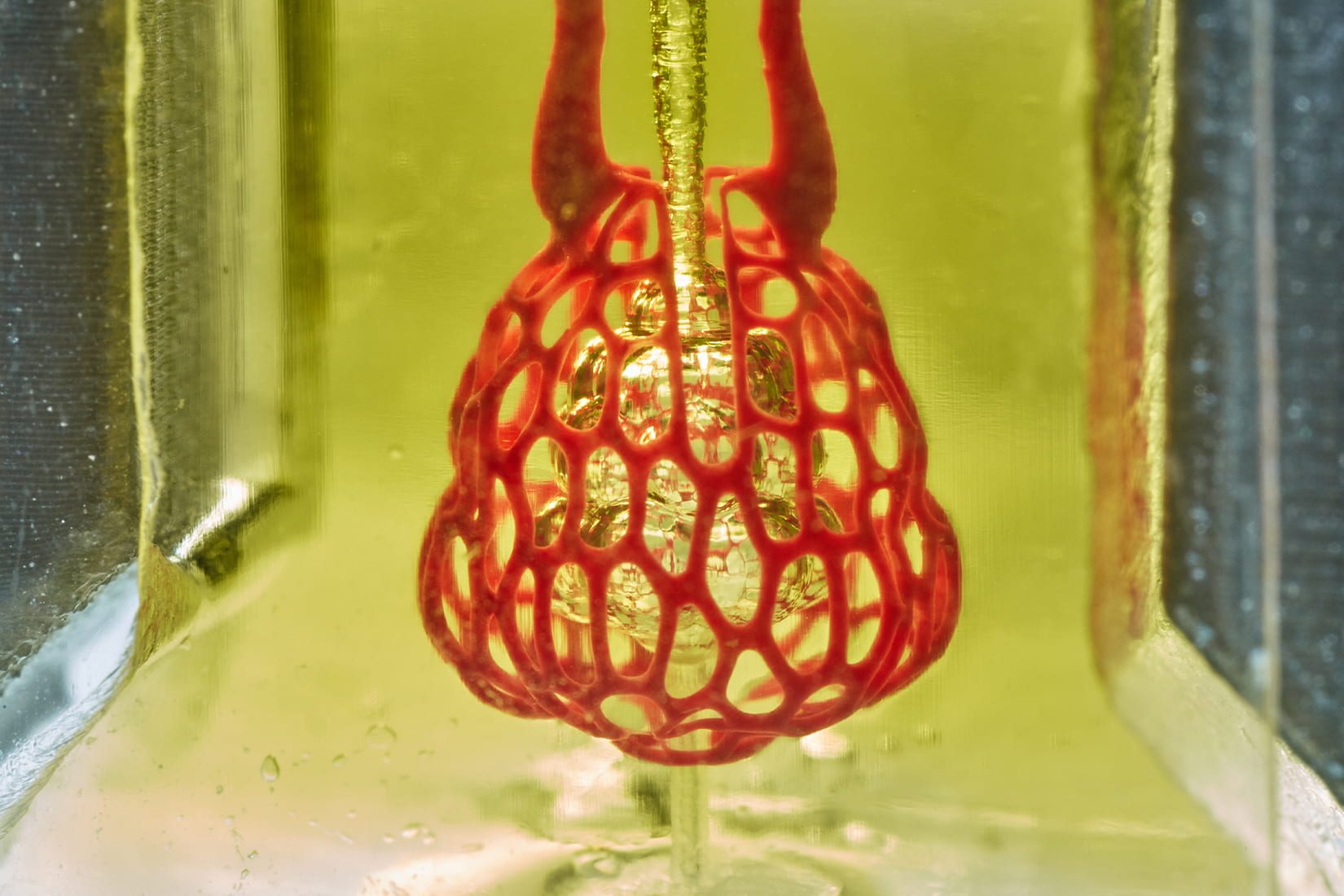
Bioprinting research from the lab of Rice University bioengineer Jordan Miller featured a visually stunning proof-of-principle — a scale-model of a lung-mimicking air sac with airways and blood vessels that never touch yet still provide oxygen to red blood cells. Jordan Miller/Rice University

Scientists have taken a major step towards the 3D-printing of replacement organs. A new technique for bioprinting tissues allows scientists to create vascular networks like those used in the body to transport blood, air, and other fluids.

Recommended Videos

Along with publishing the research in the journal Science, the scientists released a video showing a lung-like air sac which can feed nutrients and oxygen to nearby tissue:

Bioengineers clear major hurdle on path to 3D printing replacement organs

“One of the biggest road blocks to generating functional tissue replacements has been our inability to print the complex vasculature that can supply nutrients to densely populated tissues,” Jordan Miller, assistant professor of bioengineering at Rice University’s Brown School of Engineering, explained in a statement.

“Further, our organs actually contain independent vascular networks — like the airways and blood vessels of the lung or the bile ducts and blood vessels in the liver. These interpenetrating networks are physically and biochemically entangled, and the architecture itself is intimately related to tissue function. Ours is the first bioprinting technology that addresses the challenge of multivascularization in a direct and comprehensive way.”

The importance of this development was underscored by Miller’s colleague, Kelly Stevens of the University of Washington. “Tissue engineering has struggled with this for a generation,” Stevens said. “With this work we can now better ask, ‘If we can print tissues that look and now even breathe more like the healthy tissues in our bodies, will they also then functionally behave more like those tissues?’ This is an important question, because how well a bioprinted tissue functions will affect how successful it will be as a therapy.”

The scientists expect that bioprinting will become a part of mainstream medicine with the next 20 years. Current research is being performed in both university and private settings, such as startup company Volumetric which employs several of the researchers. But Miller is a proponent of open-source 3D printing and has made all the data from this experiment freely available through the publication in the journal Science.

Georgina Torbet
Georgina has been the space writer at Digital Trends space writer for six years, covering human space exploration, planetary…
The Apple Car may be dead, but it became the foundation of Apple Intelligence
A decade of work on a canceled car project reportedly laid the groundwork for Apple Intelligence.
Apple Intelligence in Apple Car

The Apple Car may have never left the garage, but it apparently gave birth to Apple's AI ambitions. According to Bloomberg's Mark Gurman, Apple's canceled autonomous vehicle project, one that consumed more than a decade of work and over $10 billion before being scrapped in 2024, ended up laying the technological foundation for Apple Intelligence. In a rather ironic twist, one of Apple's most expensive failures may also become one of its most important long-term investments.

The Apple Car forced Apple to think like an AI company

Read more
Researchers hid a prompt injection inside a PNG, and AI fell for it
Hacker

AI coding assistants like Claude are becoming every developer's favorite coworker. They can review code, explain confusing functions, and even write entire features with a single prompt. But new research suggests that this growing trust could also become their biggest weakness.

A team of security researchers (professor Sudipta Chattopadhyay and researcher Murali Ediga) has demonstrated an unusual attack that doesn't target the AI model directly. Instead, it targets what the AI doesn't pay enough attention to during code reviews. Rather than hiding malicious instructions in lines of code, the researchers tucked them inside an image file. Since many AI review tools treat images as decorative assets rather than as something worth inspecting, the pull request can appear perfectly harmless and sail through the review.

Read more
AI has already fallen into the wrong hands and they’re using it to make bombs
Logo, Text

Artificial intelligence has quickly become the go-to tool for everything from writing emails and summarizing meetings to helping students study or developers debug code. But the same technology that saves people time can also be misused, and a new report suggests that terrorist organizations are finding ways to do exactly that.

According to a research paper shared with The New York Times ahead of its publication, researchers found evidence that members of Boko Haram have been using popular AI chatbots to support both day-to-day activities and combat-related tasks. Interviews with 27 former members conducted in Nigeria over the past two years suggest that tools such as ChatGPT, Gemini, Claude, Grok, Meta AI, and DeepSeek were used to gather technical information, troubleshoot weapons, and even assist with planning attacks.

Read more