When it comes to robots, it’s easy to get so caught up in the big creations that we forget about the innovation taking place at the smaller end of the spectrum. As the University of Southern California’s new Bee Plus robot proves, that’s a massive mistake.
Its insect-inspired flying bot weighs just 95 milligrams and is smaller than a penny. It’s a spiritual sequel to Harvard University’s RoboBee project from 2013, one of the tiniest flying machines ever built. Bee Plus ups the level of complexity, however — by doubling the number of wings from RoboBee’s two to four. This increased number of wings, mirroring that of a real insect, enables a more lifelike mode of flight.
“This is possible because of the innovation in actuation design,” Nestor Perez-Arancibia, a professor in the University of Southern California’s Department of Aerospace and Mechanical Engineering, told Digital Trends. “As stated in [our] paper, basically each of the four wings is driven by an actuator which is simpler and lighter than those employed in the original RoboBee.”
Perez-Arancibia said Bee Plus “comprises a staggering amount of knowledge collectively acquired by the micro-robotics community over the past 20 years.” In particular, it represents an impressive collaboration between four Ph.D. students — Xiufeng Yang, Ying Chen, Longlong Chang, and Ariel Calderón — who specialize in, respectively, robot design, control theory, aerodynamics, and microfabrication.
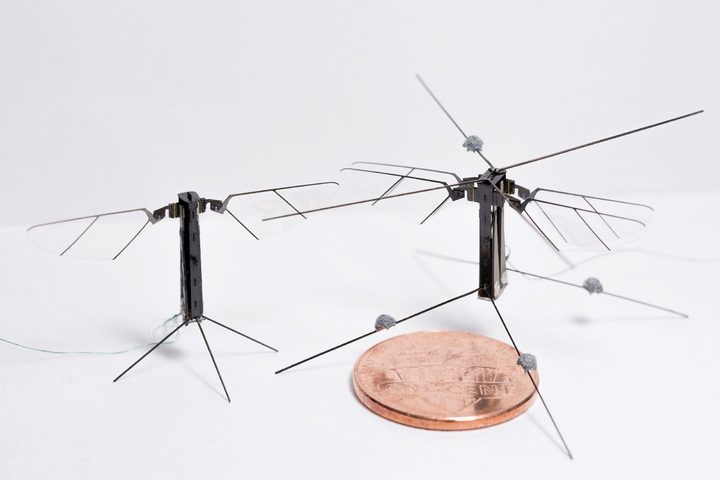
Bee Plus is capable of perching, landing, swimming, pursuing a path, and avoiding obstacles. Perez-Arancibia said that he can imagine a wide range of potential applications for the tiny robo-critter. These include artificial pollination of flowers, swarm-based research or search and rescue missions, and more. He even has his eye on less Earthbound purposes which could take Bee+ where no bee has gone before.
“I would like to see our robots flying on Mars and Titan,” he said. “I believe that we can create ant-inspired colonies of explorers in which each member has unique capabilities and can perform specialized exploring tasks, [such as taking] geological samples, [measuring] the gases in atmospheres, et cetera.”
To reach this point, it will be necessary to conquer one big current limitation. As of now, Bee Plus can only fly when tethered to a power source.
“To address this issue, my students and I have been working on this problem for the past four years, funded by the NSF,” Perez-Arancibia said. “In fact, we developed a new type of actuation technology: Catalytic artificial muscles. The papers presenting these breakthroughs are coming soon. Theoretical analyses and experiments show that catalytic artificial muscles will enable long-lasting flight employing robotic designs very similar to that of the Bee Plus.”
Provided the team can crack the problem, we’ve got no issue bumping that Bee Plus to an “A” grade.