  1. Home
  2. Emerging Tech
  3. News

See the impact site where the Beresheet spacecraft crashed into the moon

Add as a preferred source on Google

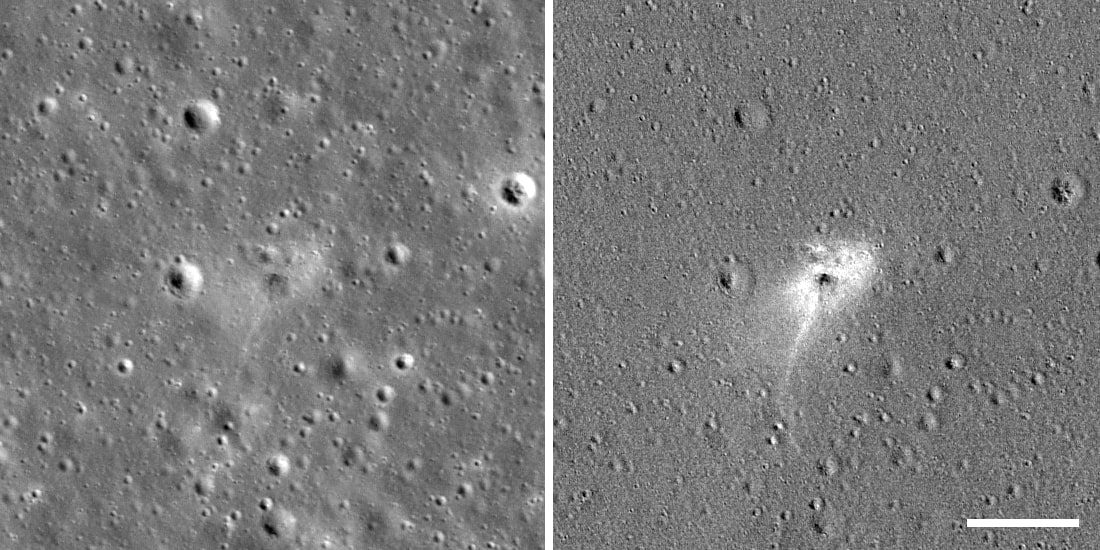
Left: Beresheet crash site. Right: A comparison of images taken before and after the crash, enhanced to show the subtle changes in the brightness of the surface. NASA/GSFC/Arizona State University

SpaceIL’s Beresheet spacecraft might not have made the final hurdle to land on the moon, but it could still make a contribution to scientific knowledge. An image of the site of the crash has been captured by a NASA’s Lunar Reconnaissance Orbiter (LRO) and is being analyzed for information about the lunar soil.

Recommended Videos

The LRO is an unmanned spacecraft which orbits the moon at an altitude of between 50 and 200km (31 to 124 miles). It was original launched to assist with tasks like locating an appropriate landing site for missions to the moon, but now mostly focuses on scientific work like gathering temperature maps and high resolution images.

The images above were gathered by the LRO’s Narrow Angle Cameras (NAC). There are two NACs on the LRO, which capture panchromatic images at a 0.5 meter scale over a 5km (3.1 mile) swath. These are accompanied by a Wide Angle Camera (WAC) which captures images at a scale of 100 meters per pixel in seven color bands over a 60km (37 mile) swath. The data from both sets of cameras is then fed to the Sequence and Compressor System (SCS). Together, the NACs, WAC, and SCS form the Lunar Reconnaissance Orbiter Camera which captures detailed images of the surface of the moon.

In the case of the Beresheet impact images, it is not clear if the impact created a crater in the surface or not. “At the scale of the NAC image we cannot detect a crater; perhaps there is one but it is simply too small to be seen,” Dr. Mark Robinson for Arizona State University explained in a statement. Alternatively, he said, the craft could have impacted the surface at a low angle which produced a gouge rather than a crater. Or perhaps because the craft was so small and fragile and was not traveling at a very high speed, it disintegrated on impact and didn’t produce a crater at all.

Even though the Beresheet landing was not successful, it could still give scientists valuable insights into the lunar environment. It is classified as a small impact event, like two previous spacecraft which impacted the Moon: GRAIL which impacted in 2012 and LADEE which impacted in 2014. These events can help scientists understand how the lunar soil, or regolith, changes over time.

Georgina Torbet
Georgina has been the space writer at Digital Trends space writer for six years, covering human space exploration, planetary…
That Claude chat you shared? Google may have seen it too
Public chat links were indexed by Google, potentially exposing sensitive information shared with the AI.
Claude AI on an iPhone.

If you've ever shared a Claude conversation using a public link, it might be worth checking your privacy settings. Over the weekend, users discovered that publicly shared Claude chats and Artifacts were appearing in Google Search and other search engines through queries such as site:claude.ai/share. The indexed pages reportedly included everything from resumes and business documents to API keys, health information, and other sensitive conversations that users likely never expected to become searchable.

How did this happen?

Read more
The AI-hooked younger generation is sourcing chatbot help even for in-person talks
From pickup lines to angry emails, here's how young adults are using AI to script their social lives, and why psychologists say it's a risky habit.
Person using ChatGPT on a MacBook.

I've definitely rehearsed a text message in my head before hitting send, especially when it's a long email with dozens of jargon and diplomatic language. However, when it comes to in-person talks, I’ve never even thought about outsourcing them to an AI chatbot.

Turns out an entire generation has handed the whole script to AI instead (via The Wall Street Journal).

Read more
Google Flow Music Spaces is becoming an all-in-one AI music studio
The latest update brings song editing, stem splitting, image generation, lyrics, and video creation into a single workspace.
Google Flow Music Featured

The company has announced a major update for Flow Music Spaces, bringing a suite of new AI-powered creative tools directly into collaborative workspaces. Instead of jumping between different apps or sessions, users can now generate and edit songs, split audio stems, create images, write lyrics, and even generate videos without leaving a Space.

What's new in Flow Music Spaces?

Read more