There are multiple animals that are able to cling onto and clamber up vertical surfaces. For all the things that today’s most exciting robots are capable of, however, not too many of them have been able to replicate this particular feat. But that may be about to change.
Researchers at Carnegie Mellon University have built a new, bioinspired robot called T-RHex, which uses microspines on its feet to grip onto rough surfaces. This allows it to climb up very steep gradients and, while it’s not yet able to climb up sheer vertical surfaces, it can grip onto them in a tenacious way that suggests that this ability isn’t out of the question in the future.
“T-RHex is a variation on the classic RHex — Robot Hexapod — platform, which uses springy cockroach-inspired legs to allow it to travel over fairly rough terrain,” Catherine Pavlov, one of the researchers on the project, told Digital Trends. “We took this existing robotic concept and added microspines to it, which are essentially tiny hooks that can catch on small surface features. Each leg on T-RHex is actually 8 to 10 stacked slices, each with a hook embedded in the tip.”
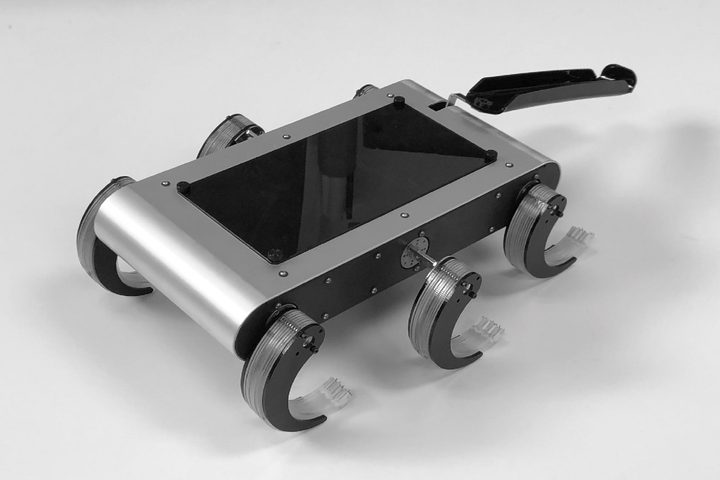
When T-RHex is walking over a flat surface, the hooks don’t come into contact with the ground. However, when it transitions to climbing mode, it walks backward and stabs the tips of its toes into the wall as it does. The design of the legs allows the hooks to move independently of each other, so that they are able to passively catch on features. This has the effect of evenly distributing the weight of the robot.
“A robot like T-RHex could climb trees to monitor wildlife in the forest canopy, descend into volcanic fissures to determine how they formed, or even explore hazardous terrain on another planet,” Pavlov continued, explaining how the robot could be used for scientific research. “What’s great about T-RHex is that it’s highly mobile and can carry a payload, so it can be sent into a wide variety of situations that would be too dangerous for humans, or where human presence would be disruptive.”
Vivaan Bahl, another researcher on the project, has some different applications in mind. “This type of robot could serve well for extreme terrain mapping,” Bahl told us. “For instance, you have an unmapped area where aerial coverage is not useful or possible, and standard wheeled robots aren’t able to scale the sheer faces. Effectively, this robot serves as a way to get across a wide variety of terrain by using the tried-and-tested RHex platform, while adding a whole new dimension — quite literally — to its movement.”