  1. Home
  2. Emerging Tech
  3. News

A tiny magnet accomplishes enormous feat, sets a new world record

Add as a preferred source on Google
National MagLab creates world-record magnetic field with small, compact coil

A magnet housed at the National High Magnetic Field Laboratory in Tallahassee, Florida, has set a record for the strongest continuous DC magnetic field ever recorded with a 45.5-tesla rating. To put this figure in perspective, a small, but strong everyday neodymium magnet scores about 0.2 teslas, while a large electromagnet comes in at around 1.5 teslas.

Recommended Videos

The 45.5-tesla benchmark was achieved in a coil smaller than a can of soda. The magnet weighed just 390 grams. The coil was wound using a superconductor referred to as rare earth barium copper oxide (REBCO). This was then wrapped with white fiberglass tape.

“My colleague Seungyong Hahn had developed a new method of winding magnets that avoids insulation and thus allows even more conductor in the winding, a direct help to raising the field in the very tiny space available,” David Larbalestier, chief materials scientist at the Magnetic Field Laboratory, told Digital Trends. “The winding is, in fact, only about 11 mm thick. Tape with very thin substrate from SuperPower enabled the magnet to operate at the phenomenally high current density of more than 1,400 amperes per square millimeter.”
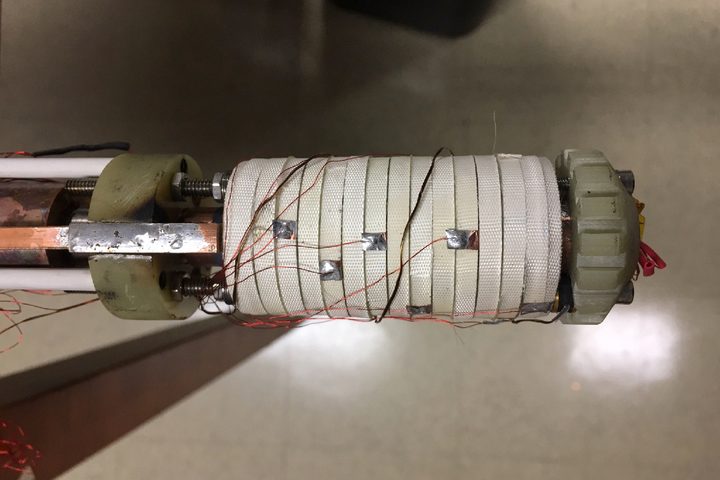
National Mag Lab

The new record-breaking magnet beat the previous record for a magnet by 0.5 of a tesla. The researchers note note the significance of the feat in an abstract describing the work: “For almost two decades, 45 tesla has been the highest achievable [DC] magnetic field. However, such a field requires the use of a 31-megawatt, 33.6-tesla resistive magnet inside 11.4-tesla low-temperature superconductor coils, and such high-power resistive magnets are available in only a few facilities worldwide.”

This new magnet, on the other hand, is impressively compact. In not only setting a new DC record, but also doing so for an extended period of time, it opens up the possibility of using small magnets for everything from future particle colliders like the Large Hadron Collider to nuclear fusion reactors or medical diagnostic tools. And, who knows, maybe someone can one day bring it to Kickstarter as an immovable fridge magnet. (Okay, we kind of doubt that one!)

A paper concerning the project, titled 45.5-Tesla Direct-current Magnetic Field Generated With a High-temperature Superconducting Magnet, was recently published in the journal Nature.

Luke Dormehl
I'm a UK-based tech writer covering Cool Tech at Digital Trends. I've also written for Fast Company, Wired, the Guardian…
Chrome is getting better at understanding the breaks and punctations you never say out loud
Voice typing in Chrome is about to feel much more natural
Google Chrome on Android Featured

Google is quietly making voice dictation in Chrome feel a lot more natural. With the latest Chrome 151 Beta, the company is introducing a new capability that allows the browser's speech recognition engine to automatically infer punctuation based on the way people speak, eliminating the need to explicitly say commands like "comma" or "full stop."

The update may sound minor at first glance, but it addresses one of the biggest frustrations with voice typing: speaking naturally often produces text that lacks punctuation unless users consciously dictate every punctuation mark. By teaching Chrome to understand pauses, rhythm, and speech patterns, Google is taking another step toward making conversations with computers feel more human.

Read more
Horror films play music to warn about danger. These headphones use the same trick to save you from robots
Spherephones replaces factory alarms with music that tells you what is coming and from where.
spherephones-georgia-tech

The ear has always processed what is coming before the eye does. In horror movies, the music always tells you something bad is coming. Now researchers at Georgia Tech are using the same idea in real life to keep factory workers safe around robots.

They have built a wearable headset called Spherephones that converts nearby robot movement into spatial music, giving you a warning before a machine gets too close. It helps the user stay aware without breaking their attention.

Read more
Elon Musk refutes report claiming that an AI device is in development at SpaceX
The billionair's two-word denial on X doesn't explain what part of the Wall Street Journal's report he's disputing.
Elon Musk speaking into a microphone with a blue background

Elon Musk has denied a Wall Street Journal report claiming SpaceX showed investors a prototype AI device before its recent IPO. "Utterly false," Musk wrote on X, responding to a post about the report that has since been deleted, offering no further explanation.

A denial that leaves more questions than it answers

Read more