  1. Home
  2. Emerging Tech
  3. News

Harvard’s tiny, insect-inspired RoboBee X-Wing can fly using solar power

Add as a preferred source on Google
The Untethered RoboBee

Size can matter when it comes to innovative flying machines — but bigger doesn’t necessarily equal better. Few robots illustrate that point better than Harvard University’s new RoboBee X-Wing: A winged drone that stands just 6.5 centimeters high and weighs only 259 milligrams. Boasting an insect-inspired design, RoboBee X-Wing takes to the sky by flapping its wings a dazzling 170 times per second. Oh, yes, and unlike other minuscule flying robots we’ve covered, it doesn’t have to be tethered to a power source to fly.

Recommended Videos

“This has been one of the major milestones in the development of insect-scale flying robots,” Noah Jafferis, a research associate in Materials Science and Mechanical Engineering in Harvard’s Wyss Institute, told Digital Trends. “Without onboard power, such vehicles have been confined to operate only in the lab. There is still much to be done to enable autonomous flight, however. Our next steps include integrating onboard sensing and control, and further improving vehicle performance to allow for operation in natural sunlight and include onboard batteries.”

At present, the solar-powered robot hasn’t taken to the skies in natural light because it requires around three times the intensity of sunlight to be able to fly. Nonetheless, as Jafferis notes, this is a crucial landmark in the field of diminutive flying robots.
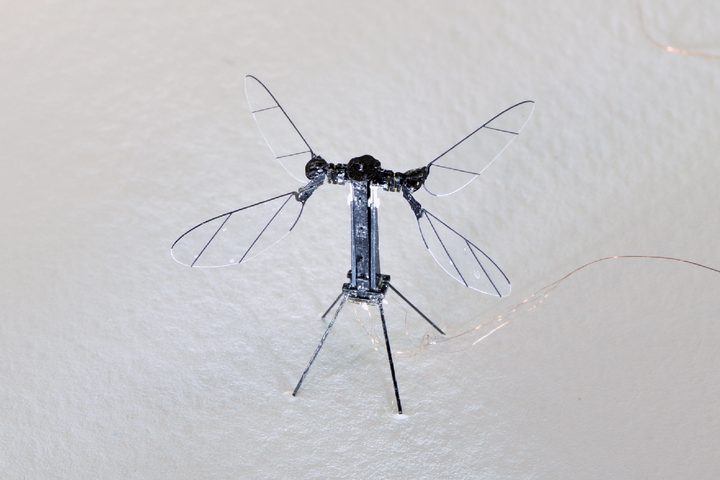
Noah T. Jafferis and E. Farrell Helbling, Harvard Microrobotics Laboratory

RoboBee X-Wing is the sequel, of sorts, to a previous influential robot developed at Harvard called RoboBee. The main changes in the new vehicle design include the use of four wings instead of two, which increases efficiency by up to 30%, and improved actuator and transmission design, increasing lift by up to 38%. This provides enough payload to integrate and drive the electronics and solar cells needed to let the vehicle fly untethered.

“Applications of this robot are still a bit far off, but swarms of them could one day be used as distributed sensor networks for environmental monitoring and mapping confined spaces such as in disaster zones or archaeological sites,” Jafferis continued. “We also anticipate that the technologies developed to create this robot will be very useful for any other small scale devices that have extreme mass and power constraints, such as medical or space devices.”

A paper describing the research was recently published in the journal Nature.

Luke Dormehl
I'm a UK-based tech writer covering Cool Tech at Digital Trends. I've also written for Fast Company, Wired, the Guardian…
Chrome is getting better at understanding the breaks and punctations you never say out loud
Voice typing in Chrome is about to feel much more natural
Google Chrome on Android Featured

Google is quietly making voice dictation in Chrome feel a lot more natural. With the latest Chrome 151 Beta, the company is introducing a new capability that allows the browser's speech recognition engine to automatically infer punctuation based on the way people speak, eliminating the need to explicitly say commands like "comma" or "full stop."

The update may sound minor at first glance, but it addresses one of the biggest frustrations with voice typing: speaking naturally often produces text that lacks punctuation unless users consciously dictate every punctuation mark. By teaching Chrome to understand pauses, rhythm, and speech patterns, Google is taking another step toward making conversations with computers feel more human.

Read more
Horror films play music to warn about danger. These headphones use the same trick to save you from robots
Spherephones replaces factory alarms with music that tells you what is coming and from where.
spherephones-georgia-tech

The ear has always processed what is coming before the eye does. In horror movies, the music always tells you something bad is coming. Now researchers at Georgia Tech are using the same idea in real life to keep factory workers safe around robots.

They have built a wearable headset called Spherephones that converts nearby robot movement into spatial music, giving you a warning before a machine gets too close. It helps the user stay aware without breaking their attention.

Read more
Elon Musk refutes report claiming that an AI device is in development at SpaceX
The billionair's two-word denial on X doesn't explain what part of the Wall Street Journal's report he's disputing.
Elon Musk speaking into a microphone with a blue background

Elon Musk has denied a Wall Street Journal report claiming SpaceX showed investors a prototype AI device before its recent IPO. "Utterly false," Musk wrote on X, responding to a post about the report that has since been deleted, offering no further explanation.

A denial that leaves more questions than it answers

Read more