1. Home
  2. Emerging Tech
  3. News

NASA’s Artemis capsule is complete, will carry the first woman to the moon

Add as a preferred source on Google
Vice President Pence Commemorates Apollo 11 With Administrator Bridenstine

The crew capsule which will carry American astronauts to the moon as part of the Artemis project has been completed. The completion of the Artemis 1 capsule was announced by Vice President Mike Pence during a speech at NASA’s Kennedy Space Center in Florida celebrating the 50 year anniversary of the historic Apollo moon landing mission.
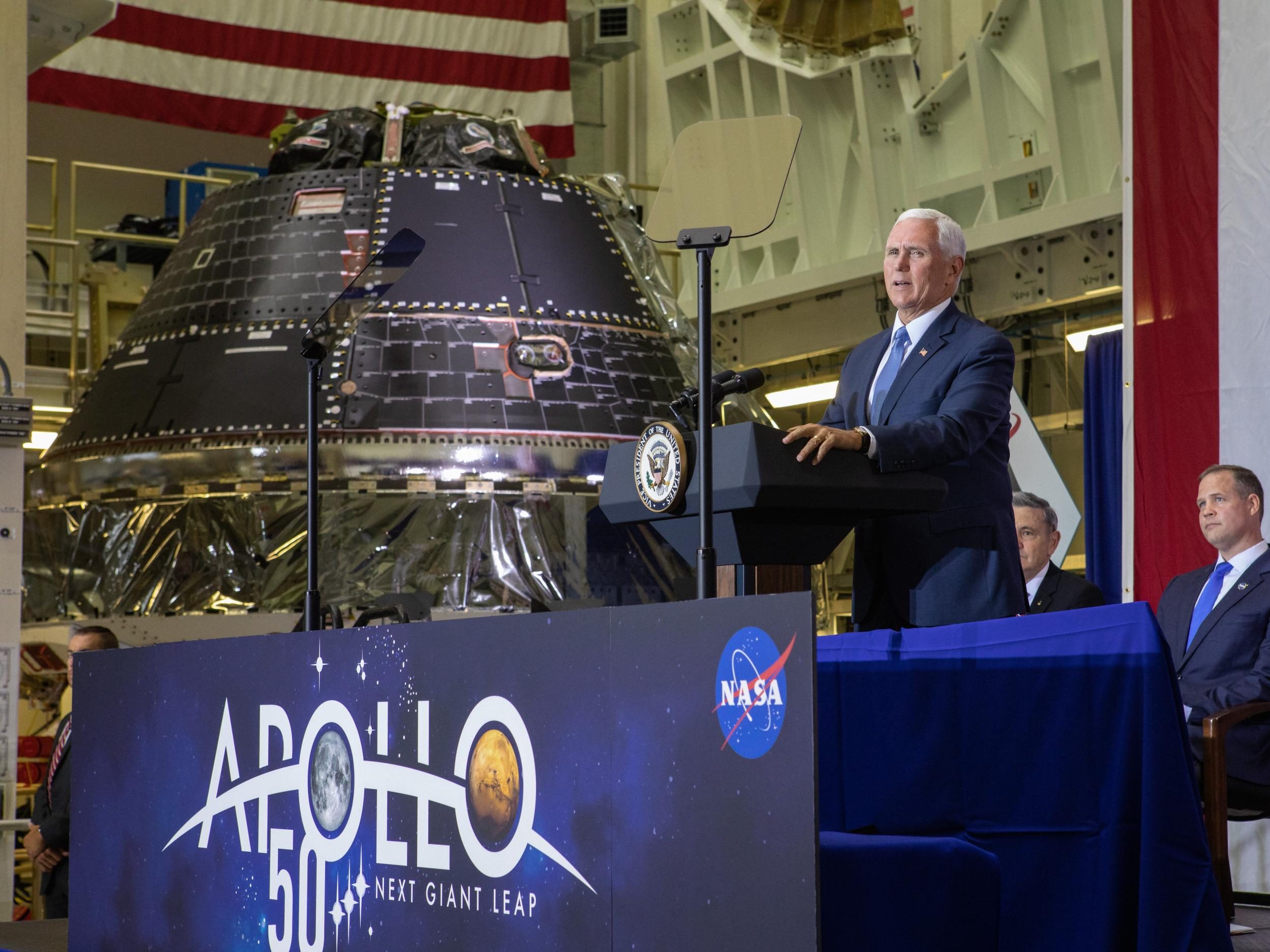
Vice President Mike Pence on stage at the NASA celebration of the 50th anniversary of the moon landing. NASA

Fifty years after successfully landing a man on the moon, NASA is hoping to recreate this feat. But this time, at least one of the crew members will be a woman. NASA has announced that this capsule will carry the “first woman on the moon.”

Recommended Videos

“Similar to the 1960s, we too have an opportunity to take a giant leap forward for all of humanity,” NASA Administrator Jim Bridenstine said in a statement. “President Trump and Vice President Pence have given us a bold direction to return to the Moon by 2024 and then go forward to Mars. Their direction is not empty rhetoric. They have backed up their vision with the budget requests need to accomplish this objective. NASA is calling this the Artemis program in honor of Apollo’s twin sister in Greek mythology, the goddess of the Moon. And we are well on our way to getting this done.”

Artemis 1 will be carried aboard a Orion spacecraft and a next-generation Space Launch System (SLS) rocket. The idea is that the mission will start with sending a team to the moon for 2024, and then the moon can be used as a stopover for planned manned missions to Mars.

The Orion crew module began its life with the building of a pressure vessel, the inside of the capsule system, at NASA’s Michoud Assembly Facility in New Orleans. Once the pressure vessel was complete it was shipped to the Kennedy Space Center to be built into a full capsule, with all the required parts being integrated.

The Orion will be joined by the European Space Agency’s European Service Module, a German-built module which will provide power, propulsion, and cooling. The two modules need to be joined and have a heat shield back panel installed.

Once this is complete, the next phase for Artemis is testing, which will take place in NASA’s Plum Brook Station in Sandusky, Ohio.

Georgina Torbet
Georgina has been the space writer at Digital Trends space writer for six years, covering human space exploration, planetary…
Google Flow Music Spaces is becoming an all-in-one AI music studio
The latest update brings song editing, stem splitting, image generation, lyrics, and video creation into a single workspace.
Google Flow Music Featured

The company has announced a major update for Flow Music Spaces, bringing a suite of new AI-powered creative tools directly into collaborative workspaces. Instead of jumping between different apps or sessions, users can now generate and edit songs, split audio stems, create images, write lyrics, and even generate videos without leaving a Space.

What's new in Flow Music Spaces?

Read more
A Florida pastor asked ChatGPT if he was okay. It nearly got him killed.
When "just relax and recover" turns out to be the worst medical advice you could get.
ChatGPT on iPhone

Scott Winters, a pastor from Florida, is suing OpenAI after ChatGPT allegedly gave him what his lawsuit calls "extremely dangerous" medical advice, advice that nearly cost him his life.

What happened to the pastor?

Read more
Scientists made robots curious like toddlers, and it helped them learn language twice as fast
Give a robot curiosity, and it starts learning language (and misbehaving) just like a toddler.
robots and kids photo

Scientists have been trying to figure out how kids pick up language so fast for decades, and a new study out of the Okinawa Institute of Science and Technology (OIST) might have cracked part of the puzzle: curiosity.

Researchers built a virtual robot with a brain-inspired neural network and set it loose in a simulated 3D world full of shapes, colors, and simple commands like "push left magenta dumbbell." 

Read more