  1. Home
  2. Emerging Tech
  3. News

Three new astronauts join the International Space Station crew for Expedition 60

Add as a preferred source on Google

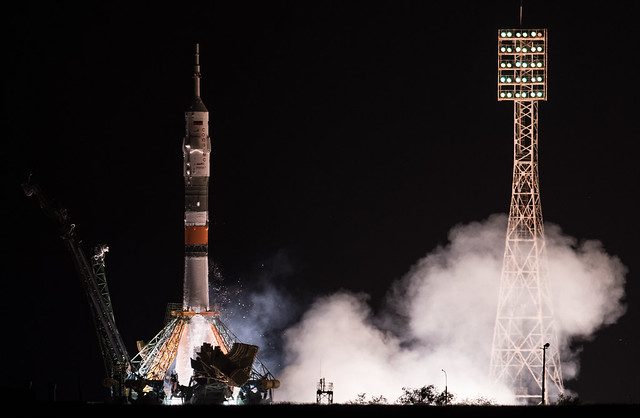
The Soyuz MS-13 rocket is launched with Expedition 60 Soyuz Commander Alexander Skvortsov of Roscosmos, flight engineer Drew Morgan of NASA, and flight engineer Luca Parmitano of ESA (European Space Agency). NASA/Joel Kowsky

Exactly fifty years after Neil Armstrong and Buzz Aldrin set foot on the moon, a new team of astronauts arrived at the International Space Station (ISS) to begin their stay there. The launch took place on Saturday, July 20, 2019 from the Baikonur Cosmodrome in Kazakhstan at 12:28 p.m. ET (9:28 p.m. Baikonur time) to carry the astronauts to the ISS.

Recommended Videos

The Expedition 60 crew includes NASA astronaut Andrew Morgan, Roscosmos astronaut Alexander Skvortsov, and European Space Agency astronaut Luca Parmitano. These three will join NASA’s Nick Hague and Christina Koch and Roscosmos’ Alexey Ovchinin who are already aboard the ISS.

Together, the new crew will spend more than six months on the station, performing scientific experiments and testing space equipment. The scientific research will include “investigations in fields such as biology, Earth science, human research, physical sciences, and technology development,” according to NASA, which will test the ways in which the low gravity environment affect outcomes. The experiments will include growing moss, printing biological tissue, and attempting a process called bio-mining which extracts metals from ores using fungi.

In addition, the crew will also be taking part in the arrival and installation of a second docking port aboard the station. This second dock will be for commercial crew spacecraft, such as those being developed by SpaceX and Boeing. The International Docking Adapter-3 (IDA-3), as it’s known, will be launched in a few days’ time as part of SpaceX Dragon’s 18th commercial resupply services mission on July 24. If you’re interested to see the launch as it happens, you can watch a livestream on NASA’s website.

Upon arrival, the docking port will be removed from the Dragon’s cargo hold using the ISS’s robotic arm, Canadarm2, and put into place. It will be installed over Pressurized Mating Adapter-3, which is part of the Harmony module. Astronauts Hague and Morgan will perform a spacewalk in August to install the docking port, and while they’re out there they will also install a new high-definition camera to monitor the exterior of the station. This is part of an ongoing mission to update the camera systems outside the station.

Georgina Torbet
Georgina has been the space writer at Digital Trends space writer for six years, covering human space exploration, planetary…
You can now generate images with Gemini’s memory without paying a dime
Study guide created by Gemini

Google has made one of Gemini's most interesting AI tricks a lot easier to try. The company is rolling out its personalized image generation feature to eligible U.S. users for free, removing a paywall that previously kept it exclusive to Gemini's paid tiers.

Powered by Google's Nano Banana image model, the feature does more than generate pretty pictures; it taps into Gemini's understanding of you, making AI-generated images feel surprisingly personal.

Read more
Meta’s Brain2Qwerty v2 turns thoughts into text, and it doesn’t need brain implants
The latest AI model decodes brain signals into coherent sentences using external scanners.
Meta Brain2Qwerty v2 Featured

Artificial intelligence is getting surprisingly good at understanding humans. Now, Meta wants it to understand our brains too. The company has unveiled Brain2Qwerty v2, an upgraded AI system that can translate brain activity into full sentences, all without requiring brain implants or surgery. The goal isn't mind reading for the masses. Instead, it's to help people who have lost the ability to speak communicate again.

How a Brain-powered keyboard works

Read more
AI chatbots can often feed into your delusions. Researchers say you should look for three signs
Experts warn that chatbot design choices can reinforce unhealthy beliefs in vulnerable users.
ChatGPT on a smartphone

Artificial intelligence chatbots have become incredibly good at sounding human. But a new review paper by psychiatrist Marc Augustin and fellow researchers Thomas A. Pollak and Helen Morrin, published in NPP—Digital Psychiatry and Neuroscience, argues that existing AI research points to an overlooked psychological risk. The paper, highlighted by The Wall Street Journal, reviews previous studies and proposes a framework explaining how three common chatbot behaviors can combine to reinforce delusional thinking in vulnerable users, creating what the authors call an "amplification spiral."

Researchers say these are the three warning signs

Read more