
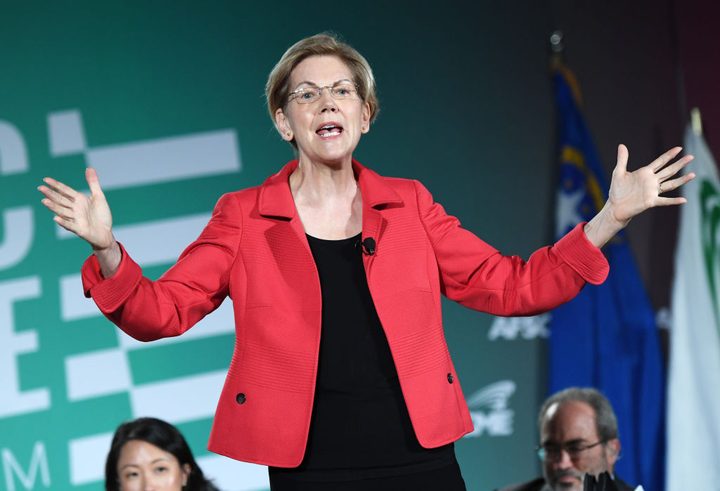
Democratic presidential candidate Sen. Elizabeth Warren (D-Mass.) announced a plan to increase rural and low-income internet access by creating what she called a “public option for broadband.”
In a Medium post published Wednesday, Warren laid out a plan to bring a broadband connection to every American home for a reasonable price. The proposition would allow local governments to essentially treat the internet like a public utility, and includes giving municipalities the right to build broadband network.
The plan would also include an $85 billion federal grant program that will to massively expand broadband access across the country, the restoration of net neutrality, and a program to improve accuracy of broadband maps.
“In the twenty-first century, every home should have access to this technology — but we’re not even close to that today. According to the FCC, in 2017 26.4% of people living in rural areas and 32.1% of people living on tribal lands did not have access to minimum speed broadband (25 Mbps/ 3 Mbps), compared to 1.7% in urban areas,” she wrote in the post.
Warren also talked about prohibiting the “sneaky maneuvers” and “anti-competitive behaviors” that internet providers use that limit certain companies to serving certain areas. Her plan mostly focuses on limiting the power providers have, especially when cities and counties want to build their own publicly-run broadband services.
“Today, as many as 26 states have passed laws hindering or banning municipalities from building their own broadband infrastructure to protect the interests of giant telecom companies. We will preempt these laws and return this power to local governments,” she wrote.
Along with parts of rural America, lower-income urban areas also have limited internet access, which Warren hopes to change. She cited that in 2017, 27% of households in Detroit and Cleveland did not have access to the internet. According to the National Digital Inclusion Alliance, 60% of households with an annual income below $35,000 are without broadband access.
In a time when advanced 5G connections are rolling out to most major cities in the country, it’s only fair that all parts of the U.S. are connected to the internet. Comcast recently announced a significant expansion to the Internet Essentials program. The program provides low-cost internet access to serve lower-income communities better.
Digital Trends reached out to the FCC, along with major ISPs like Comcast, Verizon, and AT&T, to get their thoughts on Warren’s proposals about internet and broadband access. Verizon declined to comment, and the rest have yet to respond to us.


