  1. Home
  2. Emerging Tech
  3. News

Engineers test Mars 2020 rover’s vision, find it is 20/20

Add as a preferred source on Google

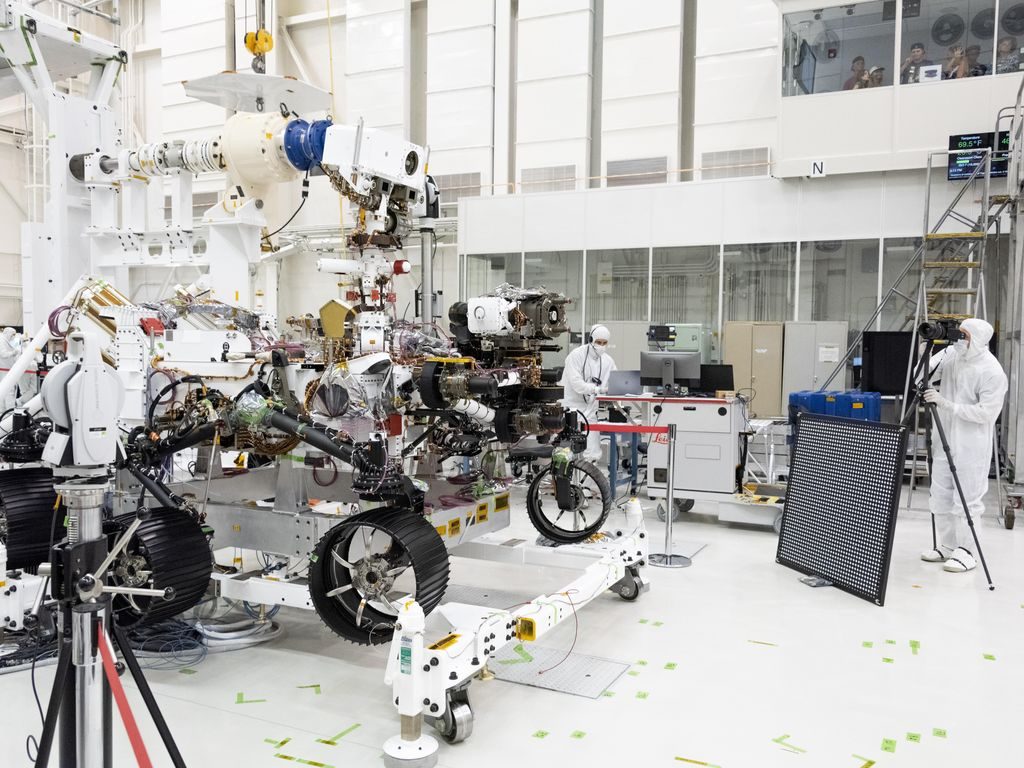
In this image, engineers test cameras on the top of the Mars 2020 rover’s mast and front chassis. The image was taken on July 23, 2019, in the Spacecraft Assembly Facility’s High Bay 1 at NASA’s Jet Propulsion Laboratory in Pasadena, California. NASA/JPL-Caltech

NASA’s Mars 2020 rover has been been given an unusual eye exam to test the cameras it will use to “see” and navigate around the Martian surface. There are a large number of cameras on board the rover for different purposes, including two Navcams, four Hazcams, the SuperCam and two Mastcam-Z cameras mounted to the rover’s central mast.

Recommended Videos

The Navcams, as the name suggests, are for navigation and collecting 3D panoramic information so the rover can find the best route through the rough Martian terrain. These cameras also work alongside the Hazcams, which are part of the rover’s self-driving system for avoiding hazards.  The SuperCam is for the scientific investigation of rock and soil samples, and the Mastcam-Zs are for observing rocks and sediment within the rover’s field of view, which could help gather valuable geological data.

In order to test that the cameras were working correctly, the NASA engineers used an image testing board covered in a grid of dots, which you can see above on the right side of the image. The testing board is placed at different distances away from the rover, from one meter to 40 meters, and the engineers test whether the cameras capture the dots with the required resolution and accuracy.

“We tested every camera on the front of the rover chassis and also those mounted on the mast,” Justin Maki, chief engineer for imaging and the imaging scientist for Mars 2020 at NASA’s Jet Propulsion Lab, said in a statement. “Characterizing the geometric alignment of all these imagers is important for driving the vehicle on Mars, operating the robotic arm and accurately targeting the rover’s laser.”

The JPL team still needs to test the cameras on the back of the rover and the one on the end of its turret, which is scheduled to happen in the next few weeks. All of this preparation is getting the rover ready during its last year of engineering before launch, planned for July 2020.

Georgina Torbet
Georgina has been the space writer at Digital Trends space writer for six years, covering human space exploration, planetary…
The future of AI may depend on this one behind-the-scenes change
Running Claude on Android.

Whenever a new AI model arrives, it's easy to get caught up in the bells and whistles. We talk about how much smarter it is, how quickly it answers questions, or how realistic its images have become. But here's the thing: none of that matters much if the AI can't reliably work with the apps and services people use every day.

That's why an upcoming update to the Model Context Protocol (MCP) caught my attention. It isn't a new chatbot or a fancy AI model. In fact, most people will never even know it's happening. But it could quietly make the AI ecosystem a lot healthier. If you've never heard of MCP before, don't worry. Think of it as a shared language that lets AI assistants safely talk to apps like Gmail, Slack, calendars, databases, and countless other services. Instead of every company inventing its own way to make those connections, MCP gives everyone a common rulebook.

Read more
The AI game-dev boom has a dark side: fewer jobs for the people starting out
Solo creators are thriving with tools like Claude Code and Copilot, but entry-level game roles are disappearing.
Man playing a video game on a desktop with glowing red and blue lights

AI is making it easier than ever for a single person to build a game. That sounds like a win for creativity, and in many ways, it absolutely is. But there is a catch. As generative AI tools help solo developers and small studios do more with fewer people, the same shift is making life tougher for writers, artists, concept creators, and junior programmers trying to break into the gaming industry.

AI is giving solo developers superpowers

Read more
A new AI model wants self-driving cars to think before they swerve
Forget guessing games, this self-driving AI actually shows its work.
Self driving car

Self-driving cars have gotten pretty good at driving. The harder problem is teaching them to drive safely in situations nobody planned for. We have heard horror stories of self-driving cars, behaving erratically in emergency situations, often times delaying first responders from reaching the scene.

A team at Seoul National University, led by professor Jun Won Choi from the Department of Electrical and Computer Engineering, thinks they have cracked part of that puzzle with a new AI model called SafeDrive. The research was recently selected as a highlight paper at CVPR 2026, a distinction that goes only to roughly 3% of all submissions.

Read more