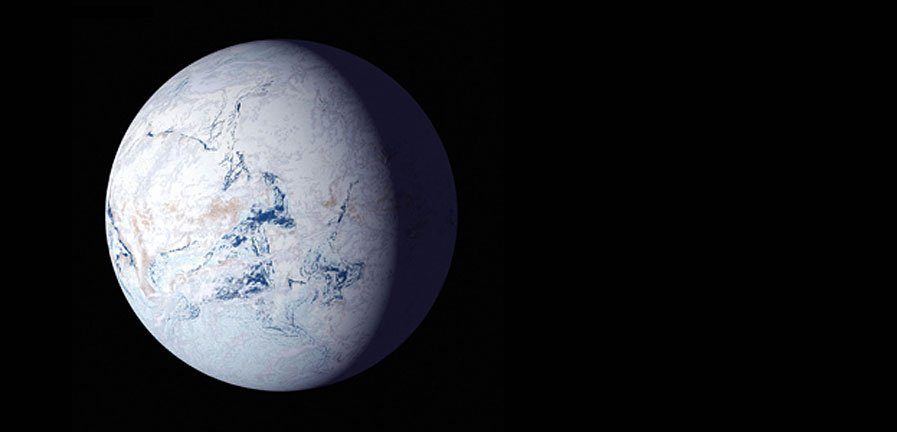
Astronomers have long assumed that, in order to be habitable, an exoplanet should be a rocky planet that lies in the habitable zone. This is the area of distance from a star at which water can exist on a planet’s surface as liquid. But a new study suggests that even frozen, icy planets could be theoretically capable of supporting life.
“You have these planets that traditionally you might consider not habitable and this suggests that maybe they can be,” Adiv Paradise, an astronomer and physicist at the University of Toronto and lead author of the new study, said in a statement.
The research looked at “snowball planets,” which are the size of Earth and which have oceans that are frozen all the way to their equators. The researchers simulated different climates of snowball planets, by manipulating variables like the amount of sunlight which a planet received and how the continents were placed. A particularly important variable was the amount of carbon dioxide in the atmosphere, as carbon dioxide keeps heat trapped and warms the surface of a planet.
If the level of carbon dioxide in a planet’s atmosphere is low, it cannot trap enough heat and it becomes a snowball. This can happen when there is heavy rainfall which absorbs the carbon dioxide, turning it into acid which causes erosion of the surface rock. The acid is broken down in the process and sinks to the seafloor, gradually removing carbon dioxide from the atmosphere.
So astronomers thought that when a planet becomes a snowball, it would stop losing carbon dioxide as its surface water is frozen. But the research showed this isn’t the case. Some snowballs continue to lose carbon dioxide, meaning there must be some surface water and rain continuing the process.
In simulations, snowballs could have some areas of land which were warm enough to host surface water, even when the oceans were frozen at the equators. This means they are theoretically capable of hosting life even in their cold state.
Supporting this theory, the authors point out that our own planet hosted life during a snowball phase. “We know that Earth was habitable through its own snowball episodes, because life emerged before our snowball episodes and life remained long past it,” Paradise said. “But all of our life was in our oceans at that time. There’s nothing about the land.”
The findings are published in the Journal of Geophysical Research.