  1. Home
  2. Emerging Tech
  3. News

Dead planets give off ghostly radio waves which we should be able to detect

Add as a preferred source on Google

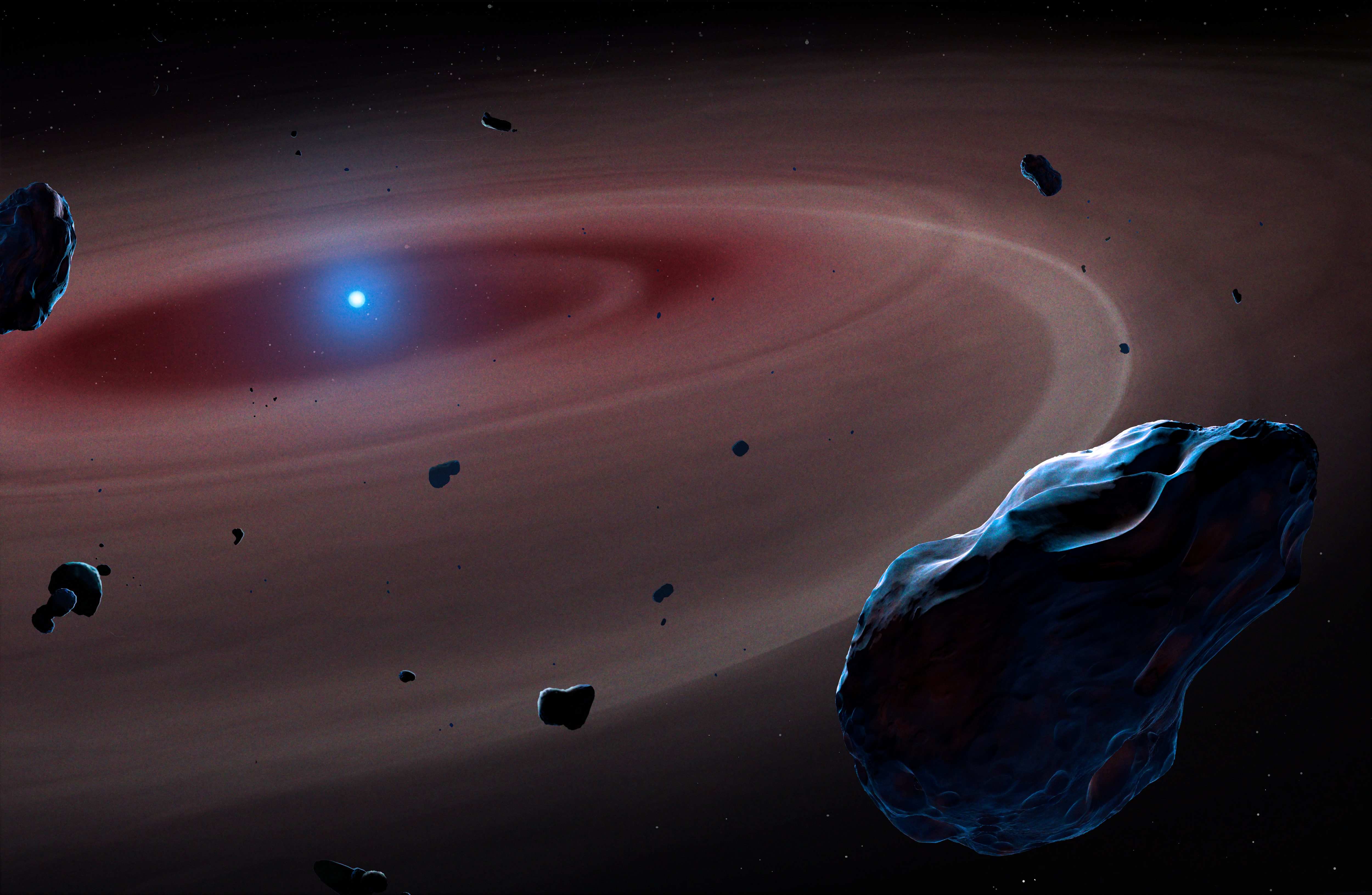
An artist’s impression of a white dwarf sitting in the center of the remnant of a planetary system. Mark A. Garlick /space-art.co.uk/University of Warwick

Dead planets orbiting dead stars can give off ghostly radio wave emissions that are detectable from Earth, allowing us to track planets even billions of years after their stars have run out of fuel.

Recommended Videos

Astronomers from the University of Warwick have proposed we could “tune into” radio waves given off by the cores of exoplanets that orbit around white dwarfs. A core is created when a planet orbits a star which has burned through its fuel and stripes away its outer layers, leaving a chunk of rock which can survive for a long time.

These cores can be spotted by looking for the magnetic field between a core and the white dwarf it orbits. The core has metallic elements in it, so it acts as a conductor and together the core and white dwarf create a circuit. Radiation from the circuit is emitted into space as radio waves, we which should be able to detect on Earth.

“There is a sweet spot for detecting these planetary cores: A core too close to the white dwarf would be destroyed by tidal forces, and a core too far away would not be detectable,” lead author Dr. Dimitri Veras explained in a statement. “Also, if the magnetic field is too strong, it would push the core into the white dwarf, destroying it. Hence, we should only look for planets around those white dwarfs with weaker magnetic fields at a separation between about 3 solar radii and the Mercury-Sun distance.”

There is an open question about exactly how long a core can survive. Modelling suggests that cores can live as long as 100 million years, and maybe even up to a billion years.

The team plans to test the theory by using radio telescopes like the Arecibo in Puerto Rico and the Green Bank Telescope in West Virginia to searching for cores orbiting white dwarfs. “Nobody has ever found just the bare core of a major planet before, nor a major planet only through monitoring magnetic signatures, nor a major planet around a white dwarf,” Veras said. “Therefore, a discovery here would represent ‘firsts’ in three different senses for planetary systems.”

The findings are published in the Monthly Notices of the Royal Astronomical Society.

Georgina Torbet
Georgina has been the space writer at Digital Trends space writer for six years, covering human space exploration, planetary…
Google Flow Music Spaces is becoming an all-in-one AI music studio
The latest update brings song editing, stem splitting, image generation, lyrics, and video creation into a single workspace.
Google Flow Music Featured

The company has announced a major update for Flow Music Spaces, bringing a suite of new AI-powered creative tools directly into collaborative workspaces. Instead of jumping between different apps or sessions, users can now generate and edit songs, split audio stems, create images, write lyrics, and even generate videos without leaving a Space.

What's new in Flow Music Spaces?

Read more
A Florida pastor asked ChatGPT if he was okay. It nearly got him killed.
When "just relax and recover" turns out to be the worst medical advice you could get.
ChatGPT on iPhone

Scott Winters, a pastor from Florida, is suing OpenAI after ChatGPT allegedly gave him what his lawsuit calls "extremely dangerous" medical advice, advice that nearly cost him his life.

What happened to the pastor?

Read more
Scientists made robots curious like toddlers, and it helped them learn language twice as fast
Give a robot curiosity, and it starts learning language (and misbehaving) just like a toddler.
robots and kids photo

Scientists have been trying to figure out how kids pick up language so fast for decades, and a new study out of the Okinawa Institute of Science and Technology (OIST) might have cracked part of the puzzle: curiosity.

Researchers built a virtual robot with a brain-inspired neural network and set it loose in a simulated 3D world full of shapes, colors, and simple commands like "push left magenta dumbbell." 

Read more