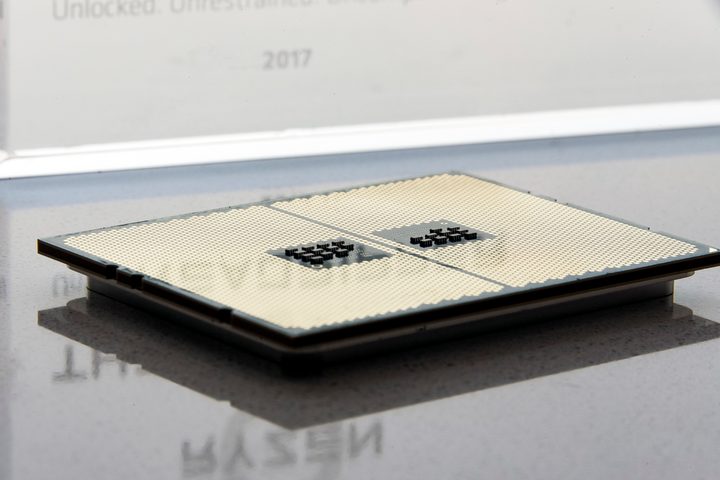
If you thought the body blows to Intel’s CPU game were finished with when Ryzen 3000 mainstream CPUs debuted, you’d be sorely mistaken. The prophesied third-generation AMD Threadripper CPUs are coming down the pipe and when they arrive, they could set new standards for high-end desktop performance. New leaked benchmarks show a 32-core, Threadripper 3000 chip obliterating not only its predecessors, but Intel’s $3,000 W-3175X chip, too.
As impressive as AMD’s mainstream Ryzen CPUs have been over the past few years, Threadripper really blew the doors off of what could be expected from high-end desktop processors. The first generation chased down Intel with a modest selection of high-performance cores, while the second threw out the design meta with a 32-core monster that, if not for some memory bandwidth limitations, might have snatched the performance crown from Intel in every benchmark there is. As it was, it only managed that in some of them.
But a third generation of Threadripper, once deemed dead by some, looks set to leapfrog Intel’s best by an enormous margin. In a GeekBench results page spotted by Twitter user @momomo_us, an unnamed AMD Sharktooth (third-generation Threadripper) CPU has posted scores that challenge massive, server rigs for multi-threaded performance, and its single-threaded scores are pretty respectable, too.
It scored 68,576 points in multi-core testing. That’s near double the 36,000 that its predecessor, the 32-core 2990WX, achieves, and far more than Intel’s 28-core monster, the W-3175X, manages at around 38,000 (as per WCCFTech). In single-threaded workloads, it managed 5,523, which is again far higher than the 2990WX and W-3175X, which score around 4,800 and 5,150, respectively.
What’s amazing is this might not even be the most capable third-gen Threadripper CPU. AMD’s Epyc server range has a new, 64-core CPU that uses the same Zen 2 chiplets. There’s always the possibility that a 64-core Threadripper is waiting in the wings, too.
One important caveat with these results is that the Threadripper 3000 chip was tested under Linux, which tends to lead to better GeekBench scores than Windows, but it’s still a monumental achievement which has us very excited about the next-gen Threadripper performance. It also gave us further insight into the specifications of the new chip.
The chip has 32 cores and 64 threads, just like the last-generation flagship, the 2990WX. However, where that CPU was based on the Zen+ architecture, this one is based on Zen 2, a far more capable design with huge improvements in instructions per clock and memory efficiency. It fixes the bandwidth issues of the last-gen designs, with not only a faster memory interface, but a mammoth 16MB of L3 cache per core. The 2990WX only has half of that.
Clock speed also saw a big bump with this sample. It maxed out at 4.17GHz — a huge increase over the 3.6GHz maximum boost of the 2990WX. Its base clock is far lower though, listed at 2.2GHz. This is likely an engineering sample, so clock speeds may change before release. We’d expect that to be higher, even if it ends up lower than the 2990WX’s 3GHz base to maintain reasonable power and thermal demands.
Regardless of clock speed specifics though, it seems like AMD has solved the memory bottleneck for Threadripper with its next-generation chips and could well decimate the HEDT market when it launches. We don’t have any kind of firm release date for third-generation Threadripper yet, but it’s expected to debut before the end of the year, or at the latest, very early in 2020.
Pricing also remains an unknown at this time. Second-generation Threadripper chip prices stretched to double that of the first generation. We don’t expect to see a new-generation Threadripper 3000 CPU cost almost $4,000, but prices may go up to reflect the new performance offered by these chips.