  1. Home
  2. Emerging Tech
  3. News

Upcoming mission to Jupiter images the planet’s moons from here on Earth

Add as a preferred source on Google

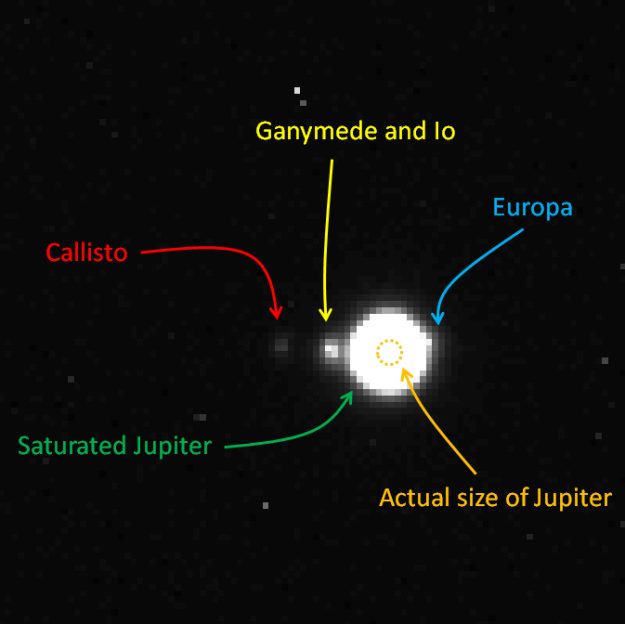
Jupiter system captured in JUICE NavCam test (annotated) Airbus Defence and Space

Jupiter has an abundance of moons, and astronomers continue to spot new ones and to make unexpected findings about the ones we’ve already seen. An upcoming mission from the European Space Agency, called the Jupiter Icy Moons Explorer, or JUICE, hasn’t even left Earth yet but has already imaged its target of the Jupiter system.

Recommended Videos

In the image above you can see the main glowing body of Jupiter, surrounded by some of its moons: Europa, Ganymede, Io, and Callisto. Jupiter appears larger than it really is due to the way the image is optimized, which brings out the details of the moons as much as possible.

“Unsurprisingly, some 640 million kilometers (nearly 400 million miles) away, the moons of Jupiter are seen only as a mere pixel or two,” Gregory Jonniaux, Vision-Based Navigation expert at Airbus Defense and Space, explained in a statement. “Jupiter itself appears saturated in the long exposure images needed to capture both the moons and background stars, but these images are useful to fine-tune our image processing software that will run autonomously onboard the spacecraft. It felt particularly meaningful to conduct our tests already on our destination!”

If you want a more detailed look at the targets, then ESA also released simulated images of what you can expect to see when JUICE gets up and personal with the moons. Using existing images of the moons Europa (left), Ganymede (middle), and Callisto (right), JUICE’s NavCam processed the data to create a simulation of what it should be able to capture once it arrives at Jupiter.
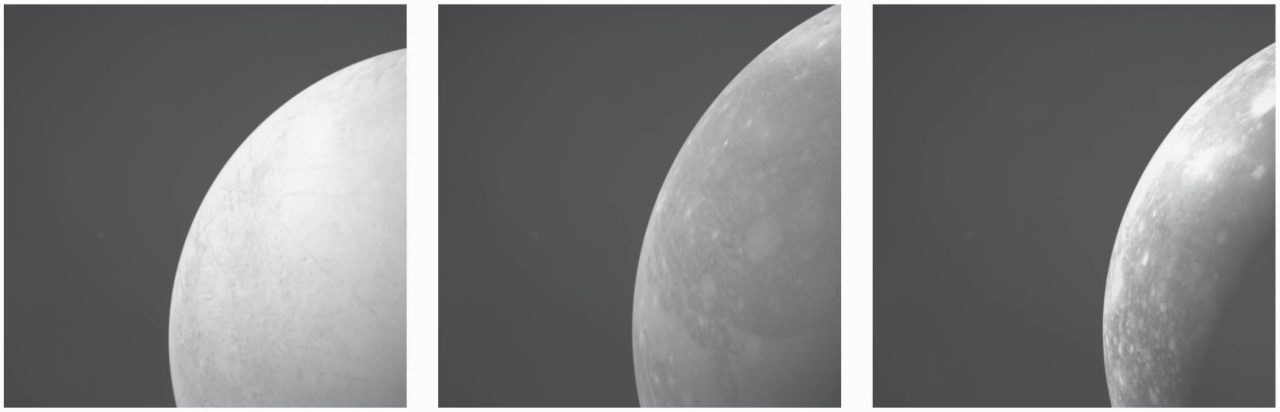
Simulated NavCam views of Jupiter moons Airbus Defence and Space

“The simulated views of the moons of Jupiter give a more realistic impression of what our NavCam will capture during flybys,” Daniele Gherardi, ESA Guidance, Navigation and Control expert, said in the same statement. “Of course, the high-resolution scientific camera suite will impress us with even more detail of these enigmatic moons.”

Another simulation built from existing images shows how the moons will be observed against Jupiter’s beautiful backdrop. This image shows Europa against the Jovian atmosphere, with the black disk representing the shadow that the moon would cast on the clouds below.
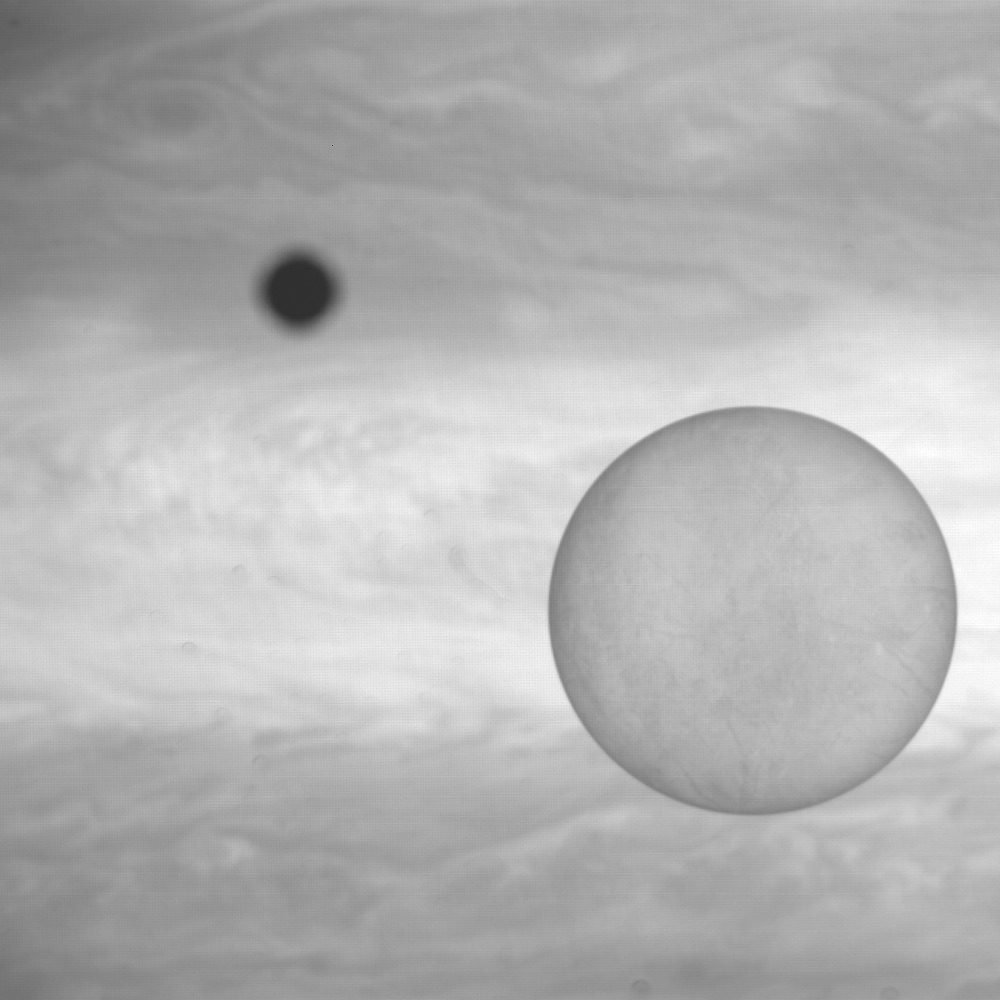
Simulated NavCam view of Jupiter and Europa Airbus Defence and Space

JUICE will launch in 2022 and will take seven years to reach the Jupiter system. Once it arrives it will not only take orbital tours around the planet but also perform a dedicated orbit around the moon of Ganymede.

Georgina Torbet
Georgina has been the space writer at Digital Trends space writer for six years, covering human space exploration, planetary…
Claude Code can now browse the web without opening Chrome
The desktop app now includes an in-app browser that can read websites, click links, and interact with web apps.
Claude Code Featured

Developers spend a surprising amount of time bouncing between their code editor, browser tabs, API documentation, GitHub issues, and design files. Anthropic thinks Claude Code should simply do all of that without constantly asking users to switch windows. The company has announced a new in-app browser for Claude Code on desktop, allowing its AI coding assistant to open websites, read documentation, inspect designs, and interact with web pages directly from within the application.

A browser built into Claude Code

Read more
Apple is suing OpenAI over theft of trade secrets in blockbuster lawsuit
The lawsuit claims OpenAI recruited Apple employees and obtained confidential information about unreleased products.
Apple store Apple Building Apple Logo

For the past two years, Apple and OpenAI have been presented as close AI partners. ChatGPT powers key Apple Intelligence features, Siri can hand complex queries over to OpenAI, and together the two companies helped bring generative AI to millions of Apple devices. Now, that partnership has taken a dramatic turn.

What is Apple accusing OpenAI of?

Read more
Home robots can already walk. The hard part is stopping them from crushing your glassware
1X’s NEO uses tactile sensing and force control to handle fragile objects, aiming at the kind of household work humanoids still struggle to do.
Baby, Person, Electronics

A robot can look convincing while walking across a stage and still be useless in a kitchen. Picking up a wet glass demands precision, quick corrections, and enough restraint to avoid squeezing too hard. 1X is tackling that problem with new tendon-driven hands for NEO, its humanoid home robot.

1X says each hand has 25 degrees of freedom, with 22 across the fingers and palm and another three in the wrist. Its joints can yield when pushed instead of staying rigid, giving NEO a better chance of handling household objects without treating every collision like a wrestling match.

Read more